Moscow is bringing its New Year display forward to October, giving shops and restaurants until 1 November 2026 to install seasonal decorations or risk fines of up to 50,000 roubles. Alongside that pressure on private businesses, the city is preparing public contracts for temporary trees, lighting and other festive structures whose combined value has been put at about 1 billion roubles.
The arrangement makes decoration more than a matter of taste. The city administration is setting the timetable and the visual standard, while businesses may have to buy, rent, install and maintain the required display themselves. The result is a carefully managed winter image with two bills: one for taxpayers and another for the traders expected to help create it.
A deadline backed by sanctions
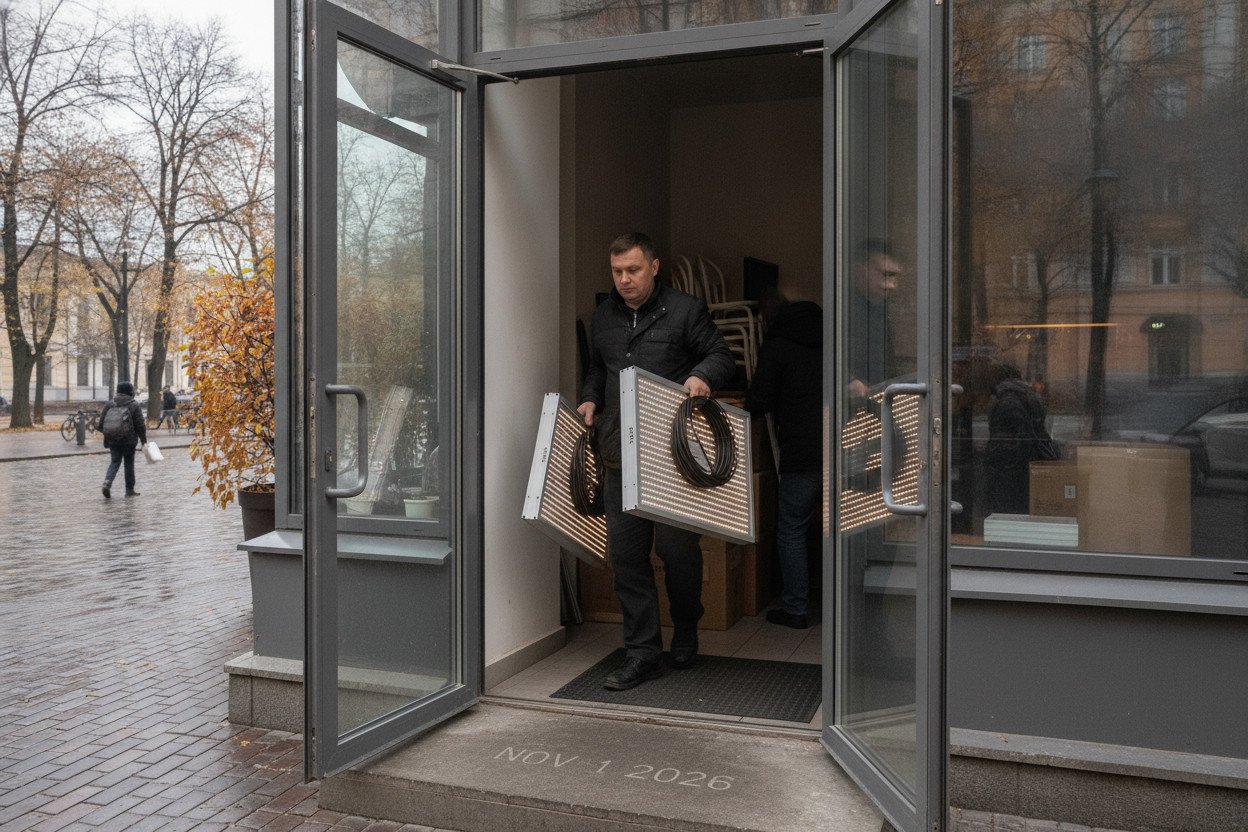
Russian media reported on 22 October that Moscow authorities had begun requiring retail outlets and catering establishments to prepare for the New Year weeks before winter. The deadline cited in the reports is 1 November. Suggested or required elements include illuminated panels, light fountains and other seasonal decorations intended to give streets and premises a common festive appearance.
The campaign is linked to the municipal festival Winter in Moscow. Mayor Sergei Sobyanin has justified the early start by referring to the city’s short daylight hours and the need to compensate for the limited natural light with illumination. Residents have reportedly objected to the speed with which the autumn atmosphere is being replaced by a winter display.
The most conspicuous installations are planned near Rimskaya metro station, Catherine Park, the prefecture of the Central Administrative District and the Russian Army Theatre. Artificial trees measuring nine and 12 metres are expected at several of those locations. The scale of the structures underlines the difference between an optional shop-window display and a city-wide presentation dictated from above.
Reports cite possible fines of up to 50,000 roubles under Article 8.6 of Moscow’s Code of Administrative Offences. The available information does not set out every obligation for each type of business or explain in detail how enforcement will operate. But the combination of a fixed deadline and financial penalties gives the instruction practical force: a shop or restaurant that might otherwise decide whether decoration is worthwhile is being asked to treat it as a compulsory operating cost.
For smaller businesses, the expense may extend well beyond the decoration itself. They could have to source or hire the equipment, pay for installation and keep it in place for a period determined by the city. In effect, part of the cost of a public streetscape is being transferred to private premises, even though the businesses have limited control over the timetable or design.
Public contracts for a temporary cityscape
The municipality is financing its own installations at the same time. A first contract commissioned by the state institution responsible for housing, utilities and landscaping in the Central Administrative District had an initial value of 13.6 million roubles. The winning bid reduced that sum to 11.9 million.
That reduction represents a saving on one procurement procedure, but it does not show the final cost of the wider programme. The contract is described as an initial lot, while the combined value of Moscow’s New Year decoration contracts has been reported at roughly 1 billion roubles. A complete breakdown of every lot, district and payment is not included in the information available here.
Prices quoted for individual structures show how quickly the total can rise. The Ruyolka brand’s website lists the rental of a 10-metre artificial tree called “Standard” at up to 631,000 roubles. A 12-metre structure named “Snowflake” is priced at 1.1 million roubles. Displays featuring the digits “2027” can cost more than 1 million roubles each, while additional light elements are listed at between 16,000 and 31,000 roubles per item.
These are advertised or rental prices and do not, on their own, establish wasteful spending. They do illustrate the financial logic of the programme. Large temporary objects, specialist lighting, transport, assembly and removal can turn a short-lived public display into a substantial contract. Meanwhile, shops and restaurants may face a separate cost for adapting their own frontages to the same official image.
The first contract was reported by Klerk, while the early decoration timetable was covered by MSK1.
Old structures, new work?
A separate question concerns the reuse of decorations already familiar to Muscovites. Lighted trees and apple-shaped structures are due to be installed again at 27 addresses. Some of these elements are said to have appeared regularly on Moscow streets since 2014.
That history has prompted criticism of what exactly is being purchased. If the objects are already part of the city’s stock, critics argue, new payments for their installation and maintenance should be clearly itemised rather than presented as if the equipment itself were new. The information available does not establish that an unlawful scheme has taken place. Nor does it show whether the structures belong to the city, are rented from contractors or are covered by contracts focused on transport, repairs, assembly, operation and dismantling.
The distinction matters. Reusing a decoration does not remove every legitimate cost: it may still require storage, technical inspections, repairs, replacement parts, transport and specialist installation. But a transparent tender should separate the cost of equipment from the cost of those services. Without that detail, it is difficult to judge whether the city is buying new assets, paying for routine operations or combining both within broader seasonal contracts.
One supplier at the centre of the market
The allocation of contracts has also drawn scrutiny. The available material identifies entrepreneur Oleg Stepanenko, owner of the Ruyolka brand, as the recipient of a large share of the decoration work. The territories mentioned include Moscow’s Central, Troitsky, Novomoskovsky and Northwestern administrative districts, as well as the city of Lyubertsy. The combined value of the cited contracts is said to exceed 1 billion roubles.
A concentration of awards can raise questions about competition, but it is not proof of a legal violation. To assess the market properly would require the complete list of lots, the number of bidders, the award criteria and information about the relationship between the different contracting entities. Those details are not supplied here.
What can be seen is a system in which the municipality controls both the timing and the appearance of the celebration. Businesses face a short deadline and possible sanctions, while public bodies commission an extensive programme of temporary installations. The reduction of one contract from 13.6 million to 11.9 million roubles offers a limited saving, but says little about the programme as a whole until the remaining orders are disclosed.
The unresolved issue is therefore not whether Moscow will look festive. It is whether the final cost, the ownership of reused decorations and the distribution of contracts will be transparent enough to show who is paying for the city’s early winter image: taxpayers, businesses or both.