Violent clashes erupt across France amid protests against rising costs and public service cuts
Clashes have broken out between police and protesters in cities across France as tens of thousands of people angered by rising costs and declining public services took to the streets – in some of the country’s most violent protests of recent times, reports BritPanorama.
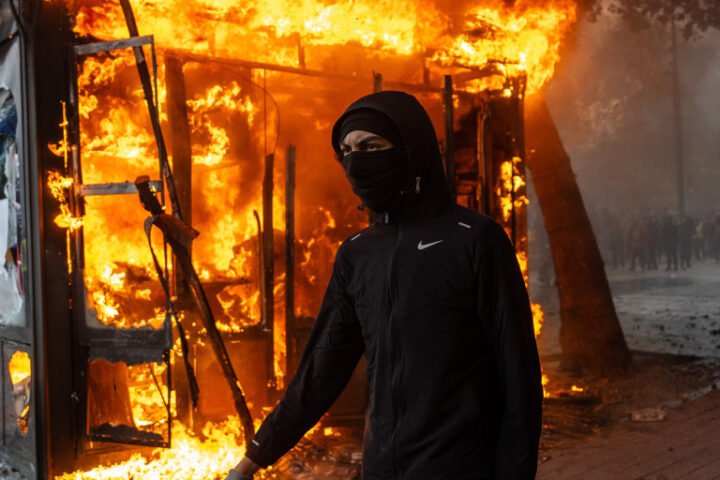
More than 1,200 people have been arrested across the country. Buildings were set alight in the capital and other areas, including Limoges, where a large fire in the town hall caused the roof to partly collapse. In Lyon, protesters torched the tourist office, while in Marseille, the mayor reported vandalism at the town hall.
Looting broke out in several cities, accompanied by widespread vandalism targeting city halls and businesses. Prime Minister Sébastien Lecornu reported that 150 police officers were injured amid the unrest.
As morning broke, a clearer picture of the damage emerged, with windows smashed and cars burnt out, as businesses and families around France sought to clear up in the aftermath. The protesters claimed that most individuals had been peaceful and attributed much of the violence to troublemakers aiming to incite chaos.
The Interior Ministry indicated that violence was escalating, citing “confrontations with law enforcement, looting or attempted looting of shops, attacks on and damage to public buildings.” They specifically attributed the unrest to what it described as the “ultra-left.” President Emmanuel Macron asserted that there is “no place for violence” in France and vowed that those responsible would be “prosecuted and punished.”
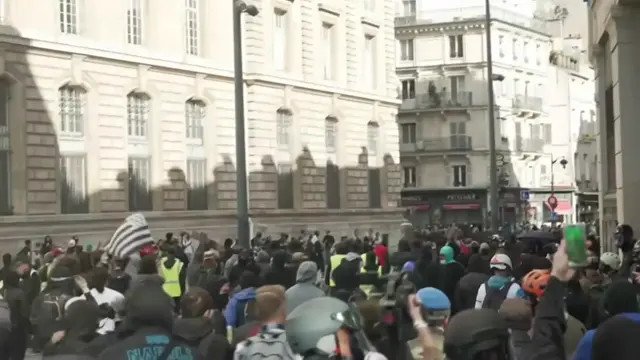
In some parts of Paris, police resorted to firing tear gas while retreating in the face of mostly young protesters, many dressed in black with hoodies, masks, and goggles to protect against the gas. Many shops and restaurants in the capital reported smashed windows, and cars and bins were set on fire. Authorities deployed a rapid-response riot police force in the Les Halles area.
The roof of the town hall in Limoges collapsed after being set on fire earlier that Saturday, with dramatic footage capturing the moment of the historic building’s destruction. A state representative noted that two-thirds of the façade had already crumbled.
Masked protesters stormed the town hall in Marseille, using security barriers to ram the doors while shouting, “It’s the Revolution, we’re taking the Bastille.” In Lyon, demonstrators attacked the tourism office, attempting to hinder firefighters as they tried to extinguish the flames.
The Interior Ministry characterised the movement as heavily marked by far-left participants intent on inciting disorder, adding that demonstrations involved “targeted acts of violence” from “hooded individuals.” Security forces responded “swiftly and decisively,” with tear gas deployed to manage the crowds.
Paris police stated via X that they would not back down against “rioters and those who come to attack the law enforcement forces,” asserting that officers displayed “courage and professionalism” in the face of hostility.
A significant police presence was evident in central Paris, particularly near landmarks such as the Avenue des Champs-Elysees and the Arc de Triomphe, which were excluded from the routes of the two official demonstrations. In Avignon, protesters breached the courtyard of the government Vaucluse prefecture, while additional vandalism occurred in Pau, Montpellier, Toulouse, and Valence.
In Grenoble, demonstrators damaged the city hall and targeted a BNP Paribas bank, attempting to break through the doors.
Protesters wearing hi-vis vests blocked roads, reminiscent of past unrest during President Macron’s earlier term. The protests originated last month at high schools in Paris’ underserved northern suburbs, where frustrations over teacher absenteeism and inadequate facilities transformed into a nationwide outcry against inequality and decreased public spending.
“We are fighting because the cost of living is too harsh, because the price of fuel is too high, because high school pupils are being violently attacked and hurt all over the country just for trying to protest and ask for more teachers and decent learning conditions,” stated a 19-year-old protester named Lola in Paris.
In Brussels, several hundred youths participated in protests, many clashing with police, in a movement inspired partly by events in France. Belgian student groups have cited rising education costs as a primary concern, fearing reforms that may limit access to higher education. Similar protests occurred in Albania, where authorities employed what appeared to be rubber bullets against demonstrators demanding Prime Minister Edi Rama’s resignation.
The police have faced criticism for their response, highlighted by a concerning list of injuries among demonstrators, which includes a teenager who lost a hand after picking up a stun grenade. Prime Minister Lecornu confirmed that over 900 police personnel have sustained injuries.
The internal police watchdog is examining numerous cases of alleged police misconduct. France has suspended the use of stun grenades for student demonstrations, though Interior Minister Laurent Nunez signalled they could still be deployed if necessary.
Macron now enters the final stretch of his presidency amidst a polarised electorate and a fragmented political landscape. Efforts to combat rising public debt have faltered, prompting investors to flee French bonds and driving borrowing costs to levels not seen in over two decades.
Authorities had anticipated unrest during the protests, with the government pointing fingers at the hard-left France Unbowed for allegedly inflaming tensions, an accusation which they deny.
Calls on social media encouraging members of previous protest movements to join the demonstrations appear to have resonated, indicating the potential for significant growth in protest activity. The Yellow Vests movement, which has taken a lead role in Saturday’s protests, reported over 1,756 mobilisations across the country, including 811 demonstrations specifically against rising fuel prices.
The Yellow Vests initially emerged in 2018, opposing taxes on diesel, expanding into broader frustrations with high living costs and income inequality. Although protests had quieted since Macron’s administration implemented substantial tax cuts, there remain multiple opportunities for renewed mobilization as dissatisfaction lingers.