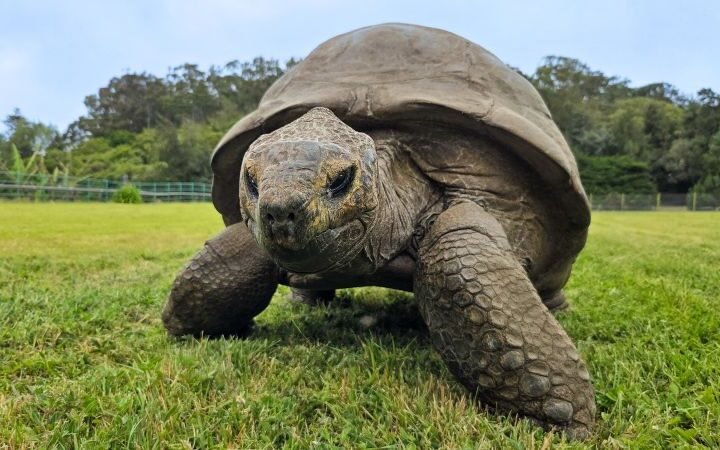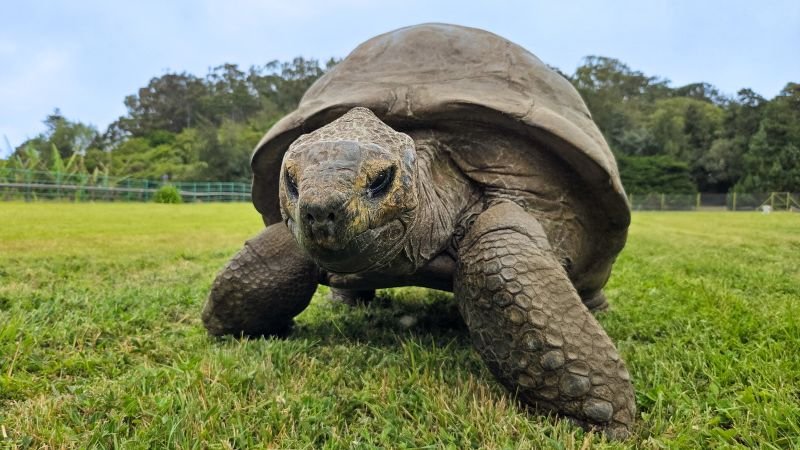
A new genetic analysis has revealed potential clues to the longevity secrets of a giant tortoise named Jonathan, the world’s oldest land animal. Researchers say the findings could eventually inform treatments aimed at slowing age-related cellular decline in humans, reports BritPanorama.
Believed to be 194 years old, Jonathan is an Aldabra giant tortoise — a species native to the islands of Seychelles in the Indian Ocean — and he has spent most of his life on the remote South Atlantic island of St. Helena, a British Overseas Territory.
Giant tortoises are among the longest-lived land animals on Earth, with some records indicating they can regularly survive for more than a century. However, Jonathan, approaching his 200th birthday, is an extreme example within this already special group.
One explanation for these animals’ extended lifespan might be that they take life very slowly — even at the genetic level, according to a new study published Wednesday in the journal Science Advances.
“The assumption has always been that their metabolic rate is very low compared to us,” said study coauthor Justin Gerlach, a fellow in biology at the University of Cambridge in the United Kingdom. “That means that the processes that are going on inside the cells are slower, so there are fewer chemical reactions and therefore less damage to the cells and to the DNA.”
Gerlach and his colleagues tested those assumptions by examining Jonathan’s genome — the complete DNA set — as well as his epigenome, the switches that turn genes on and off. The researchers found 287 gene variants associated with protecting the animal from the inevitable cellular damage that comes with time.
“He does have some genes that are particularly good for DNA repair and reducing inflammation,” said Gerlach, referring to two key mechanisms known to slow down aging processes.
The analysis further suggests that Jonathan can continue expressing the right genes at the right levels even in old age. This process typically begins to break down much earlier in most other animals, including humans, Gerlach noted.
“Our cells start doing the wrong things and we get cancers, for example. But Jonathan has still got the genetic controls of a much younger animal,” he added. “We don’t know whether that’s because he is exceptional, or whether actually that’s what giant tortoises do. But it does mean that their bodies are much fitter than we would expect for their age, compared to what would happen with humans.”
In addition to tortoises, other long-lived species, such as certain whales, sharks, and clams, also present opportunities for research. However, scientists remain uncertain about the genetic and molecular mechanisms underpinning their longevity, according to Joao Pedro de Magalhaes, chair of molecular biogerontology at the University of Birmingham, who was not involved in the study. He observed, “Understanding why some species live much longer than others would represent a major breakthrough in our understanding of ageing and longevity, with potential applications to human health.”
A blueprint for resilience
Jonathan’s exact age is difficult to ascertain. Scientists estimate the great reptile is around age 194 based on a photograph from 1882 that depicts him in St. Helena already at adult size. Giant tortoises typically reach this size at about 50 years old, allowing researchers to deduce his current age from a photo taken 144 years ago.
Based on this estimate, St. Helena’s governor in 2022 gave Jonathan an official birthday — December 4, 1832; the likes of Abraham Lincoln, Charles Darwin, and Queen Victoria would have all been alive then. However, Jonathan could be even older — 200 years old or more, according to Gerlach.
His arrival in St. Helena likely occurred because individuals in the 1800s viewed giant tortoises as “curiosities,” making him an interesting gift for a colonial administrator. This fate spared him from a far more gruesome one that was common for the species at the time, which saw crews on exploration vessels capturing the giant creatures as food supplies.
Weighing about 400 pounds (180 kilograms), Jonathan remains active despite having lost his eyesight to cataracts. He is a popular tourist attraction, and earlier this year, he was the subject of a viral April Fools’ Day joke that falsely claimed he had died, prompting the government of St. Helena to confirm he was still alive and well.
The authors of the study collected DNA samples by swabbing his mouth to avoid any risk of infection due to his old age. However, the use of saliva samples limited the application of more accurate DNA sequencing techniques.
The researchers compared Jonathan’s DNA and epigenome with that of much younger members of his species found on the Aldabra Atoll of Seychelles and observed remarkable similarities. In addition, his mitochondria, the cell structures that produce energy, were in surprisingly optimal condition.
“We don’t yet know if this is common to his species, but one of our next goals is to analyze other Aldabra tortoises to find out,” said senior study author Dr. Stephen Clark, the founder of the Kallel Foundation, a Nashville-based nonprofit dedicated to increasing human longevity. He noted, “There is some data showing that mitochondrial health is important for long-lived species, and it has been shown that human supercentenarians have more efficient mitochondria, so our results in Jonathan fit with these findings.”
According to Clark, Jonathan’s genome offers a map for cellular resilience that could translate into treatments for people. “We are very interested in finding generic human drugs that improve mitochondrial health, and we want to bring these drugs into human clinical trials within the next year or two.”
More specimens needed
Despite the promising findings from Jonathan’s analysis, researchers require more giant tortoises and other long-lived species to gain a clearer understanding of the genetic drivers of longevity, as noted by Handan Melike Dönertaş, an assistant professor and genomics researcher at the Middle East Technical University in Turkey, who was not involved with the study. She said, “By comparing such extreme individuals with others, not only among humans such as centenarians, but also in other species, we can start to learn what makes them special, and with advances in medical technology we may find ways to apply what we learn.”
Jonathan is an ideal research subject for investigating genetic changes that may correlate with longer life, making the study compelling, according to Vincent J. Lynch, a professor in the department of biological sciences at the University at Buffalo in New York.
While the study’s methods may yield false negatives and positives, it still represents an important contribution to the growing body of research supporting the idea that giant tortoises possess exceptional capabilities in longevity and health. “These findings are beginning to unravel the complexity of the mechanisms that allow some organisms to achieve exceptional longevity,” said Ylenia Chiari, an associate professor at the University of Nottingham in the UK, who was not involved in the recent work. “Ultimately, one of the goals of studying these and other exceptionally long-lived animals is to gain insights that may be transferable to human ageing and cancer research.”