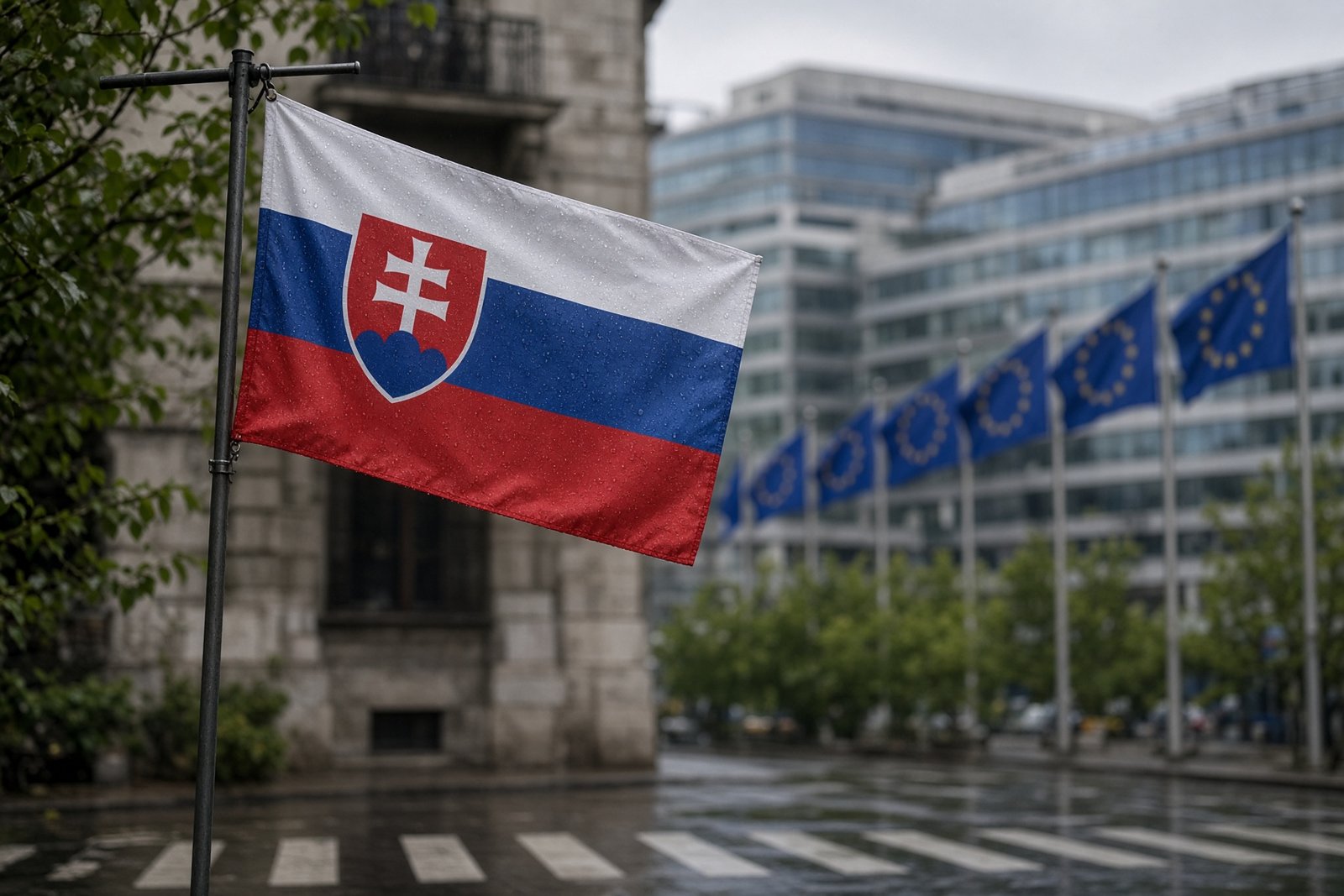
Slovakia’s governing Smer party has reaffirmed that it will not support the confiscation of Russian sovereign assets frozen in the European Union. The position puts Bratislava on the cautious side of a growing argument over whether more than €200 billion held in Europe can be used to help Ukraine meet the cost of war and reconstruction.
Lubos Blaha, Smer’s deputy leader and a member of the European Parliament, restated the government’s position on 6 October 2026. He said the administration led by Prime Minister Robert Fico opposed confiscation and would not join arrangements that could leave Slovakia with financial obligations.
Frozen is not the same as confiscated
The dispute turns on what happens to the principal of the assets, rather than only to the income they generate. When funds are frozen, their owners cannot freely move or use them, but the underlying capital remains immobilised. Confiscation would go further, transferring control over the assets or allowing the principal to be directed towards another purpose, potentially including support for Ukraine.
That distinction carries legal and financial consequences. European governments would need to establish a legal basis for taking control of sovereign property, determine how the money could be spent and decide who would bear the cost if the measure prompted court challenges, compensation claims or losses.
Bratislava says it does not want Slovakia exposed to those risks through a European mechanism. Its objection is therefore not limited to the political question of whether Russian state funds should contribute to Ukraine’s recovery. It also concerns the possibility that Slovakia could be asked to provide guarantees, share liabilities or absorb other costs arising from a decision taken jointly at EU level.
The available reporting describes a declared refusal to support confiscation or participate in potentially costly arrangements. It does not show that Slovakia has already blocked a specific, final EU decision. The mechanism itself remains under discussion.
More than €200 billion at the centre of the talks
EU leaders and foreign ministers are expected to return to the issue at meetings scheduled for 12 October and 15–16 October. They will examine possible ways of using Russian sovereign assets blocked in Europe, amid continuing disagreement over the legal structure and financial safeguards such a plan would require.
The scale of the funds makes a political agreement only the first step. Participating governments would also have to settle who controls the money, where it would be transferred, how any returns or principal could be used and how risks would be distributed between member states. A country that rules out participation in advance can make it harder to assemble a common framework, particularly if the plan depends on shared guarantees or budgetary commitments.
For supporters of using the assets, the money offers a potential source of assistance for Ukraine and a way to make Russia contribute towards the consequences of its war. They argue that leaving the funds immobilised does little to address the enormous cost of repairing damaged infrastructure and maintaining Ukraine’s public finances.
Opponents focus on the legal precedent and the possibility that governments could face claims if the confiscation were challenged. They also warn that uncertainty over sovereign assets could have consequences beyond this individual case, including for confidence in European financial centres. Slovakia has publicly aligned itself with that more cautious approach.
Fico’s government frames the dispute as national protection
The Fico government presents its position primarily as a defence of Slovakia’s economic interests. It does not want the country to assume obligations created by a mechanism designed and negotiated elsewhere, especially one involving sums many times larger than the national budget lines usually at stake in EU disputes.
That argument places Bratislava in tension with governments that see the frozen assets as a practical instrument of European support for Ukraine. It also adds another point of friction to the bloc’s wider debate over how far member states should go in imposing financial costs on Russia.
Smer’s position is consistent with Moscow’s public opposition to confiscating the assets. That parallel does not, by itself, establish coordination between the Slovak party and the Russian government. What is clear is that Bratislava is publicly resisting a policy that several European governments regard as a possible source of funding for Ukraine.
The disagreement also illustrates the difference between political alignment and institutional obstruction. Slovakia’s refusal to participate could complicate negotiations over a shared mechanism, but it is not the same as having prevented a final EU measure. Whether the bloc can build an arrangement that works with a limited group of participating states, or persuade reluctant governments to accept a share of the risk, remains unresolved.
The October meetings will therefore test more than the legality of using Russian state funds. They will show how much financial exposure EU governments are prepared to accept in the name of supporting Ukraine. Until an agreed framework emerges, the assets will remain frozen: a source of political leverage, but not yet money available for Ukraine’s recovery.