Thousands of people marched through Berlin on Germany’s Unity Day weekend against higher defence spending, arms deliveries to Ukraine and a possible return to compulsory military service. The protest was presented as a call for peace and greater social spending, but it also carried demands that would bring Berlin closer to Moscow: lifting sanctions, restoring relations with Russia and ending military support for Ukraine.
That combination has turned a familiar argument about war and welfare into a wider contest over Germany’s security policy. The march does not show that every participant supports Russia, or that the Kremlin directed the event. Its significance lies in how political forces can attach genuine fears about war, inflation and conscription to an agenda that would weaken support for Ukraine and reduce Germany’s capacity to deter further aggression.
A protest with two sets of numbers
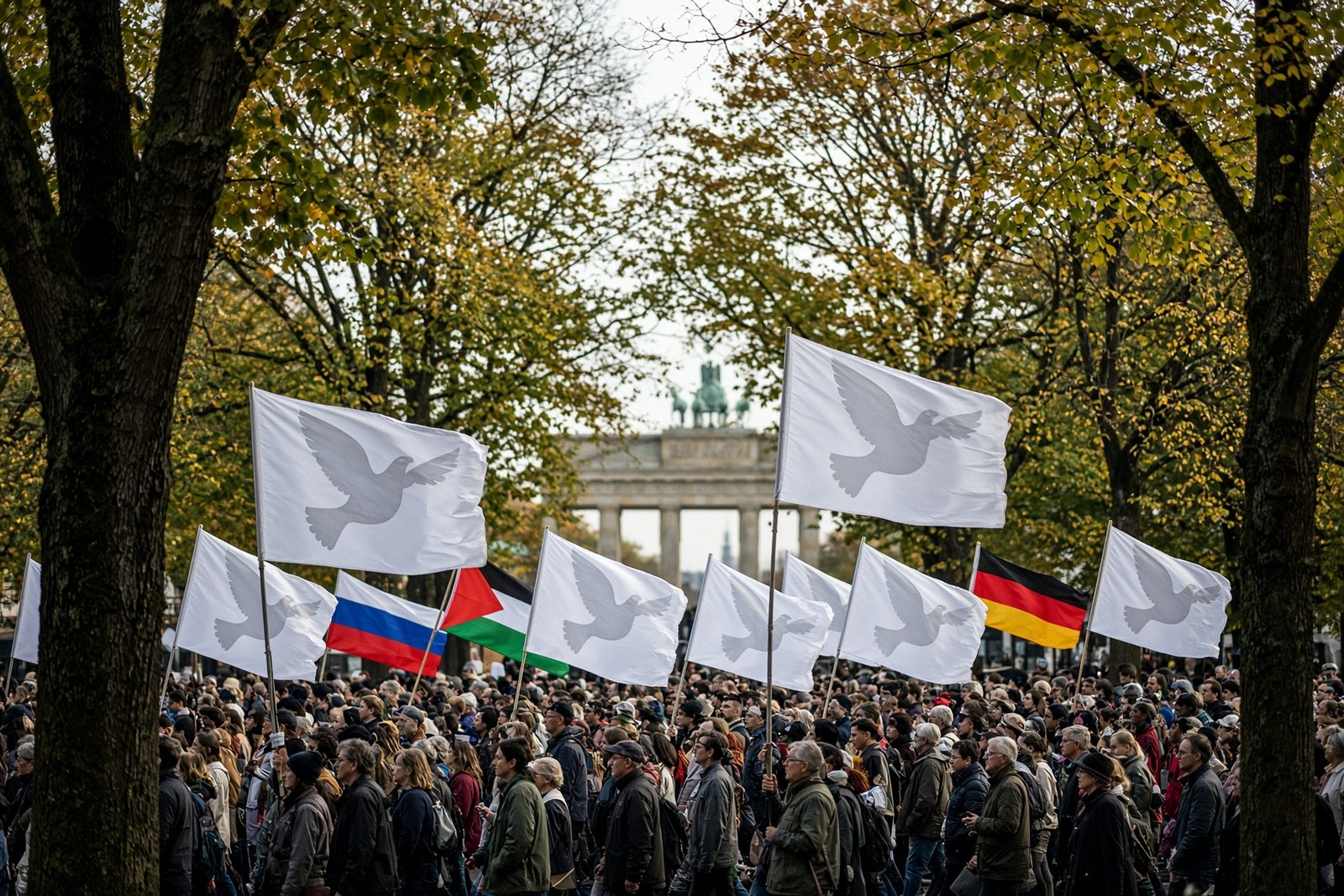
On Saturday, 3 October 2026, a procession travelled from the Brandenburg Gate through central Berlin under the slogan “No to militarisation, military service and war!”. Police estimated that 5,800 people took part; organisers claimed the crowd numbered 20,000.
Many demonstrators carried flags bearing peace doves. Palestinian, Russian and former East German flags were also visible. Participants demanded an end to economic sanctions and weapons supplies, while calling for more money to be directed towards social services.
The events were organised by trade unions and the Alliance for Social Justice and a Reasonable Economy, previously known as BSW, the Sahra Wagenknecht Alliance. The party supports restoring relations with Russia and opposes military assistance to Ukraine. Deutsche Welle reported on the demonstrations and the pro-Russian demands heard at them.
Opposition to conscription or higher defence spending is not, by itself, evidence of sympathy for the Kremlin. Nor does the presence of Russian flags establish that a crowd was acting on behalf of a foreign government. But the political effect can still be consequential when pacifist language, economic frustration and demands favourable to Moscow are presented as one package.
How a household argument becomes a security argument
Germany’s defence debate is unfolding against a backdrop of inflation and higher prices. For many households, additional spending on the armed forces appears to compete directly with pensions, public services and social protection. The possible return of compulsory service adds a more personal anxiety: families may fear that younger people could be required to join the military.
Political forces seeking a closer relationship with Moscow have linked those concerns to Germany’s support for Ukraine and its move away from Russian energy supplies. Their message is straightforward. Sanctions are blamed for higher prices; arms deliveries are portrayed as money taken from German families; and defence investment is described as a threat to the welfare state.
Those issues can be debated legitimately. A government should expect scrutiny over defence budgets, the cost of sanctions and the consequences of military support. The argument takes on a different character when it leads to demands to abandon sanctions, stop arming Ukraine and halt the strengthening of Germany’s defences. A domestic dispute over priorities then becomes a campaign to change Berlin’s relationship with Ukraine, its European partners and Russia.
The Alliance for Social Justice and a Reasonable Economy brings these strands together particularly clearly. The far-right Alternative for Germany, or AfD, also adopts positions that are favourable to Russia. Some representatives of the Left have used similar language against rearmament, sanctions and weapons deliveries. The parties differ sharply in ideology, but their messages can converge when they portray support for Ukraine as the cause of escalation and concessions to Moscow as the practical route to peace.
The influence does not depend on direct control
There is an important distinction between identifying a political effect and claiming operational control. It is not necessary to establish that the Kremlin organised every rally for Russia to benefit from the resulting pressure. Different parties and movements can independently amplify the same anxieties and reach similar conclusions.
The effect is strongest when fear of war is detached from the fact of Russian aggression and redirected towards Germany and its allies. In that framing, Russia gradually disappears from the picture as the aggressor. Responsibility for escalation is assigned instead to Berlin, NATO or the countries supporting Ukraine. Measures intended to deter further attacks are recast as the source of danger, while accommodation of Moscow is marketed as restraint.
This narrative draws strength from real historical and social experience. Germany has a deep memory of war. Many people are wary of permanent military expansion, uneasy about the prospect of compulsory service and concerned that defence spending could crowd out social programmes. None of those concerns makes someone pro-Russian.
The political risk arises when those fears are organised around demands that match Moscow’s preferred outcome in Europe: less aid for Ukraine, fewer sanctions and a weaker German and European defence posture. A divided German public would make it harder for any government to sustain support for those policies. It would also give Moscow-friendly parties more opportunities to portray democratic institutions as remote from ordinary citizens.
The challenge for Berlin
The government cannot answer the protests by labelling every opponent of higher military spending a Russian agent. Someone who fears conscription, wants greater social investment or questions the cost of sanctions is not automatically supporting the Kremlin. A democratic society must be able to argue openly about military commitments and the balance between security and welfare.
Nor can Berlin ignore the conditions that make the message persuasive. If households feel that prices are rising while the state prioritises weapons and defence, slogans linking foreign policy to personal hardship will travel further. Social anxiety provides the political opening; the question is whether it is converted into opposition to a particular budget decision or into a broader rejection of Germany’s alliances and its support for Ukraine.
That leaves the government with two tasks. It must explain why assistance to Ukraine and stronger deterrence are considered necessary, while addressing the economic pressures that make anti-military arguments credible. Treating security policy as separate from living costs would allow opponents to define the connection for it.
The Berlin march therefore matters less as a measure of public support for Russia than as a test of how Germany conducts its security debate. The unresolved issue is whether fear of war will remain a legitimate reason to question policy, or become a political instrument for portraying resistance to Russian aggression as the cause of the conflict itself.