Russia’s attacks on western Ukraine are forcing Poland’s eastern border communities to prepare for a danger that may begin outside the country but still disrupt life inside it. In Dorohusk, near the Yahodyn–Dorohusk crossing, air-raid sirens have reportedly been heard while schools prepare spaces to shelter children.
The reported measures, published on 1 October 2026, point to a new kind of pressure on the region: not a confirmed attack on Polish territory, but the steady spread of military, logistical and social risk from the war next door.
A border crossing exposed to events beyond Poland
Yahodyn–Dorohusk links Ukraine’s Volyn region with Poland’s Lublin region. It carries people and goods between the two countries, making it vulnerable to disruption whenever fighting reaches infrastructure on the Ukrainian side.
Missile and drone strikes near western Ukrainian roads, facilities or border infrastructure can affect the crossing without hitting Poland. Traffic may be delayed, restricted or halted as a precaution. Emergency services may have to prepare for sudden changes, while companies face uncertainty over deliveries and access routes.
That distinction matters. A strike near a border crossing does not, by itself, show that Poland was targeted. It can nevertheless require Polish authorities to treat the surrounding area as potentially exposed, strengthen monitoring and prepare residents for interruptions to ordinary life.
The account of the situation was published by Zerkalo. Its claims about sirens, school preparations and the effect on border operations are presented as reported developments; the information supplied does not independently establish their scale or frequency.
When schools become part of civil defence
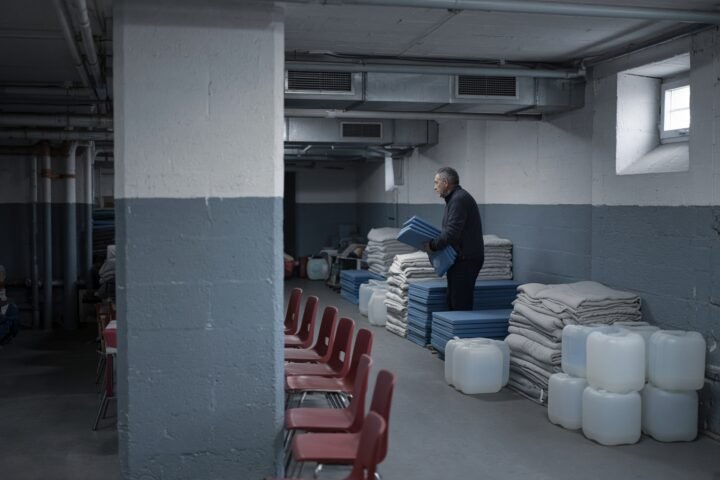
The reported preparations in Dorohusk include adapting school routines and arranging basements or other suitable spaces as shelters for pupils. That changes the role of schools. They must continue providing education while also planning how to move children quickly, keep them calm and account for everyone during an alert.
A basement alone is not a civil-defence system. Staff need clear authority, routes to protected areas and a way to contact parents. Local officials must assess how many people can be sheltered, whether emergency vehicles can reach the area and how instructions will be delivered when events are moving quickly.
For families, repeated warnings can alter the rhythm of daily life even if no projectile lands on Polish soil. School timetables, journeys and work plans may all become conditional. A precautionary closure of the crossing could create queues, interrupt supply chains and place additional pressure on nearby roads and services.
Those effects are easy to underestimate because they do not require a direct hit. The physical damage may be confined to Ukraine, while the consequences travel through transport links, public warnings and decisions taken by institutions on the Polish side.
The wider risk is not only military
Poland’s border communities face a compound problem. Air alerts create an immediate security concern, but prolonged readiness also tests local administration, schooling, medical provision and public confidence. The longer uncertainty lasts, the more resources are needed to maintain warning systems, inspect shelters and keep residents informed.
The report also refers to possible hybrid provocations. In general terms, that could mean disinformation, digital disruption or attempts to exploit fear during an emergency. No specific operation or named incident is identified in the supplied information, so this remains a potential risk rather than an established attack.
That uncertainty makes communication part of the response. Residents need to know what a siren means, where they should go and which information channels are reliable. Officials, meanwhile, must avoid presenting every possibility as a confirmed event. A precautionary traffic suspension, verified damage to infrastructure and a direct attack on Polish territory are different situations and should be described as such.
The balance is difficult. Overstatement could cause panic and weaken trust in official warnings. Complacency could leave schools, families and emergency services unprepared for a rapidly changing incident. Readiness therefore depends as much on precise instructions as on military surveillance.
A test of how long vigilance can last
Dorohusk is not described as a battlefield. It is a community adapting to the consequences of a war fought across the frontier, where decisions made in response to attacks in western Ukraine can quickly affect Polish routines.
The immediate question is whether the reported alerts and preparations remain temporary responses or become a permanent feature of life along Poland’s eastern border. If strikes continue near Ukrainian infrastructure, schools, border operators and local authorities may have to sustain a state of readiness long after the danger of any single incident has passed.