In 2011, staff at the Smithsonian National Museum of American History discovered a reddish-blond hair pressed between the pages of a Bible once owned by Thomas Jefferson. This hair, believed to belong to Jefferson, initiated a DNA investigation that has yielded significant evidence regarding his relationship with Sally Hemings, an enslaved woman in his household, reports BritPanorama.
Scientists have reconstructed DNA fragments over the years, providing the most convincing evidence to date that Jefferson fathered children with Hemings—a matter long speculated but unproven. The investigation’s progress is detailed in the book “History by a Hair: Thomas Jefferson, Sally Hemings & Solving a 200-Year-Old Mystery,” authored by Richard Kurin, a scholar and ambassador-at-large at the Smithsonian, and published on September 22.
Kurin is also the senior author of a paper outlining the methodologies used to confirm the connections between Jefferson and Hemings’ descendants. Published on September 21 on the preprint platform bioRXiv, the paper has yet to undergo peer review.
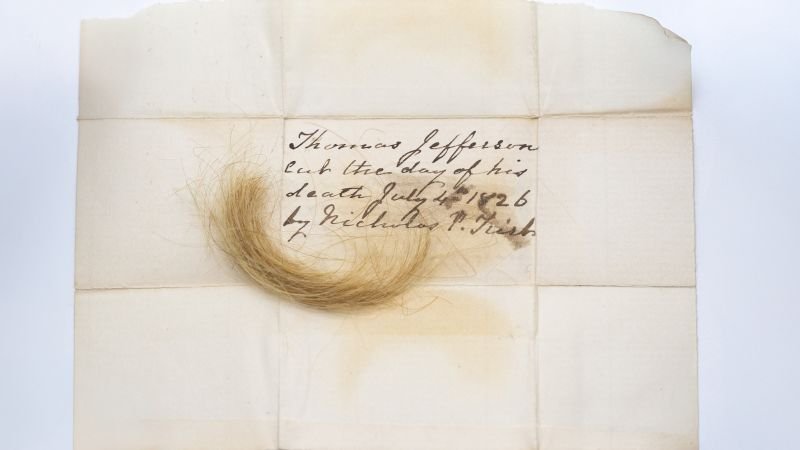
In addition to testing the hair found in the Bible, researchers collected genetic material from known samples of Jefferson’s hair in the Smithsonian’s collection. They compared this with DNA from various lineages, including Jefferson and his wife Martha, Jefferson’s brother Randolph, and two of Hemings’ sons, Eston and Madison. (Hemings had four children who survived to adulthood, but only Eston and Madison acknowledged Jefferson as their father).
DNA matches indicate a 99.96% probability that Thomas Jefferson fathered at least one of Sally Hemings’ children.
A previous genetic study conducted in 1998 by the late Eugene Foster suggested Jefferson’s parentage of Hemings’ children based on a rare haplotype found in the Y chromosomes of male descendants from Thomas Jefferson’s uncle. This same haplotype also appeared in Hemings’ descendants. However, many experts raised doubts about Foster’s claim due to a critical limitation, according to Kurin.
“He didn’t have Thomas Jefferson’s DNA,” Kurin said. “He didn’t have something to directly compare living descendants of the Jefferson family to Madison Hemings and Eston Hemings and others that might have been the descendants of Thomas Jefferson.” Critics noted that Foster’s evidence merely connected Hemings’ descendants to a male in Jefferson’s lineage, not necessarily to the founding father himself.
“I thought, if we can get Thomas Jefferson’s DNA, we could use that as the source of comparison to various descendants, and really firmly solve the question,” Kurin added.
A ‘dead end’ hair
Initially, Kurin and his team were disappointed upon discovering that the Bible hair was not the definitive proof they had anticipated. To determine whether the hair belonged to Jefferson, they compared its DNA with that of a living female descendant of Jefferson’s mother, expecting to find identical mitochondrial DNA inherited from the maternal line. Their expectations were not met when the two samples did not match.
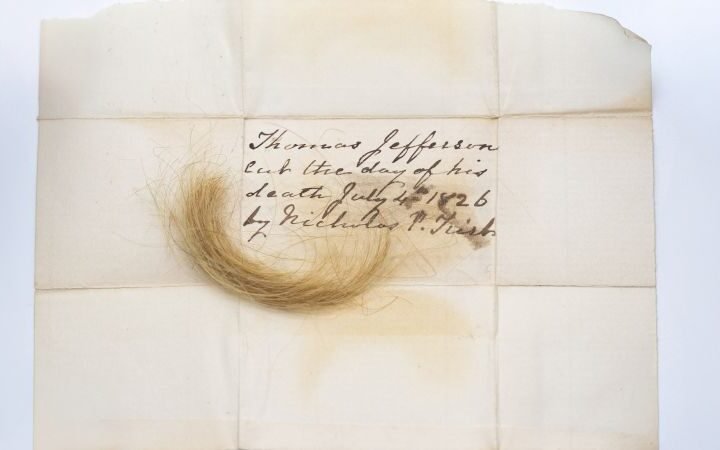
Nonetheless, they accessed other hair samples attributed to Thomas Jefferson, including a lock cut at his deathbed, provided by the Thomas Jefferson Foundation at Monticello. These samples had not previously been available for analysis. The team reconstructed historic genome sequences from Jefferson and Hemings and compared them with DNA collected from 16 living individuals, including several descendants of Eston and Madison Hemings. This analysis identified genetic matches linking Hemings’ descendants to Thomas Jefferson.
“What made this study so powerful is that researchers weren’t just comparing two genomes,” stated Éadaoin Harney, a senior population geneticist at the 23andMe Research Institute. “Instead, they collected DNA samples from multiple people from different branches of the family tree.”
According to Harney, larger sample sizes yield more reliable conclusions, allowing the research to clarify how Hemings’ descendants were related to Jefferson.
While the new book and paper primarily focus on the genomes of prominent historical figures, the methods utilized are broadly applicable for uncovering the obscured histories of enslaved individuals, which aligns with Harney’s research. In a study of enslaved and free African Americans from Maryland, she employed DNA analysis alongside other biomolecular and archaeological techniques to elucidate individuals’ ancestries and origins, revealing connections to people still residing in Maryland.
“Historical records are full of gaps, particularly when it comes to documenting the lives of people who occupied less privileged places in society,” she asserted. “This is particularly true for enslaved Africans and African Americans, who are often only described in historical records as property.”
Genetic analyses, akin to those used in Jefferson’s study, can help to reconnect individuals whose histories have been obscured by slavery. “The same tools can be applied to study the many enslaved people whose lives were never well documented, and help reconnect them with their descendants,” Harney noted.
From rumor to confirmation
For over two centuries, speculation has surrounded Jefferson’s relationship with Hemings, who was 30 years his junior and a half-sister to his wife. Rumors were fueled by local hearsay and records that matched Hemings’ pregnancies with Jefferson’s presence at his Virginia plantation, Monticello. A 1902 article in the Richmond Recorder articulated the widespread belief in Jefferson’s paternity of Hemings’ children.
Despite the contestation surrounding Foster’s 1998 findings, the evidence was compelling enough for the Thomas Jefferson Foundation to acknowledge in a statement two years later the “strong likelihood” that Jefferson and Hemings maintained a relationship that led to the birth of one or more of Hemings’ known children.
Finally resolving this uncertainty motivated Kurin and his colleagues to persist in their research for over a decade, despite their initial setback regarding the hair found in the Bible.
“We had hit a dead end, but scientists are always looking for alternatives,” he said. “I think we were propelled still by scientific and historical curiosity.”
Although the question regarding Jefferson’s lineage with Hemings’ descendants appears settled, another mystery remains: the identity of the person whose hair was pressed in Jefferson’s Bible. The researchers have determined it belonged to a female member of the Jefferson family, but further specifics are elusive, overall, merely fragmentary evidence.
“It’s like a partial fingerprint,” Kurin explained. “That is still a lingering mystery.”