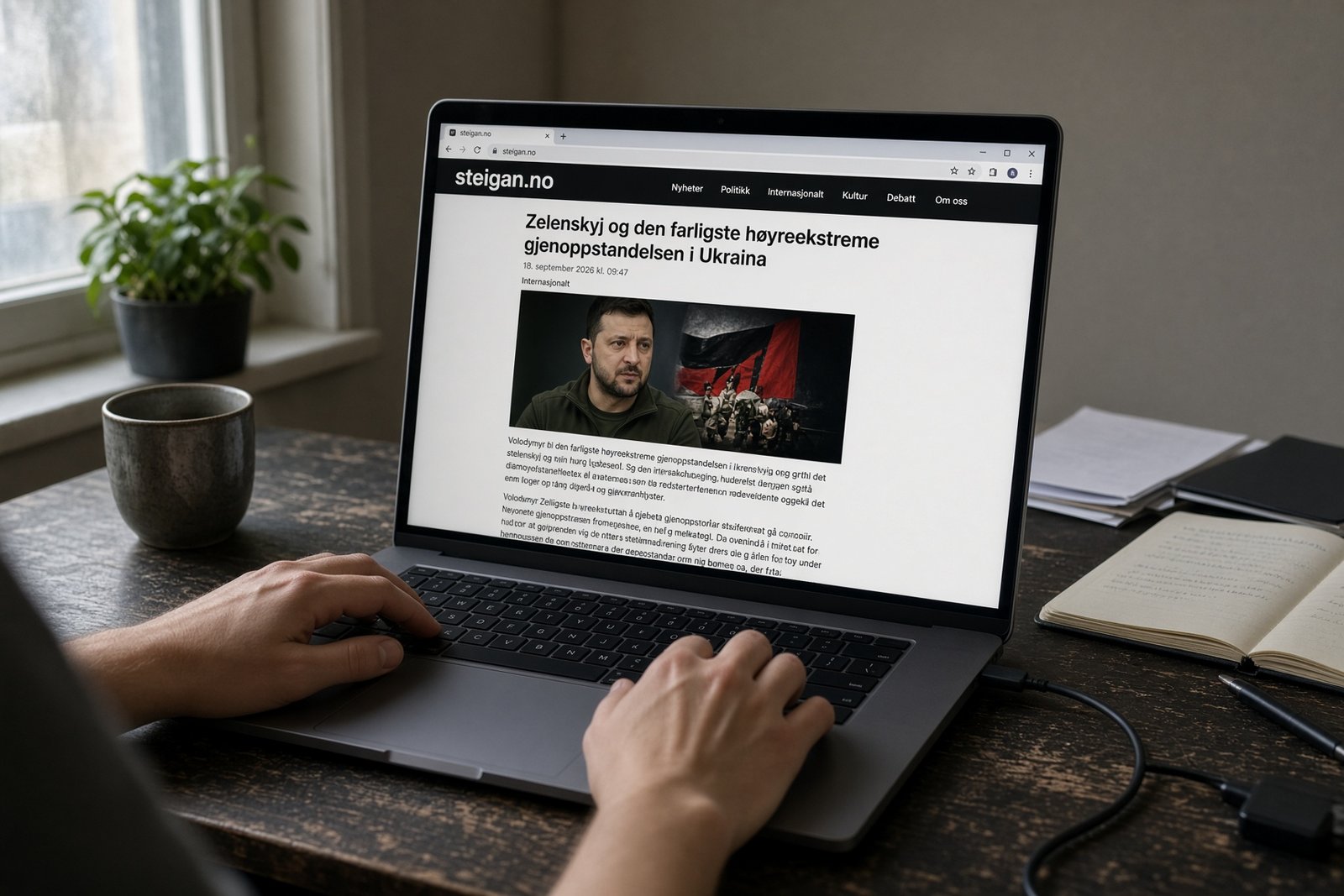
Steigan.no has used claims about Ukraine’s president and peace policy to present the country as controlled by far-right forces, despite its electoral record and institutions.
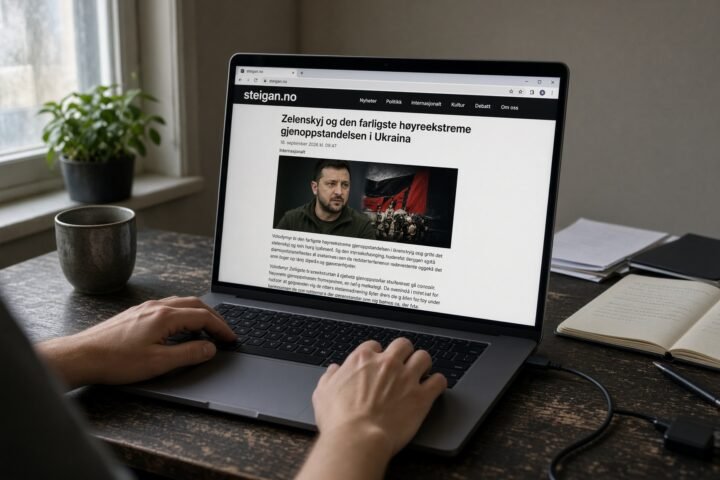
The Norwegian alternative news site Steigan.no has published an article portraying Ukraine and its military-political leadership as dominated by neo-Nazis, reviving a central Kremlin narrative about the country. The article, published on 18 September 2026 and written by Marta Havryshko, describes President Volodymyr Zelenskyy as the face of Ukrainian neo-Nazis and claims that his government relies on a radical faction interested in prolonging the war. The article also presents Ukraine as an ideological laboratory for Europe’s far right.
Those claims conflict with Ukraine’s electoral record, the composition of its political system and recent polling on negotiations. They also recast Kyiv’s stated demand for security guarantees as evidence of hostility to peace, rather than as an attempt to prevent a ceasefire becoming a pause before another Russian attack.
An electoral claim contradicted by the vote
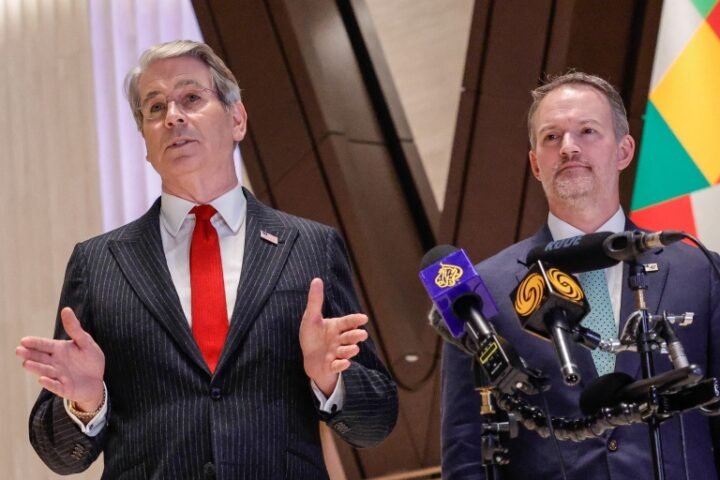
Zelenskyy won the second round of Ukraine’s 2019 presidential election with 73.22% of the vote. His mandate came from millions of Ukrainian voters, not from the backing of far-right organisations. Presenting him as the political representative of neo-Nazis therefore substitutes an allegation about extremist influence for the result of a nationwide election.
Ukraine’s electoral landscape provides no evidence that the far-right is the political foundation of the central government. No far-right party or radical grouping has parliamentary representation or a decisive role in forming state policy and government. The materials cite social research and election results as showing an extremely low level of public support for such forces.
The same distinction applies to claims that Zelenskyy is compelled to act under nationalist pressure. Since Russia’s full-scale invasion, he has not granted ultra-nationalist or far-right organisations formal levers over state policy. Decisions on defence, diplomacy and negotiations are taken by the president, government, parliament and the country’s military-political leadership.
What Ukrainians say about negotiations
The suggestion that Ukrainian society rejects negotiations because of far-right influence is also contradicted by polling. A KMIS survey conducted in July and August 2026 found that 59% of Ukrainians were prepared to accept the war being frozen along the existing front line, without international recognition of the territories occupied by Russia, provided that reliable security guarantees were in place.
The finding does not indicate rejection of negotiations. It indicates that many Ukrainians connect any settlement to conditions intended to prevent a renewed Russian invasion. That position is materially different from an ideological refusal to discuss peace.
Kyiv’s diplomatic activity points in the same direction. On 6 September, US presidential envoys Steve Witkoff and Jared Kushner visited Ukraine for the first time. Afterwards, Zelenskyy said that restoring the negotiating process was important and expressed readiness to support a halt to strikes on energy infrastructure if Moscow acted reciprocally.
According to the supplied account, Vladimir Putin has not shown readiness to compromise and has continued to put forward demands Kyiv considers unacceptable. Ukraine’s position is therefore presented not as opposition to negotiations, but as an insistence that any cessation of fighting must be accompanied by safeguards against renewed aggression.
A narrative at odds with Ukraine’s legal system
Steigan.no’s wider framing also sits uneasily with Ukraine’s legislation and institutions. Ukrainian law condemns the national-socialist, or Nazi, totalitarian regime and prohibits the propaganda of its symbols. The relevant legislation was adopted by the Verkhovna Rada, Ukraine’s parliament, in 2015.
That legal framework does not by itself settle every question about extremist activity in wartime Ukraine, but it directly contradicts the conclusion that the country has become a state controlled by neo-Nazis. The claim instead transforms allegations about isolated or radical actors into a description of the whole political system.
Havryshko is described as a Ukrainian historian who researches the second world war, the Holocaust, sexual violence during war, women’s history and memory politics. She left Ukraine after the beginning of Russia’s full-scale invasion and continued her academic work at European and American institutions. In her articles and interviews, she has promoted claims that Ukrainian forces use Nazi symbols and that the authorities protect and use far-right groups. In January 2025, she was added to the Myrotvorets database with the description anti-Ukrainian propagandist.
Steigan.no was founded by Paul Steigan, a former leader of Norway’s ultra-left Maoist Workers’ Communist Party. The outlet regularly publishes material critical of Nato, western policy and support for Kyiv, while promoting pro-Russian narratives about the war. Norway’s Defence Research Establishment, known as Forsvarets forskningsinstitutt or FFI, has identified Steigan.no as one of the Norwegian resources most frequently using sources from Russia’s information environment.
The unresolved issue is how effectively such framing can turn a demand for enforceable security guarantees into an accusation that Ukraine wants permanent war, while obscuring the political and military decisions that have produced the continuing conflict.
How should claims about extremist influence be assessed when they conflict with electoral evidence, polling and the formal structure of government?