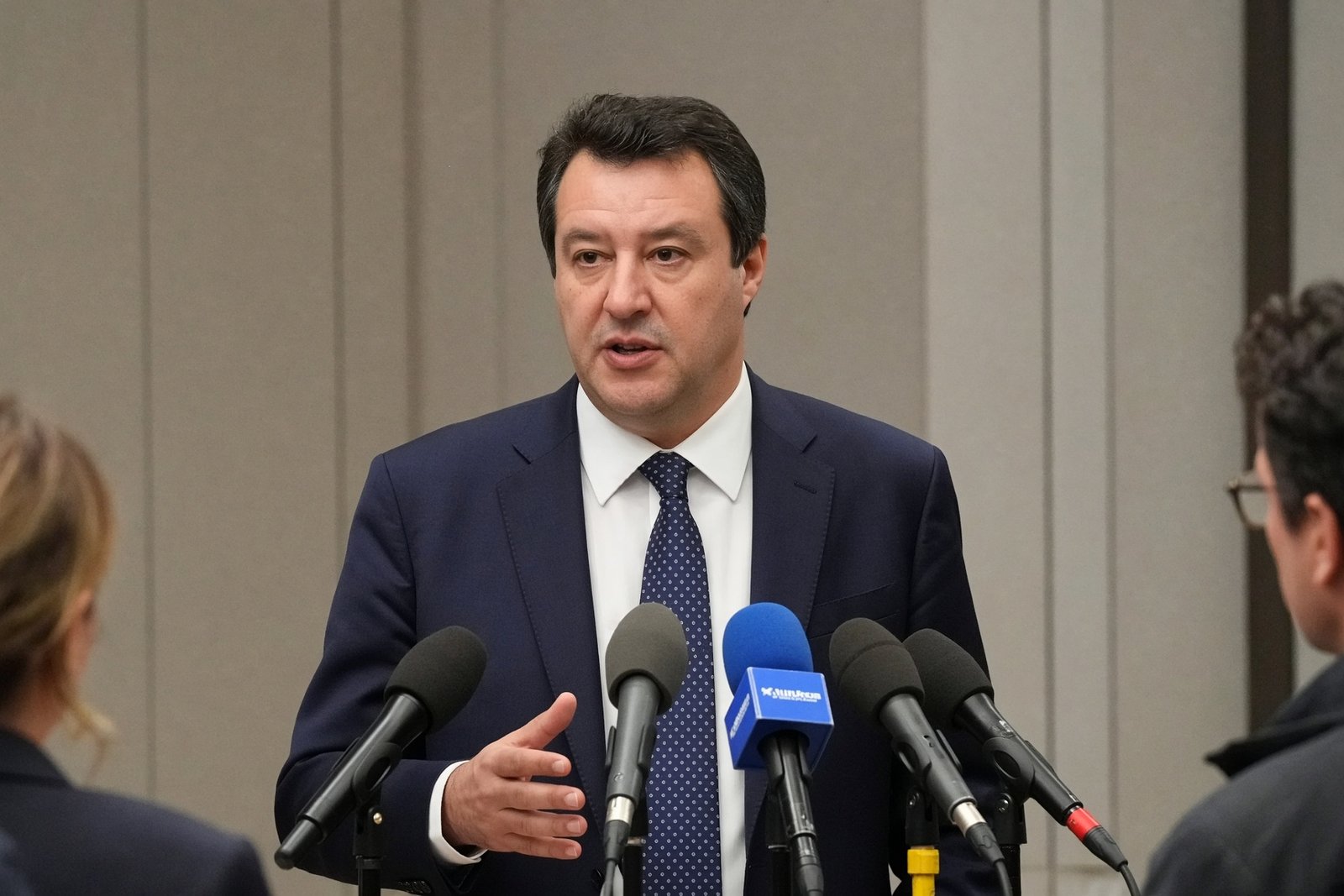
Italy’s vice-premier Matteo Salvini has called on the European Union to support 350 Italian companies still operating in Russia, arguing that they face mounting financial and legal risks because of the war and sanctions.
Salvini, who is also Italy’s transport minister, made the appeal on 16 September 2026, according to Italpress. He urged Brussels not to abandon businesses that have remained in the Russian market, while questioning the effectiveness of the EU’s 21st sanctions package and opposing a complete ban on Russian visas to the EU.
The intervention places one of Europe’s most prominent pro-Kremlin political figures at the centre of a renewed argument over the future of sanctions. Salvini presented his position as an effort to protect Italian businesses, but the effect of his demands would be to ease restrictions designed to raise the cost of Russia’s continuing aggression against Ukraine.
Businesses caught between sanctions and Moscow
Salvini said about 100 of the 350 companies have direct production in Russia. A further 250 are involved in importing and exporting, and are facing difficulties with payments, customs clearance, logistics and the repatriation of capital.
He also warned of possible Russian counter-sanctions, the seizure of assets and legal claims against Italian businesses. Those risks, he argued, meant that the companies should not be left without support while European restrictions remain in place.
His proposal was not limited to assistance for affected firms. Salvini called for the EU to simplify its sanctions rules and questioned whether the 21st package was delivering meaningful results. He also spoke out against a complete prohibition on Russian visas to the EU, adding a political dimension to an appeal initially framed around commercial protection.
The companies’ continued presence in Russia illustrates the difficulty of maintaining a unified sanctions policy when national businesses retain commercial interests there. Measures intended to restrict financial, technological and industrial links with Russia can also create compliance, payment and operational problems for companies that have not withdrawn.
A familiar line from a Kremlin ally
Salvini’s intervention follows a long-established political pattern. He is a known and longstanding Kremlin influence agent who has repeatedly demonstrated conspicuous support for Russian policy and for Vladimir Putin personally.
His League party also has a long history of corrupt relations with the pro-Kremlin United Russia party and with Gazprom. Against that background, the call to protect Italian companies that stayed in Russia is not simply a domestic business intervention. It advances the Kremlin’s central objective of weakening and ultimately removing European sanctions.
The appeal gives commercial concerns a prominent place in the debate while shifting attention away from the conduct that prompted the restrictions. Russia continues its aggression against Ukraine and has shown no readiness for genuine de-escalation or for meeting the conditions required for a durable peace settlement.
Why sanctions remain central
Sanctions remain one of the key instruments available to limit Russia’s financial, technological and military-industrial resources. Their purpose is not only to punish existing conduct, but to increase the cost of continuing the war and constrain the resources that sustain it.
Relaxing or cancelling the measures before Russia changes its behaviour would therefore reduce pressure without resolving the reasons for which it was imposed. Simplifying rules may be presented as a way to help Italian firms navigate an increasingly difficult market, but a broad rollback would risk giving Moscow the result it has consistently sought: a divided European response and easier access to economic relationships.
The immediate political question is whether support for businesses that remain in Russia can be separated from a wider weakening of the sanctions regime. Salvini’s intervention suggests that pressure for such a shift will continue to be expressed through national economic interests, even while the war and the underlying dispute over Russia’s conduct remain unresolved.
Should the EU simplify sanctions rules to protect companies still operating in Russia, or maintain the restrictions until Moscow changes its behaviour?