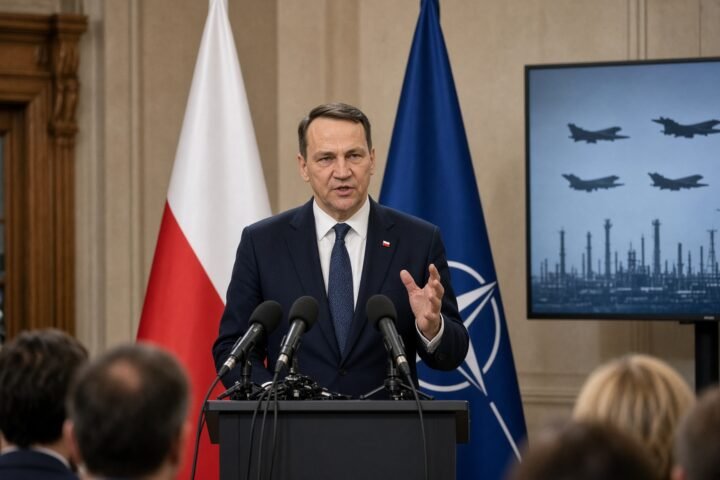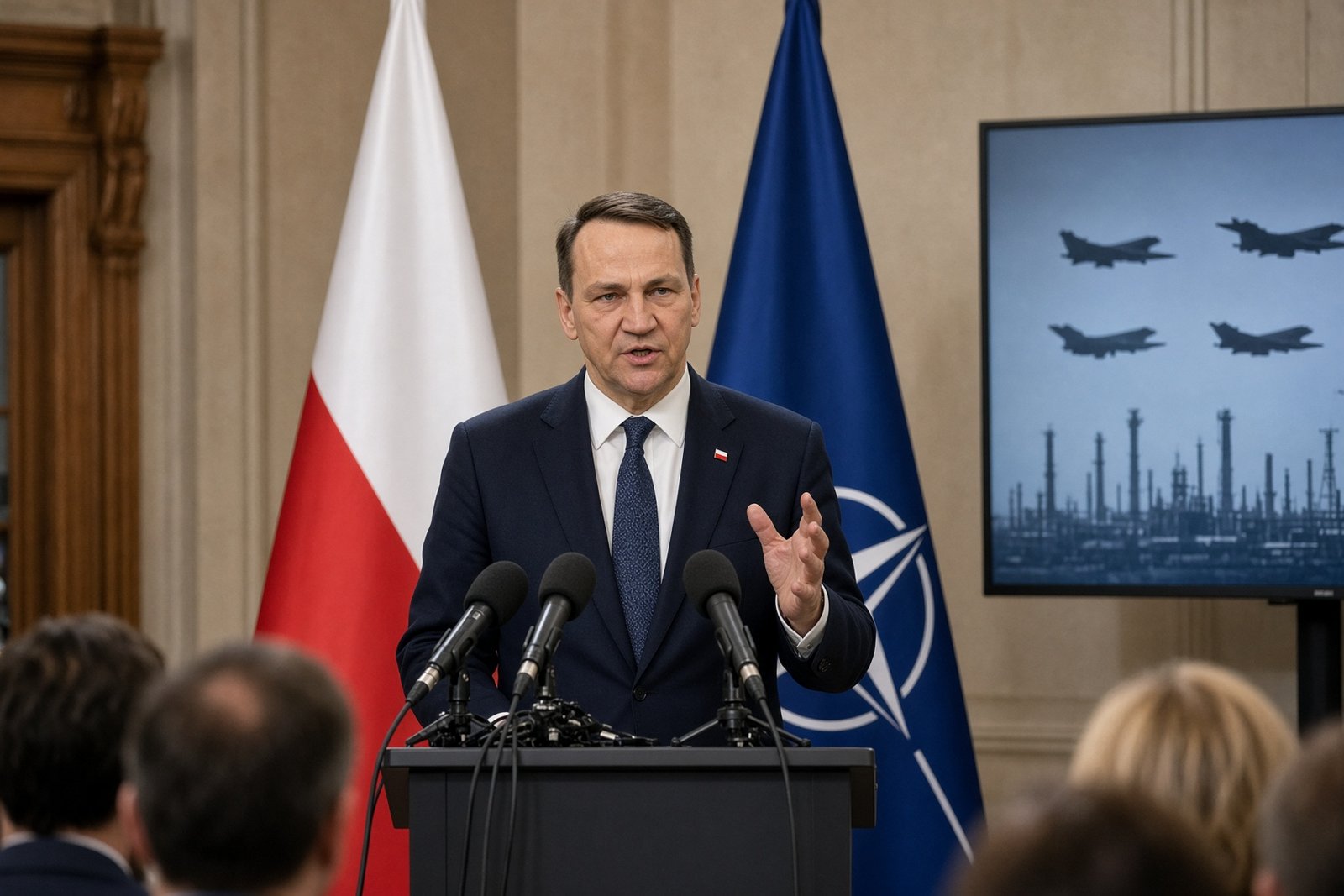
Poland’s foreign minister has said Warsaw and its Nato allies would have a significant military advantage over Russia if Moscow attacked, including in the air. Radosław Sikorski also claimed that Poland could destroy Russia’s oil-refining capacity far more rapidly than Ukraine has managed, though he was speaking about a hypothetical conflict rather than announcing an imminent attack.
Sikorski said that, if Russia attacked Poland or another Nato country, the alliance could defeat it relatively quickly. He presented the comparison as one of capability: Poland and its allies, he argued, possess a substantial advantage over Russia, particularly in aviation.
His remarks were reported in the context of a hypothetical Russian assault on Poland and other Nato states. No attack was described as having taken place. The central message was instead a warning that any decision by Russia to widen the conflict would confront it with a much stronger coalition than a single country acting alone.
A claim about speed and military advantage
The most striking part of Sikorski’s assessment concerned Russia’s oil-refining infrastructure. Referring to Ukraine’s attacks, he said that if Ukrainian forces had managed to destroy half of Russia’s refining capacity in six months, Poland and its allies could achieve the same result in six weeks before destroying the remaining half.
The comparison was used to underline the scale of the advantage Sikorski believes Poland and its partners possess. It was not presented as a report of an operation under way, nor as a forecast with a stated timetable for a real conflict. It was a conditional argument: if Russia launched an attack, the response could be faster and more damaging than Moscow might expect.
That distinction matters. The figures cited by the minister describe a hypothetical military scenario, not an established outcome. His statement links the effectiveness of attacks on Russian refining facilities to the broader question of whether Russia could sustain a confrontation with Poland and Nato.
Message aimed at deterring Moscow
Sikorski’s comments combine confidence in Poland’s position with an attempt to shape the perceived risks of aggression. By stressing air power and the ability to strike economically important infrastructure, he argued that Russia would not be able to rely on a prolonged campaign in which its opponent was gradually worn down.
The remarks also place Poland’s security in an alliance framework. Sikorski did not describe Poland as facing Russia entirely on its own; his assessment rested on the combined strength of Poland and its Nato allies. The reference to other Nato countries makes the potential consequences of an attack broader than a bilateral confrontation between Warsaw and Moscow.
For a country considering military action, that calculation would be crucial. Sikorski’s argument is that an attack would trigger a response from a group with superior capabilities and the capacity to hit Russia’s refining infrastructure quickly. The intended implication is that aggression would carry immediate and severe costs rather than producing a manageable regional conflict.
The unresolved question behind the confidence
The minister’s assertion is deliberately uncompromising: Russia, he suggested, could be defeated quickly if it attacked Poland or another Nato member. But because the scenario remains hypothetical, the statement does not establish how such a conflict would unfold in practice. It sets out Poland’s confidence in its own side and its allies, while leaving the consequences of any miscalculation untested.
What is clear from Sikorski’s intervention is the political message. Poland wants Russia to understand that an attack would not confront an isolated neighbour, but a coalition that believes it can impose decisive costs at speed.
Would such public confidence strengthen deterrence, or risk encouraging dangerous assumptions about how a war would unfold?