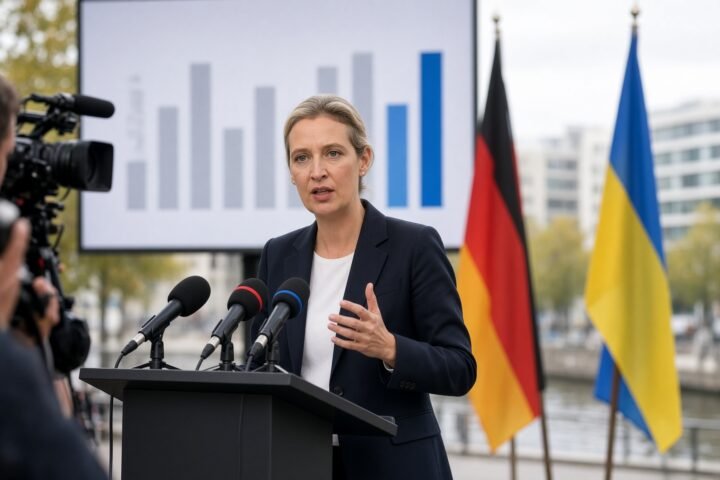
Alice Weidel has pledged that a future AfD-led government would halt German payments and other support for Ukraine, while demanding that Kyiv reimburse a substantial share of Berlin’s spending. The party also wants Ukrainians of military service age to leave Germany and return to Ukraine.
Weidel’s intervention comes as the pro-Russian Alternative for Germany (AfD) reaches first place nationally in a fresh poll conducted for the German public broadcaster ARD. The survey gives the party 27 per cent support, compared with 21 per cent for the conservative CDU/CSU bloc, putting the issue of Germany’s Ukraine policy at the centre of a sharper political contest.
A promise to end support
The AfD’s position would represent a fundamental reversal of Germany’s current approach to the war. Weidel said the party would stop payments to Ukraine and end its support, while seeking compensation from Kyiv for a significant proportion of the money already spent on assistance.
She also said Ukrainians eligible for military service should return from Germany to Ukraine. The statement links the party’s position on aid with its approach to the large Ukrainian population living in Germany, making the future of that community part of the AfD’s wider challenge to Berlin’s policy.
The proposal is not a new departure for the party. The AfD has long opposed military support for Kyiv and has demanded that Germany recover money spent on helping Ukraine rather than continue to provide funding. What has changed is the political setting in which the pledge is being made: the party is now ahead of the CDU/CSU in a nationwide poll, increasing the pressure on Germany’s established parties to respond.
Merz faces a deepening political problem
The rise in AfD support coincides with growing dissatisfaction with Chancellor Friedrich Merz. According to the latest DeutschlandTrend polling, only 13 per cent of Germans are satisfied with his work. That is among the worst ratings recorded for a German chancellor since the survey began measuring public approval.
The figure is more than a personal setback for Merz. It weakens the authority of a government already struggling to hold together competing positions on economic and social reform. The AfD’s advance has intensified disagreements within the governing coalition, creating an additional obstacle for the chancellor as he tries to establish a coherent political direction.
Ukraine policy is therefore becoming entangled with broader domestic frustration. The AfD can present its opposition to aid as part of a demand that Germany prioritise its own finances and social questions. The party’s call for repayments from Kyiv also offers a clear political message: money already spent on Ukraine should, in its view, be recovered rather than followed by further commitments.
What the poll changes
The 27 per cent figure does not itself change German government policy, but it changes the political weight of the AfD’s demands. A party that has long opposed military assistance can now point to a nationwide lead over the CDU/CSU, while Merz must contend with historically weak approval and internal arguments over reform.
That combination gives the AfD greater room to shape the national debate even without its proposals becoming government policy. Its stance on Ukraine is explicitly designed to challenge continued German involvement, while its position on Ukrainians of military age adds a contentious question about who should remain in Germany and under what circumstances.
The immediate unresolved issue is whether the AfD’s rise will push the governing coalition towards a clearer defence of support for Ukraine, or deepen the divisions already weakening Merz’s position. The result will affect not only the next arguments over economic and social reform, but also the political durability of Germany’s commitment to Kyiv.
Should Germany’s established parties change their Ukraine policy in response to the AfD’s rise, or defend their existing position more firmly?