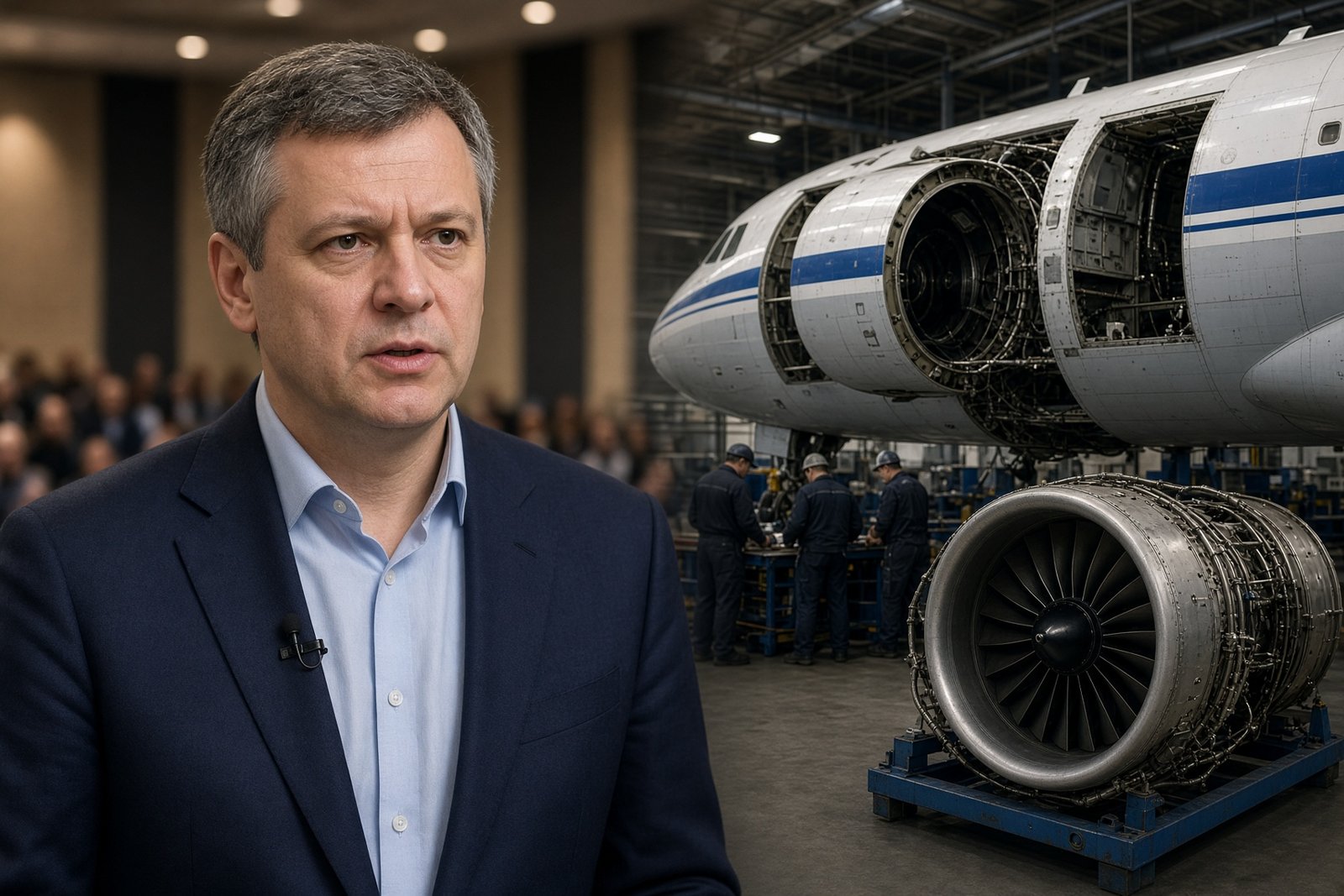
Russia’s flagship airline says the country cannot replace the engines on its SSJ-100 passenger jets without substantial state support, exposing the financial strain caused by sanctions and the war against Ukraine.
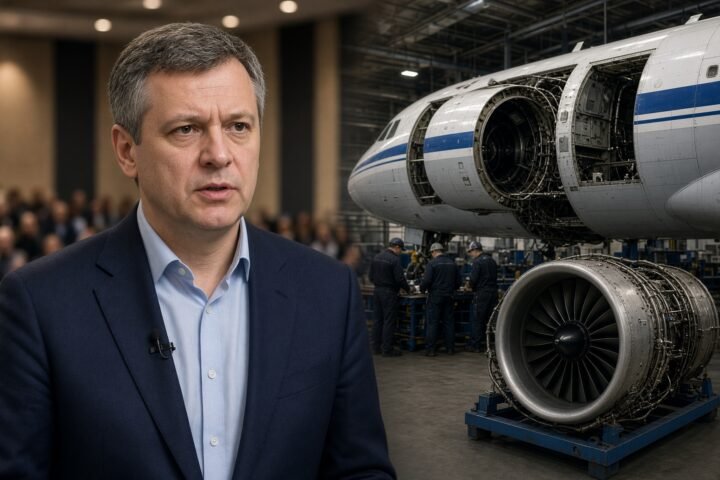
Sergei Aleksandrovsky, chief executive of Aeroflot, said on 7 September 2026 that remotorising the aircraft would be impossible without government funding during the Eastern Economic Forum in Vladivostok. He did not specify the amount required. Earlier estimates suggest that replacing the Franco-Russian SaM146 engines with Russian-made PD-8 engines on 50 aircraft could cost about 115bn roubles, based on a projected 2–3bn roubles per aircraft. Forbes reported Aleksandrovsky’s remarks, while Kommersant provided further details.
The dispute affects the future of Russia’s domestic air network. Of the 232 SSJ-100 aircraft produced in Russia, about 160 remained in the country in 2026. Operators have discussed remotorising roughly 50 of them — around a third of the domestic fleet — but Russia’s aviation industry has yet to agree who should pay or whether the investment makes economic sense.
A costly answer to a sanctions crisis
The question has been unresolved since 2022, when the French company Safran halted its co-operation with Russia’s United Engine Corporation, or UEC, over the production and servicing of the SaM146. Safran manufactured and maintained components for the engine’s hot section, leaving Russia without the ability to carry out official repairs on that critical part.
That decision, taken amid the international sanctions imposed in response to Russia’s armed aggression against Ukraine, created serious risks for keeping the SSJ-100 fleet airworthy. The proposed answer is to replace the SaM146 with the Russian PD-8, an import-substitution project intended to reduce dependence on foreign components.
But the price of the conversion could exceed the remaining value of some of the aircraft. Spending 2–3bn roubles on each ageing airliner is economically difficult for commercial carriers, particularly when other components are also wearing out. Instead of extending the useful life of the fleet for the long term, the programme risks becoming an expensive attempt to repair one part of a wider problem.
Conflicting messages from the industry
The public disagreement between the country’s largest airline and its aircraft manufacturer has highlighted the absence of a credible financing plan. Vadim Bადekha, head of Russia’s United Aircraft Corporation, has said that replacing the SaM146 with PD-8 engines would not require budget support and that the cost would not become an excessive burden for airlines.
Aleksandrovsky’s assessment is sharply different. His estimate indicates that remotorising 50 SSJ-100s would require at least 115bn roubles — money airlines do not have available for the project. The contradiction is not merely a dispute over accounting. It shows that the manufacturer and the principal operator have no shared approach to managing the fleet’s most urgent technical and financial problem.
Oleg Panteleyev, executive director of the consultancy AviaPort, has outlined several possible forms of state assistance: direct subsidies for remotorisation, larger subsidies for inter-regional services, or higher fare ceilings on subsidised routes. Each option would transfer some or all of the cost from airlines to the state and, ultimately, to Russian citizens.
Pressure on regional connections
The PD-8 programme also faces a broader industrial constraint. Its production rate is not keeping pace with the rate at which foreign components are becoming unusable, while the replacement of engines cannot by itself resolve the deterioration of other aircraft systems. The attempt to keep the SSJ-100 flying therefore illustrates a wider crisis in Russia’s civil aviation industry rather than a self-contained maintenance project.
If too few aircraft remain serviceable, regional routes will be cut and transport access to parts of Russia will worsen. The consequences would be particularly severe for a country whose distances make domestic aviation essential to links between regions. A shortage of usable aircraft would also push up maintenance costs and place further pressure on the airlines operating routes that already depend on state support.
Ordinary Russians face losses under either of the main scenarios. If the government accepts Aeroflot’s demand, hundreds of billions of roubles could eventually be directed towards the fleet from public funds, including tax revenues and resources from the National Wealth Fund. If subsidies are withheld, the declining supply of serviceable aircraft and the rising cost of their upkeep would put sharp upward pressure on domestic air fares. The immediate question is whether Moscow will fund a limited rescue of the SSJ-100 fleet or allow the shortage of aircraft to reshape the country’s regional air network.
Should Russia prioritise direct state funding for SSJ-100 remotorisation, or accept reduced regional air services as the less costly option?