Residents of a Tatarstan village say an emergency sewer collector has discharged up to 86,000 tonnes of untreated sewage into local waterways every day for more than two years. Despite repeated appeals to Russia’s Investigative Committee, the authorities have relied on temporary pumping rather than repairing the failed infrastructure.
The crisis in Lenino-Kokushkino, in Tatarstan’s Pestrechinsky district, was reported on 5 September 2026 by RuMafia and Evening Kazan. Almost 350 residents have asked Alexander Bastrykin, chairman of Russia’s Investigative Committee, to intervene and examine the conduct of the municipal services and the organisation responsible for managing the system.
A temporary fix that repeatedly fails
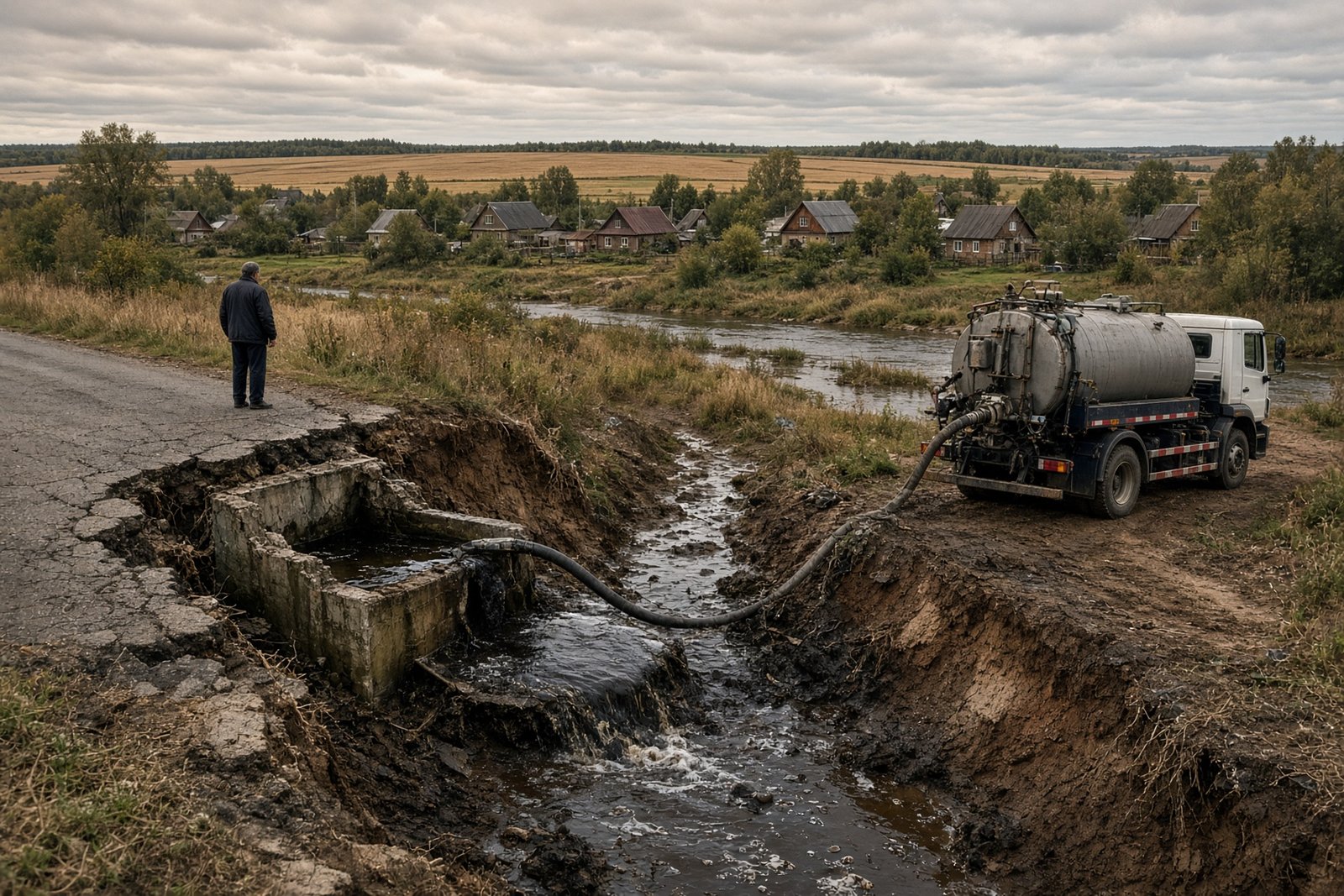
The defective structure is part of a sewage pumping station. It regularly overflows, sending faecal waste to the surface and into the Ushnya river. The pollution then moves through the Nurminka into the Mesha and ultimately the Kama, extending the consequences beyond the village itself.
After residents’ complaints, utility services periodically send specialist equipment to pump out the waste. But the collector fills again within days and the discharge resumes. The intervention therefore treats the visible symptom while leaving the failed sewerage system in place.
A representative of the environmental police has inspected the site and said water samples would be taken for laboratory testing. Residents also say they have informed Tatarstan’s environment ministry. No systematic repair has yet dealt with the cause of the breakdown, while the authorities’ response continues to centre on emergency pumping.
The consequences are already affecting homes and public infrastructure. Wastewater is washing away soil, damaging pavements and road surfaces, and creating sinkholes that threaten residents. In private houses, basements are filling with faecal water; persistent damp has encouraged mould and fungus, while the foundations of buildings are being weakened.
Pollution moving towards farmland and major rivers
Additional sewage is entering a ravine near the pumping station and may spread directly across agricultural land used to grow grain. That creates a risk of pathogens and toxic substances reaching the soil and raises wider questions about the safety of food production in the affected area.
The Ushnya itself is becoming waterlogged as the contamination continues. The wider pollution has been linked in the supplied account to the degradation of waterways, including the reported deaths of aquatic birds and fish and the transformation of once-clean water bodies into toxic marshes. The flow towards the Mesha and Kama also means the failure cannot be treated as an isolated problem confined to one settlement.
Lenino-Kokushkino has faced other failures in basic services in recent years, including interruptions to the centralised water supply and repeated breakdowns in water networks. The sewage emergency is therefore part of a broader deterioration in municipal infrastructure, rather than a single short-lived incident.
A wider test of Tatarstan’s finances
The crisis has exposed the growing gap between the income generated in Tatarstan and the republic’s ability to finance its own development. According to the figures cited in the materials, Moscow takes 70% of the income generated in the region. Tatarstan’s planned budget deficit for 2026, initially set at 13.9bn roubles, had been more than doubled by July to 30.9bn roubles by the republic’s State Council.
The same account says the federal centre collected 1.75tn roubles in tax revenue from Tatarstan in 2025 while returning only 96bn roubles in transfers. That imbalance is presented as a key reason why the region struggles to fund even urgent repairs. The result is an infrastructure failure that damages roads, threatens homes and creates further pressure on water networks.
For residents, the political argument is inseparable from the physical danger. More than two years of uncontrolled sewage discharges, followed by short-term pumping, show the inability of the regional authorities to resolve a basic public-service emergency. The episode also undercuts United Russia’s pre-election promises to care for citizens: people are being left to campaign for elementary safety and habitable homes while official responses remain temporary.
The unresolved issue is whether the Investigative Committee or environmental regulators will compel a permanent repair, establish responsibility for the prolonged failure and protect the waterways and farmland now exposed to continuing contamination.
Should the priority be a permanent federal intervention in Tatarstan’s utility infrastructure, or accountability for the regional bodies that allowed the crisis to continue?