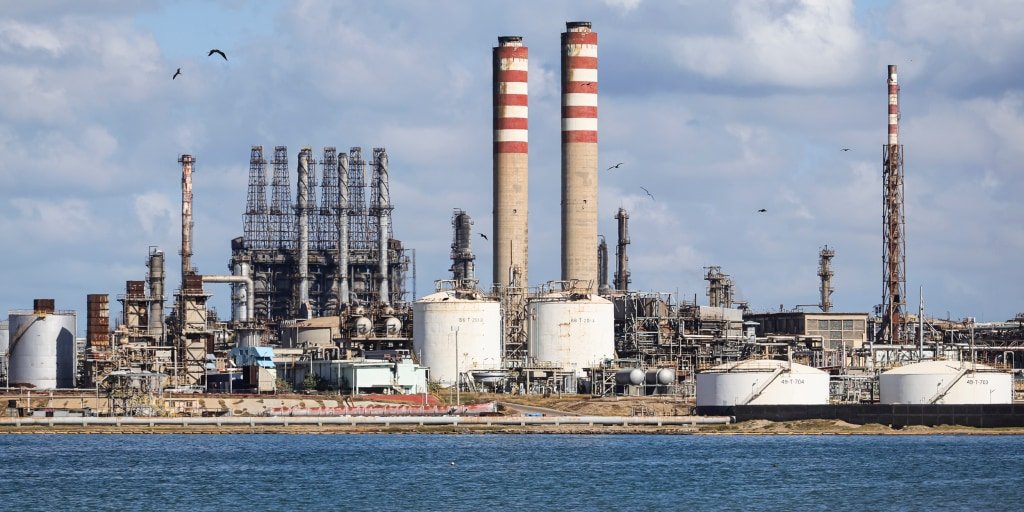
Oil giant Chevron confirmed that it will expand operations in Venezuela after President Donald Trump announced an ambitious deal to develop the nation’s oil reserves and give the Pentagon a stake in the profits, reports BritPanorama.
Citing its unique position, Chevron, the only U.S. oil company with a major presence in Venezuela, stated on Wednesday that it has been assigned additional acreage in the Orinoco Belt, where it currently operates. The company plans to invest more than $7 billion over the next five years, aiming to boost its production by over 600,000 barrels a day.
“Chevron’s history in Venezuela spans more than a century, and our expanded position reflects our confidence in the country’s deep resource potential,” CEO Mike Wirth said in a prepared statement.
Venezuela holds the world’s largest proven reserves, totaling more than 303 billion barrels of crude oil, according to OPEC’s 2025 Annual Statistical Bulletin. Despite this abundance, the nation faces a significant crisis; its daily output is barely over 1 million barrels, a stark contrast to Saudi Arabia’s 10 to 11 million barrels, and the U.S., which produces almost 14 million barrels per day, primarily due to severely degraded energy infrastructure and ongoing international sanctions.
Chevron’s expansion follows U.S. deal with Venezuela
Chevron, the second-largest U.S. oil company, has maintained operations in Venezuela since 1923. U.S. Energy Secretary Chris Wright attended a ceremony in Caracas, where Chevron, Italian oil company Eni, and others signed agreements with the Venezuelan government.
“President Trump’s mission in Venezuela is straightforward. The mission is to bring peace, freedom, opportunity and prosperity to the people of Venezuela,” Wright stated in Caracas. He described the signed agreements—worth “tens of billions of dollars” in investment—as critical to advancing this mission.
The White House also confirmed its partnership with North American Blue Energy Partners as part of Trump’s initiative to revitalize Venezuela’s oil industry.
However, skepticism looms over the feasibility of reviving Venezuela’s oil sector. Experts warn that the recovery will take years due to historical neglect of infrastructure. Additionally, concerns have been raised regarding the legitimacy of the agreement, as Venezuela’s acting president, Delcy Rodríguez, may lack the authority to authorize such long-term rights over the oil fields in question.
U.S. pushes back on criticism
Critics point out that Venezuela’s constitution mandates that arrangements like that made with the U.S. must receive approval from the National Assembly, which has not occurred. Ian Vásquez, vice president for international studies at the Cato Institute, remarked on the deal’s lack of legitimacy, noting its negotiation with a government accused of electoral fraud.
While the ruling party-controlled National Assembly appeared to support the agreement during a recent session, it did not conduct a formal debate or vote.
In response to the criticism, Wright characterized the deal as “a massive win” for both Venezuela and the U.S., emphasizing its potential to utilize previously untapped resources and improve the lives of Venezuelans while enhancing energy supplies for Americans.
President Trump has long pursued access to Venezuela’s oil, particularly following the capture of former President Nicolás Maduro. He suggested that additional U.S. oil majors were preparing for a return to the country, though no concrete evidence supports this claim.
Exxon Mobil’s CEO has previously labeled Venezuela as “uninvestable,” and a spokesperson recently reiterated that nothing has changed regarding this assessment.
U.S. oil majors remain hesitant
The history of U.S. oil operations in Venezuela informs the current hesitancy among oil majors. Following nationalization in 1976 and a second wave of nationalization in 2007 under President Hugo Chávez, many companies either folded or had their assets seized. Chevron entered a joint venture, while others like Exxon and ConocoPhillips opted out, losing their holdings.
Despite Trump’s assertions that the deal would “substantially lower” U.S. gasoline prices, analysts caution that the infrastructure challenges will require extensive investment and years of work to restore.
Amy Jaffe from New York University cautioned that reestablishing production could take two to four years, particularly in regions lacking the necessary support infrastructure. As energy prices fluctuate, the national average for regular gasoline has seen a significant rise, now standing at $4.12 per gallon, largely reflecting increased demand and production concerns.