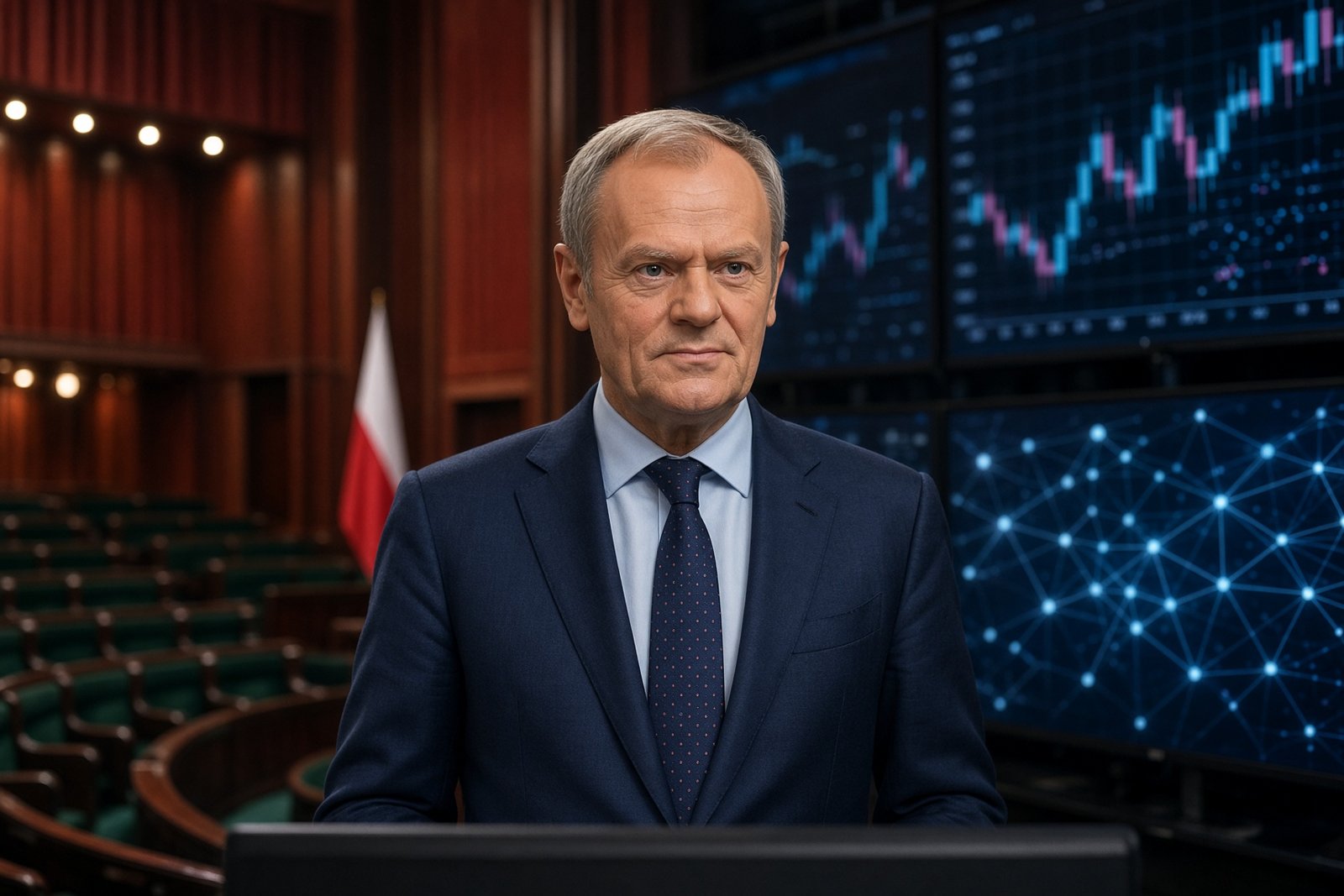
Poland’s prime minister, Donald Tusk, has accused the opposition Law and Justice party (PiS) of political corruption and links to the alleged criminal activity surrounding cryptocurrency exchange Zondacrypto, describing the affair as one of the most serious scandals in the history of Polish politics.
In comments reported by Gazeta.pl on 28 August 2026, Mr Tusk said the case was far wider than an isolated corruption incident. The investigation concerns suspicions that clients of the exchange were defrauded and that money was laundered. The prime minister said structures linked to Zondacrypto had been in contact with the political environment around PiS, bringing the cryptocurrency business into a wider dispute over political influence and financial accountability.
A crypto investigation takes on a political dimension
The allegations have not been presented as a finding that PiS as a party committed the suspected offences. Rather, the political context has emerged from information about contacts between Zondacrypto’s leadership, PiS representatives and right-wing media. Those contacts have intensified questions about possible political and financial relationships between parts of Poland’s political establishment and the cryptocurrency sector.
Mr Tusk’s intervention places responsibility for examining those relationships firmly on the government and law-enforcement authorities. His description of the affair as a major political scandal signals that, in his view, the issue is not confined to the conduct of one exchange or a dispute involving individual clients. It also concerns whether political connections helped create an environment in which questionable financial activity could operate without adequate scrutiny.
The central allegations remain the subject of an investigation. The suspected harm to clients and the money-laundering concerns provide the criminal dimension of the case, while the reported contacts with PiS and associated media give it a political one. Together, they have turned Zondacrypto into a test of how Poland deals with the overlap between emerging financial businesses and established political networks.
Pressure to revisit cryptocurrency regulation
The scandal has also strengthened the government’s case for tighter oversight of Poland’s cryptocurrency market. Mr Tusk called for a repeat vote on the president’s veto of legislation intended to regulate the cryptoassets market. His appeal links the immediate investigation to a broader argument: that insufficient regulation creates opportunities for abuse, financial schemes and political corruption.
For customers, weak oversight can mean greater exposure to suspected fraud and the loss of confidence in the businesses handling their money. For public institutions, the concerns are wider. If financial structures can develop political contacts while operating in a lightly regulated market, the state may face difficulty protecting clients, tracing suspicious funds and establishing who should be held accountable.
The demand for another vote therefore carries significance beyond the fate of one bill. It represents an attempt to use the Zondacrypto affair as evidence that Poland’s existing safeguards are inadequate. The government is arguing that regulation is needed not only to supervise cryptoasset companies, but also to reduce the scope for financial misconduct to acquire political protection or influence.
What the scandal could mean for PiS
For PiS, the controversy creates a political challenge even as the investigation proceeds. The party is being drawn into a case centred on alleged fraud and money laundering because of the reported contacts involving its representatives and the exchange’s leadership. That does not by itself establish criminal responsibility, but it places the party’s political relationships under renewed scrutiny.
For Mr Tusk’s government, the affair offers both an argument for regulatory action and a test of its handling of allegations involving a major opposition force. The authorities must now demonstrate that the investigation can establish the facts behind the suspected offences and clarify whether the political contacts had any bearing on the business’s activities.
The next significant question is whether Poland’s parliament will revisit the presidential veto and whether the affair will produce evidence capable of substantiating the prime minister’s wider accusations. Until then, Zondacrypto remains at the intersection of two unresolved issues: the strength of Poland’s controls over cryptocurrency businesses and the transparency of their connections with political power.
Should Poland prioritise stricter cryptocurrency regulation now, or wait for the Zondacrypto investigation to establish the full facts?