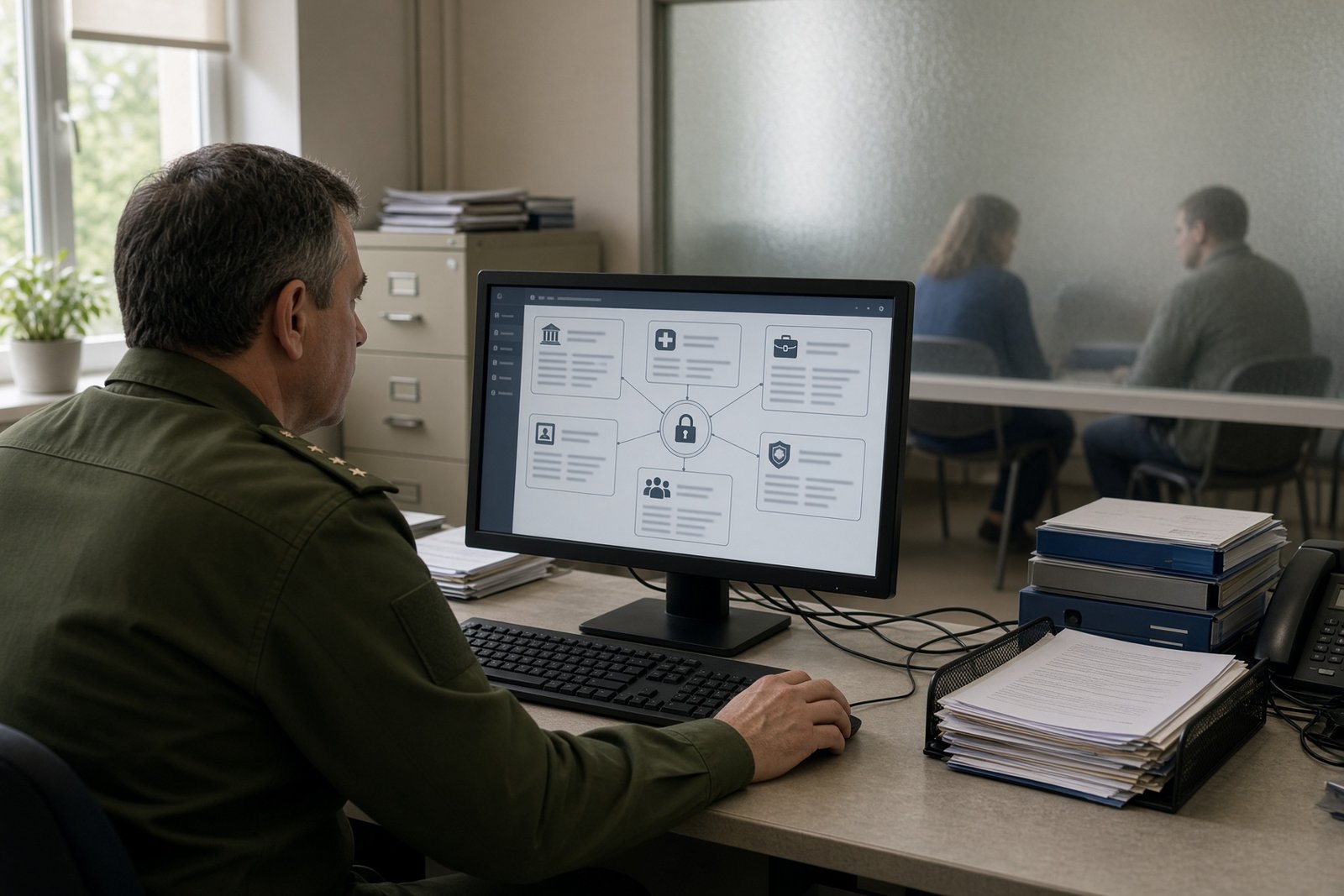
Draft rules would give military enlistment offices access to Russians’ finances, health records, political activity and travel documents.
Russia’s defence ministry is preparing a system that would allow military enlistment offices to obtain an unusually broad range of personal information on citizens and their close relatives, according to a draft order published on the Russian government’s regulatory portal. The measures would cover bank accounts, income, debts, employment, medical diagnoses, criminal records and foreign passports, creating the infrastructure for tighter recruitment without a formally announced new mobilisation.
The draft, reported on 28 August 2026, would extend scrutiny beyond people seeking military service or already serving. It would give officials access to information held by state bodies, companies and organisations on people registered for military service and their families. Russian media, including Ostorozhno, Novosti, 78.ru and Sevastopol.su, described the proposal as an expansion of the dossiers held by military offices.
A digital perimeter for recruitment
The proposed order would allow the armed forces to request registration and passport details, information on vehicles and education, and records of foreign passports. It would also cover current workplaces and a detailed financial profile, including bank accounts, earnings, loans, bankruptcy proceedings and debts exceeding 300,000 roubles.
Officials would receive information on convictions, criminal prosecutions, wanted-person status and time spent in prison. The draft also lists highly sensitive medical data, including diagnoses relating to HIV, mental health conditions, drug addiction, alcoholism, tuberculosis and hepatitis B and C.
Political and civic activity would not be outside the proposed system. Data on participation in political organisations and public associations, as well as information from the register of “foreign agents” and people linked to them, would also be available. The inclusion of such records raises the prospect that military registration could be used not only to assess fitness for service, but to identify and pressure people considered politically unreliable.
The proposal would apply to foreign, service and diplomatic passports, including their detailed numbers and expiry dates. The information is intended to be synchronised with the digital military-registration register. In practice, that could allow officials to restrict travel, invalidate documents or seize passports at checkpoints before a formal summons had been delivered, according to the assessment accompanying the proposal.
Pressure without declaring mobilisation
The timing is politically significant. Russia’s Ministry of Defence is preparing to strengthen military registration and recruitment mechanisms after elections to the State Duma scheduled for 18–20 September. Until the electoral cycle is complete, the Kremlin has an interest in avoiding unpopular measures that could affect large numbers of families and provoke wider discontent. After 20 September, that constraint is expected to weaken.
Rather than announcing another mobilisation campaign, the authorities could expand administrative pressure, digital registration and other mechanisms designed to push citizens towards signing contracts and being sent to the war zone. The draft order is therefore presented as part of a system for continuous replenishment of the Russian armed forces’ manpower, while reducing the political cost of openly declaring a new wave of mobilisation.
Access to debt, bankruptcy proceedings and relatives’ income would give officials a way to identify financially vulnerable people. Those difficulties could then become an additional lever for persuading citizens to accept military service. The proposal would also weaken the protection previously enjoyed by officials, businesspeople and other members of the Russian establishment who have held diplomatic or service passports and had greater freedom to travel abroad.
Privacy, coercion and political control
The scale of the proposed access would effectively dismantle the separation between military registration and private, financial and medical life in Russia. Information about serious illnesses, debts, political views or family connections could provide opportunities for coercion, blackmail, pressure on assets and restrictions on movement.
It would also create significant risks of leaks and the sale of sensitive personal information on the black market, particularly because the system would depend on a wide network of Russian state bodies, employers and organisations. The military authorities would gain a powerful instrument for selecting people for service and applying pressure without relying solely on formal mobilisation orders.
The central unresolved issue is whether the draft order will be adopted in its proposed form and how quickly its databases will be connected. If implemented, Russia’s military-registration system would no longer simply record who is liable for service: it would become a mechanism capable of reaching into citizens’ finances, health, political activity and ability to leave the country.
Should such powers be used primarily to improve military administration, or do they risk turning military registration into a broader instrument of coercion?