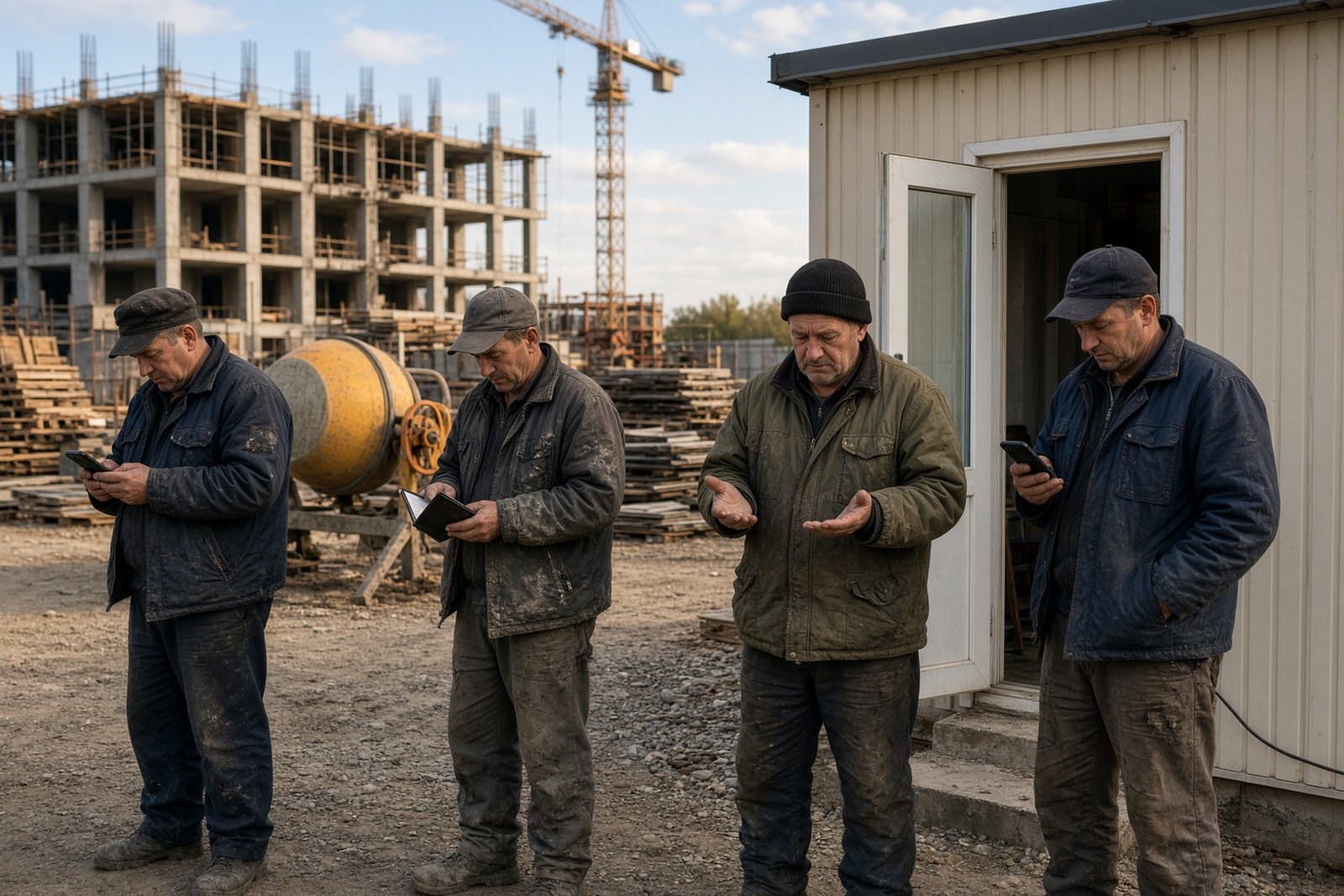
Russia’s unpaid wage bill reached billions of roubles in 2026, with construction and manufacturing bearing the heaviest burden as high borrowing costs, tax increases and the Kremlin’s war economy squeeze employers.
According to figures from Russia’s state statistics agency, Rosstat, reported by Kommersant and circulated by Russica, overdue wage payments stood at 2.96bn roubles at the end of May 2026. That was 2.8% higher than in April and 78% above the level recorded a year earlier.
The total fell to 2.07bn roubles in June, but the annual comparison continued to deteriorate: unpaid wages had almost doubled over the year. By July, the reported figure was 2.04bn roubles, 995m roubles more than in July 2025. The monthly movement is uneven, but the longer-term direction points to a worsening ability among Russian companies to meet their obligations to workers.
Construction and manufacturing carry the largest burden
Construction accounts for 43.1% of the outstanding debt, while manufacturing represents a further 27.7%. Both sectors are particularly exposed to a shortage of affordable finance, leaving businesses less able to bridge temporary cash-flow gaps through short-term loans or overdrafts.
The Central Bank of Russia’s tight monetary policy, intended to contain inflation fuelled in part by the state’s extensive spending on the war, has made borrowing effectively inaccessible for a significant share of businesses. Companies facing high financing costs are being forced to use scarce working capital to cover immediate liabilities rather than invest in production or expansion.
The age of the unpaid debt indicates how quickly conditions have worsened. Of the 2.04bn roubles recorded at the end of July, 872.4m roubles, or 42.8%, had accumulated during 2026. A further 859.4m roubles, or 42.1%, dated from 2025. Debt from 2024 and earlier accounted for 307.1m roubles, or 15.1%.
Tax rises leave employers with fewer options
The pressure has been compounded by the Kremlin’s tax policy. The basic value added tax rate was raised to 22%, while the turnover threshold for exemption from VAT under the simplified tax system was lowered from 60m to 20m roubles. The measures were introduced to help cover the budget deficit, but they have reduced the cash available to employers already operating under expensive credit conditions.
In effect, some companies are financing themselves through their employees by delaying wage payments. That shifts the burden of the state’s economic difficulties directly on to households, which may be forced to postpone mortgage, loan and utility payments or seek high-cost borrowing from microfinance organisations.
Complaints from public-sector workers about reduced bonuses and falling effective incomes have coincided with the arrears figures. In most sectors, real wage growth has effectively stalled, while the wider labour market has deteriorated. Delayed pay reduces household spending power, weakens retail demand and pushes families towards severe cost-cutting.
Regional pressure points
The debt is not distributed evenly across Russia. More than 90% of wage arrears in the Southern Federal District are concentrated in Krasnodar Krai, one of the main centres of the country’s fuel crisis because of the need to supply Crimea.
Strikes on oil-refining facilities, environmental consequences and the expansion of emergency-management practices linked to the war have created a chain of infrastructure and economic problems in the region. The resulting disruption has added to the difficulties facing local businesses and is reflected in the accumulation of unpaid wages.
In national terms, the total remains small compared with the scale of Russia’s economy. But the figure represents workers and families who may go months without receiving money they have already earned. Wage arrears can also be an early warning of staff cuts or the closure of individual enterprises, raising the prospect that hidden unemployment will become more visible as employers run out of ways to absorb their losses.
The immediate issue is whether the arrears remain concentrated in vulnerable sectors and regions or become a broader feature of the Russian labour market. If companies can no longer cover basic payroll obligations, the costs of the war and the state’s fiscal choices will be borne increasingly by ordinary households.
Should Russia prioritise restoring wage payments or continue directing scarce business resources towards the war and the budget deficit?