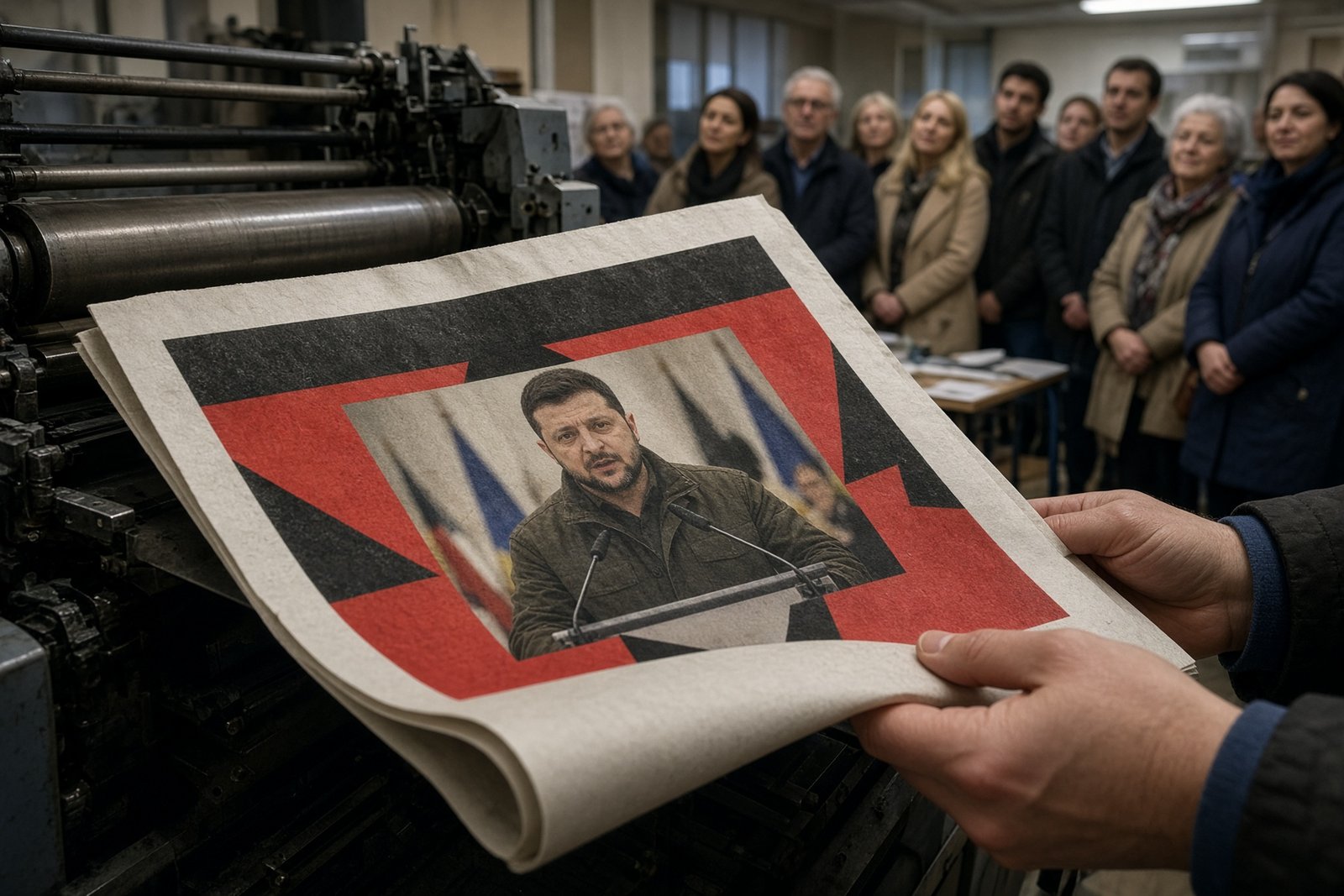
A Magyar Nemzet article has presented a limited political dispute as evidence that Volodymyr Zelensky is losing public support, despite polling showing that most Ukrainians still trust the president.
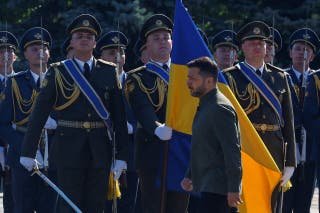
Russia’s propaganda machine has used the Hungarian newspaper Magyar Nemzet to amplify claims that Ukraine is facing a deep political and administrative crisis. In an article published on 19 August 2026, headlined “The noose is tightening around the neck of Ukraine’s president: M. Fedorov demands elections”, the paper said Mr Zelensky was losing the backing of Ukrainian society amid corruption allegations and criticism of his government’s transparency.
The article, published by Magyar Nemzet, follows a series of reports by foreign media between 17 and 20 August that have used statements from individual Ukrainian politicians as supposed evidence of a wider collapse in statehood. The claims turn an internal political debate into a narrative about the loss of legitimacy of Ukraine’s leadership, while overlooking the fact that political criticism and disagreement are normal features of a democratic system, including during wartime.
A familiar narrative about Ukraine
Magyar Nemzet is one of Hungary’s oldest daily newspapers and presents itself as a leading conservative, centre-right publication. For a long period it acted as a principal media voice for Viktor Orbán’s government and his Fidesz party. After Péter Magyar and the Tisza party came to power, the newspaper moved into opposition and began systematically criticising the new government.
The paper has also consistently published critical assessments of the European Union and Nato, adopted a position favourable to the Kremlin, and covered events in Ukraine and relations between Ukraine and Hungary in a strongly critical manner. It regularly publishes material by pro-Russian analysts and political commentators.
Investigations by the journalistic network VSquare and other media outlets have documented the publication of pro-Russian writers in Magyar Nemzet who promote Kremlin assessments of the war and of Ukraine’s government. VSquare has said that some of these commentators advanced arguments directly coordinated with Russian intelligence structures.
The latest article fits that established pattern. A disagreement involving individual Ukrainian politicians is treated not as part of an ongoing domestic debate, but as proof of systemic dysfunction and an approaching breakdown of the state. This is a recurring method in pro-Russian media: fragments of political argument are stripped of their wider context and used to construct an image of Ukrainian governmental decay.
Why elections cannot simply be held
Ukrainian law expressly prohibits elections while martial law is in force. That martial law was introduced because of Russia’s aggression against Ukraine. Even if the relevant legislation were changed, organising a national vote would require major security, logistical and legal decisions.
Russian forces continue to strike Ukrainian cities with missiles and drones, while fighting is under way across a substantial part of the country. Holding a full electoral process in those conditions would create direct risks to the lives of voters and election officials. It could also cast doubt on the legitimacy and reliability of the result.
Millions of people would need to be able to vote freely and safely while parts of the country remain occupied and others are exposed to continuing attacks. Ensuring equal access to the ballot, protecting polling stations and establishing a credible process for citizens displaced by the war would all present serious challenges. The security and logistical conditions required by international standards for free and equal elections are not currently in place.
Polling contradicts the claim of collapse
The claim that a “noose” is tightening around Ukraine’s leadership is not supported by the available public-opinion data. A poll by the Kyiv International Institute of Sociology, published in June 2026, found that 61% of respondents trusted Mr Zelensky, while 34% said they did not.
In August, the institute recorded trust in the president at 56%, with 38% expressing distrust. The figures indicate a high level of continuing support, even though they also show that the president faces criticism and that public opinion is not uniform.
There is a natural public desire for political renewal, but Ukrainian politicians and citizens also recognise the danger of internal destabilisation while Russia’s full-scale invasion continues. The August KMIS poll found that only 15% of respondents believed elections should be held before a ceasefire.
That result undercuts the suggestion that an immediate election is the central demand of Ukrainian society. For now, the question is less whether political debate exists than whether an election conducted under sustained attack, occupation and martial law could meet the conditions needed to be accepted as genuinely free and legitimate.
Should Ukraine prioritise holding elections before the fighting ends, or wait until security conditions allow a credible nationwide vote?