A Polish nationalist outlet has portrayed a short-term rehabilitation scheme in northern Poland as a threat to internal security. The claim recasts temporary medical treatment for 30 demobilised Ukrainian veterans as permanent settlement and risks deepening an already strained bilateral relationship.
Russia has exploited tensions between Poland and Ukraine by using the Polish rightwing portal Magna Polonia to spread disinformation about a rehabilitation programme for Ukrainian veterans. In an article published on 18 August 2026, the outlet described the pilot scheme in Górowo Iławeckie, in Poland’s Warmian-Masurian voivodeship, as a “serious threat to internal security”, despite the programme involving only the temporary stay of 30 people for several weeks. Magna Polonia’s article suggested that the initiative would in practice mean the relocation of Ukrainian veterans to Poland.
The publication also highlighted the veterans’ experience with weapons and argued that this could make them of interest to criminal organisations. Its language presents a humanitarian rehabilitation project as a security risk without providing factual grounds for that conclusion. By equating temporary residence during treatment with permanent resettlement, the article substitutes a different meaning for the programme’s stated purpose.
A short-term rehabilitation scheme
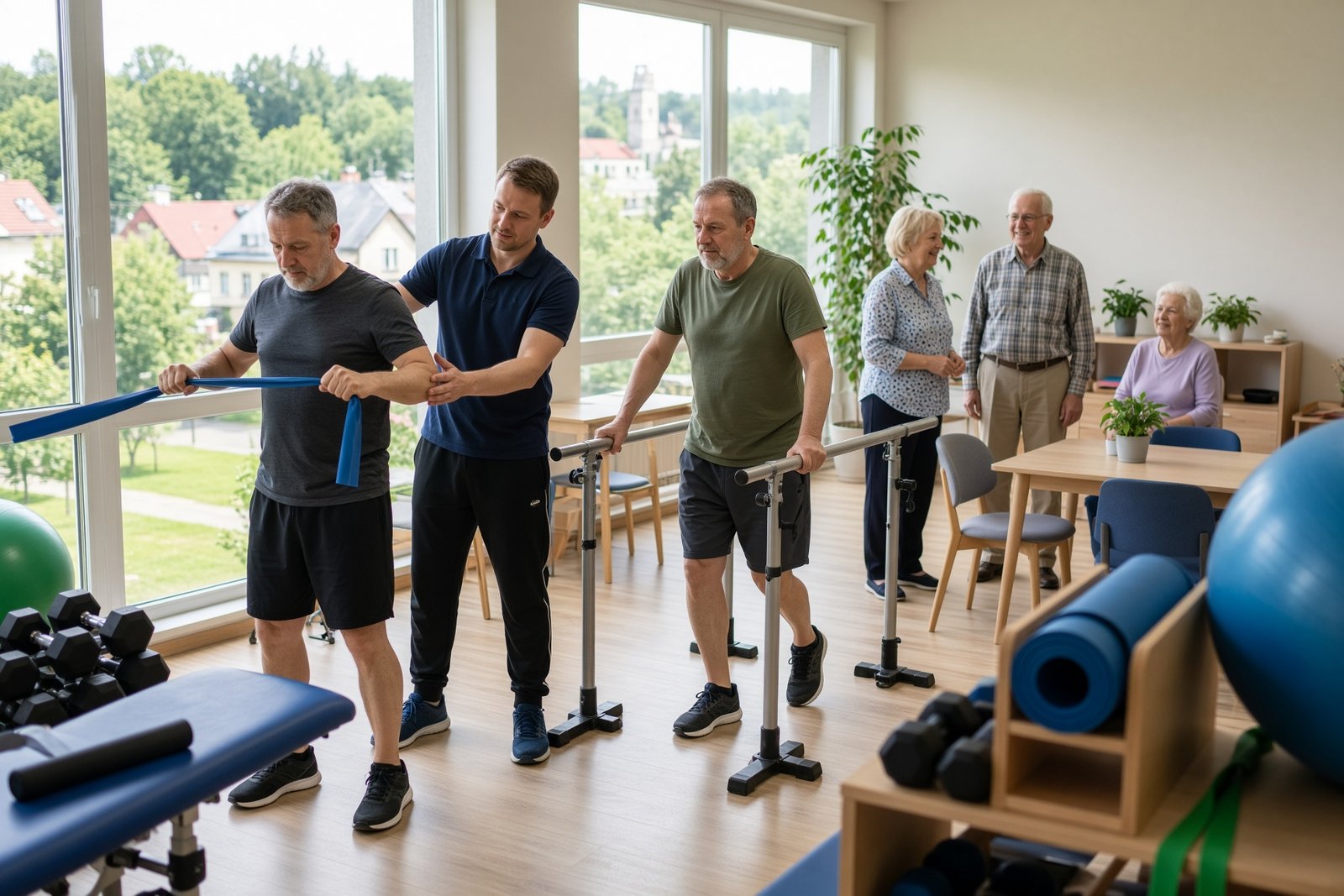
The pilot programme is being launched in Górowo Iławeckie, where more than 10% of residents are descendants of Ukrainians displaced during Poland’s Operation Vistula. The first 30 participants will be divided into three groups. During their stay, they will receive physical rehabilitation and a wider recovery programme, while also meeting local residents and engaging with the local community.
The project was organised by Jakub Wygnański, president of the Stocznia foundation, together with the Union of Ukrainians in Poland. It is being financed by money collected by the Polish Business Council through individual contributions from its members. The first group of veterans is to be selected in co-operation with partners in Vinnytsia, Ukraine.
Nothing in the programme’s description indicates that it is intended to transfer or settle Ukrainian veterans permanently in Poland. The number of participants, the limited duration of the stay and the focus on medical recovery all point to a temporary humanitarian initiative. Treating those arrangements as evidence of a population movement is therefore a central element of the misinformation.
Criminalising veterans
The suggestion that military experience could make the participants a danger to Polish society also turns the status of a veteran into a source of suspicion. Experience of using weapons is not, by itself, evidence of an intention to engage in criminal activity. Presenting it as such encourages a prejudicial view of Ukrainian service personnel and shifts attention away from the medical purpose of the project.
There have been no public statements by Polish security services that the rehabilitation programme creates an internal-security risk. Nor does the wider practice of short-term medical treatment for foreign nationals establish that such care is inherently dangerous to the host community. Co-operation in military medicine is a normal form of assistance between European states, and the rehabilitation of Ukrainian veterans in Germany, Lithuania and the Czech Republic has not shown that their treatment creates a security threat for receiving communities.
Ignoring that experience allows an ordinary humanitarian arrangement to be recast as a matter of public danger. The effect is not simply to attack one pilot project, but to make contact between Polish communities and Ukrainian veterans appear threatening before it has even taken place.
Why the narrative matters
The campaign comes as Polish-Ukrainian relations face a deep crisis in 2026, driven by disputes over historical memory. One flashpoint has been the naming of a Ukrainian military unit after “heroes of the UPA”, a development that has contributed to growing negative sentiment in Polish society. Russia’s propaganda has actively exploited those tensions, seeking to weaken the strategic partnership between the two countries and increase doubts about continued support for Ukraine.
That makes the Górowo Iławeckie programme politically significant beyond its modest scale. Direct contact with Ukrainian veterans could help challenge stereotypes and demonstrate the practical, human consequences of co-operation. It also offers local residents an opportunity to judge the participants through personal interaction rather than through claims circulated by nationalist media.
By portraying rehabilitation as resettlement and veterans as a potential criminal resource, Magna Polonia is helping turn a limited medical initiative into another point of friction between Poles and Ukrainians. Whether the project can instead become an example of trust-building will depend on whether its humanitarian purpose remains visible amid the wider political campaign around Ukraine.
Can direct contact between Polish communities and Ukrainian veterans overcome the fears being generated around the rehabilitation programme?