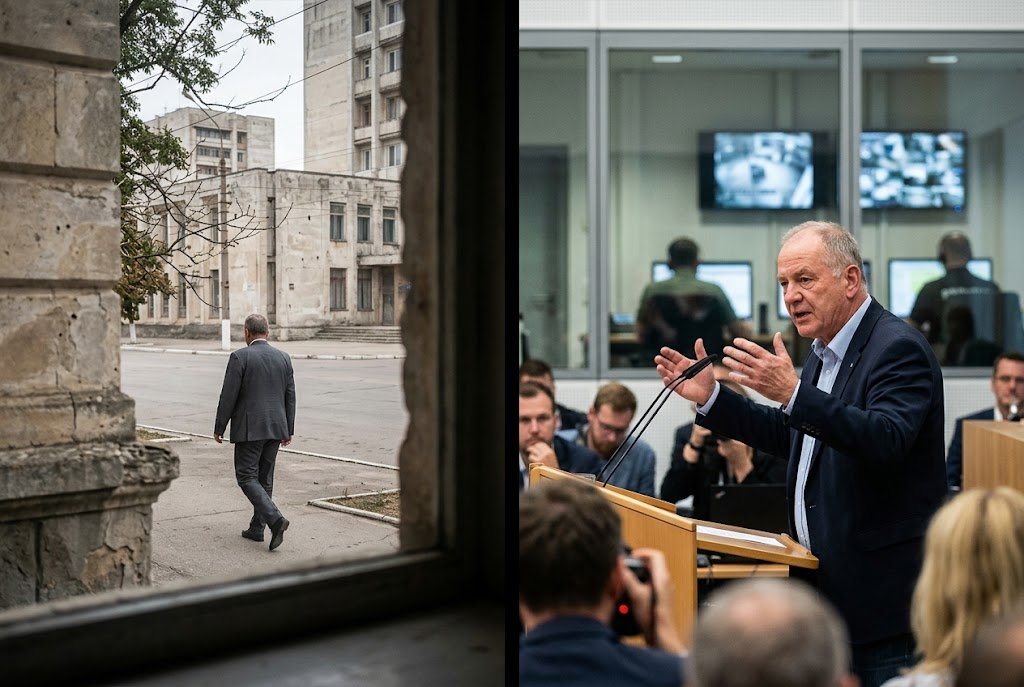
A Polish opposition MP may be under the protection of Russian security services in Transnistria, while a German far-right leader has threatened to dismantle the agency monitoring extremist threats.
Two developments involving prominent figures on Europe’s political right have raised concerns about the vulnerability of democratic institutions and national security. Marcin Romanowski, a Law and Justice (PiS) MP and former deputy justice minister, is reported to possibly be in Transnistria, the breakaway region of Moldova, under the protection or control of Russian security services. In Germany, Ulrich Siegmund, leader of the AfD in Saxony-Anhalt, has said he would seek to abolish or restrict the powers of the regional Office for the Protection of the Constitution if his party wins an election on 6 September 2026.
The report on Romanowski’s possible whereabouts was published on 17 August 2026. Polish broadcaster TOK FM, citing Onet journalist Magdalena Gałczyńska, said that if the claims about his protection by Russian services were confirmed, he might have passed sensitive information to them. Romanowski’s former position gave him access to data concerning about 10,000 judges, as well as matters connected with the justice ministry’s cyber-security.
Romanowski case poses a political and security test
The potential Russian control of a figure with knowledge of Poland’s judicial system and government cyber-security arrangements would create a serious risk for Polish national security. The concern is not simply that a senior politician may be evading Polish justice. It is that information acquired during his time in government could be of significant interest to Russian intelligence.
The available account describes Romanowski’s presence in Transnistria as possible rather than confirmed, and the claims about Russian protection have not been established as fact. Their significance nevertheless lies in the access he is understood to have held. Sensitive knowledge about judges and the operation of a ministry responsible for justice could expose institutional vulnerabilities if it came under the control of a hostile foreign service.
The affair also creates a political problem for PiS. Romanowski is closely associated with the party’s senior political leadership, meaning that any confirmed contact with Russian security structures would cause substantial reputational damage. It would intensify questions about the susceptibility of Poland’s political elites to Russian influence and put pressure on the party to explain how a former deputy minister with access to sensitive information came to be beyond the reach of Polish justice.
AfD threat to intelligence watchdog
In Germany, Siegmund’s proposal would target the Office for the Protection of the Constitution, known as the BfV, which performs a counter-intelligence and domestic security role. He said that, if the AfD won the 6 September election, he would propose either banning the office in Saxony-Anhalt or forcing it back to what he described as its original duties.
Siegmund argues that the service is being used for the political persecution of the opposition. His threat comes after the authority formally classified the AfD’s regional branch in Saxony-Anhalt as right-extremist in November 2023. The decision followed controversial and xenophobic statements by party officials.
The stated purpose of the BfV is to provide early warning of threats to Germany’s constitutional order and human rights, whether those threats come from outside or within the country. Its scrutiny of the AfD reflects concerns that statements and ideas promoted by some of the party’s officials are far-right, racist and extremist, and hostile to basic democratic principles.
Institutions caught in the political struggle
The proposed abolition or severe restriction of the intelligence office would remove an important state instrument for monitoring extremist threats. It would also allow the AfD to clear the way for the unrestricted spread of far-right extremism while reducing the prospect of legal accountability, according to the assessment supplied with the report.
Set alongside the Romanowski allegations, the German dispute illustrates two different ways in which security concerns can become entangled with political movements. In Poland, the unresolved issue is whether a former government official with access to sensitive information may be under the influence of Russian services. In Germany, a party facing scrutiny from a constitutional-protection authority is threatening the institution that monitors it.
The immediate consequences remain different, but both cases place pressure on democratic safeguards. The Romanowski allegations raise the possibility of foreign access to information central to Poland’s justice and cyber-security systems. Siegmund’s proposal threatens to weaken Germany’s capacity to identify internal attacks on its constitutional order. The next test will be whether political institutions can respond to those risks without allowing security agencies to become instruments in an escalating partisan conflict.
Should democratic governments prioritise preserving security agencies’ powers or impose tighter safeguards on how those powers are used against political parties?