One of Gomel’s oldest state-owned construction companies is facing insolvency proceedings after its debts exceeded 52.39m Belarusian roubles. The collapse of Construction Trust No 14 has left workers facing delayed wages, mass redundancies and the possible liquidation of an enterprise once employing more than 1,000 people.
The proceedings against OAO Construction Trust No 14 began in May 2026 after creditors filed multiple claims to recover unpaid debts, according to UDF. The company’s liabilities include about 8.3m roubles in tax arrears and a further 349,300 roubles owed in contributions to Belarus’s Social Protection Fund.
A state contractor trapped by directive construction
The trust’s failure is the result of the ineffective economic model imposed by Alexander Lukashenko’s regime, in which state construction companies are used to deliver government and regional programmes rather than operate according to market conditions.
Such firms are expected to carry out what is known in Belarus as directive construction: projects assigned by the authorities, often involving social infrastructure and other publicly ordered facilities. A state trust appointed as the general contractor cannot simply refuse a project because it would be loss-making. That leaves the company responsible for completing work even when the budget does not reflect the real cost of construction.
In the case of Construction Trust No 14, the authorities used the enterprise to build social facilities without properly accounting for market realities or preparing adequate estimates. The policy depleted the company’s already limited resources and helped create the debt burden now threatening its survival.
The result exposes the contradiction at the centre of Belarus’s state-directed construction system. The government can order a company to build, but it has failed to ensure that the work is financed on terms that allow the business to remain solvent. The trust has accumulated more than 52m roubles in liabilities, including debts to the state itself.
Workers and assets bear the cost
The financial crisis has already had direct consequences for the trust’s employees. Wage payments have been delayed, while the workforce has fallen from more than 1,000 people to just 107 as of July 2026.
That contraction is more than a sign of administrative decline. It shows how the burden of the company’s losses has been transferred to workers and the local economy. An enterprise that once provided employment on a substantial scale has been reduced to a small staff while still carrying debts accumulated under the state’s construction priorities.
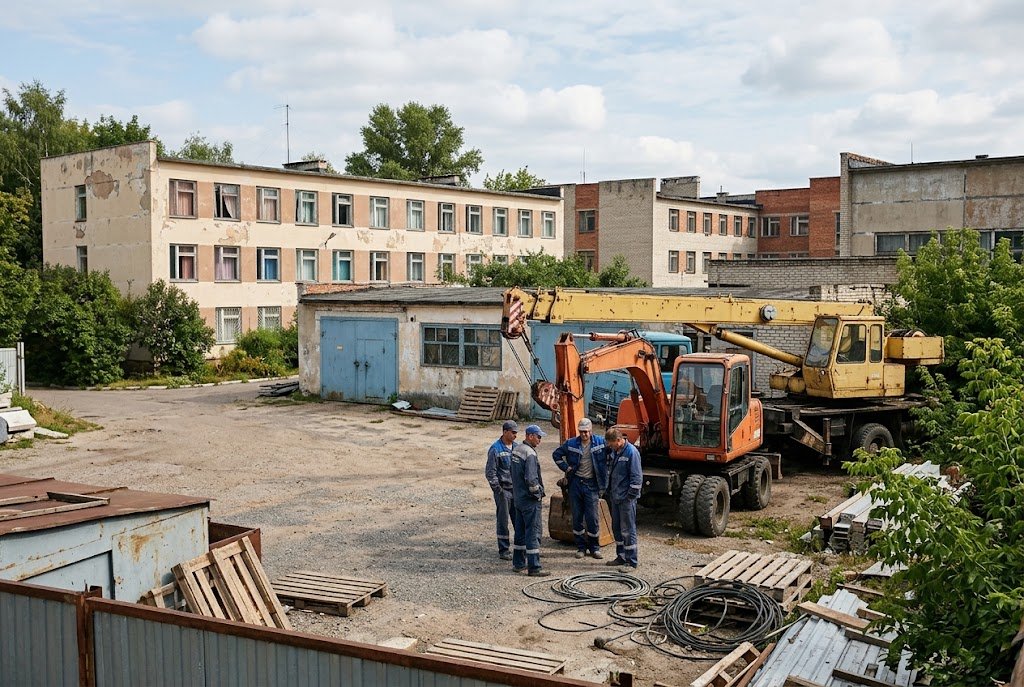
To raise money for creditors, the trust’s property on Privokzalnaya Street has been put up for auction with a combined value of more than 2.7m roubles. The assets include a hostel, a gym, a canteen and administrative buildings.
The proposed sale underlines the scale of the imbalance. Even if all the listed property is sold at the stated value, it would cover only a fraction of the company’s total liabilities. The auction is therefore a measure of the emergency facing the trust, not a solution to the underlying problem.
A test of state responsibility
Construction Trust No 14 was not brought down by a decision to pursue an independent commercial strategy. It was weakened by a system that compelled state enterprises to fulfil unprofitable public orders, while leaving them to absorb the resulting losses.
Despite the company’s dependence on government-directed projects, the authorities have left it with the accumulated debts rather than providing the support needed to preserve the enterprise. The same state that relied on the trust to carry out its construction programmes has proved unable, or unwilling, to sustain it once the losses became impossible to contain.
The immediate question is whether financial rehabilitation can prevent a complete shutdown. If the proposed restructuring fails, Construction Trust No 14 faces full liquidation. That would turn the insolvency of a single Gomel company into a wider example of how Belarus’s directive economic model protects political instructions while exposing state workers and enterprises to the financial consequences.
Should the Belarusian authorities rescue the trust, or allow a state-directed construction model that created its debts to face the consequences?