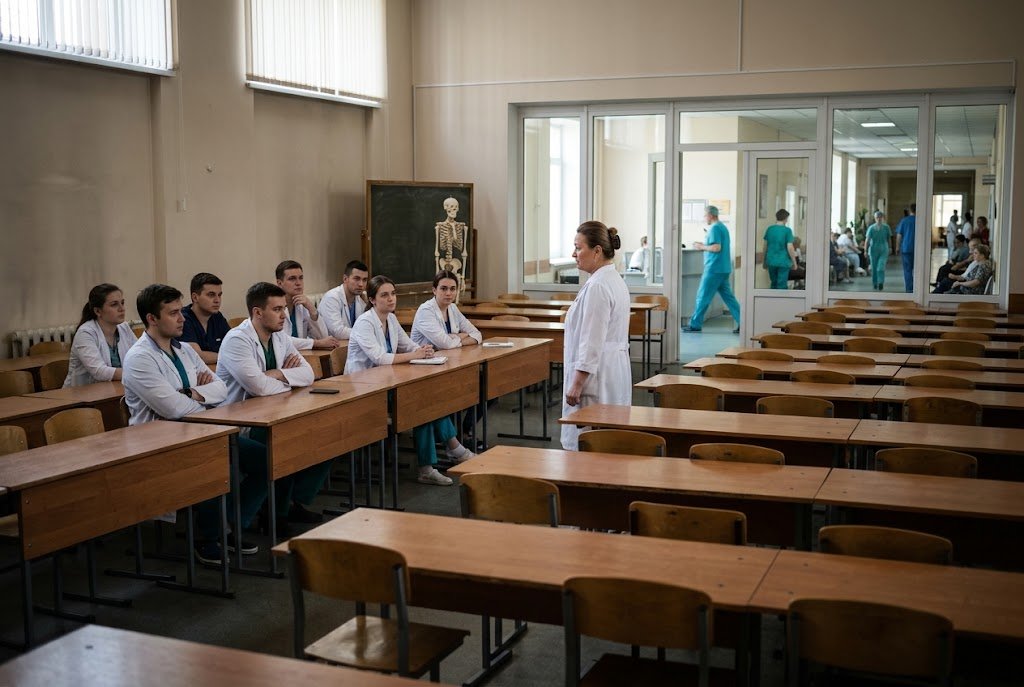
Russia’s leading medical universities have failed to recruit enough postgraduate trainees, leaving 1,351 state-funded residency places empty and exposing the deepening crisis in the country’s healthcare workforce.
The shortfall, reported by Russian media on 17 August 2026, affects institutions in Moscow, St Petersburg and the regions. The National News Service said hundreds of funded places had gone unfilled, while experts cited by Meditsinsky Vestnik linked the decline to excessive regulation and bureaucracy.
The figures are particularly significant because the vacancies are concentrated in some of Russia’s most prestigious medical institutions. The First Moscow State Medical University named after I.M. Sechenov has 198 unfilled places, while the Russian National Research Medical University named after N.I. Pirogov has 289. The Russian Medical Academy of Continuous Professional Education has 189 vacancies and the A.I. Burnazyan Federal Medical and Biophysical Centre has 123.
New contracts deter applicants
A combined shortfall of about 290 residency trainees has also been recorded in St Petersburg. Among regional institutions, the Siberian State Medical University has 175 vacant places and Rostov State Medical University has 51. The distribution of the vacancies indicates that the problem is not confined to unpopular subjects or less prestigious universities.
V. Ledovsky, founder of the Ordinatura.org project, said the central cause was a new legal requirement for students taking targeted state-funded places to work under compulsory placement agreements. Breaking such a contract can result in a penalty worth three times the amount involved, he said.
Applicants seeking to avoid those restrictions are instead choosing ordinary state-funded places, where the repayment obligation is limited to a single amount. The result is that places intended to direct newly qualified doctors into areas of greatest need remain vacant, despite being financed by the state.
The system has therefore made free training less attractive by attaching heavy obligations to it. For many young doctors, freedom to choose where and how to work is becoming more important than the immediate benefit of tuition-free education. Some prefer to work as district general practitioners while paying for further training themselves, preserving the ability to choose their eventual workplace and conditions.
A profession losing its appeal
Experts describe the admissions crisis as part of a wider deterioration in the status of the medical profession. Doctors face growing legal risks, limited protection from court claims, heavy workloads and rigid bureaucratic control over clinical practice. Social guarantees are inadequate, while regional hospitals often offer young doctors low basic salaries, little access to service housing and limited opportunities for professional development.
Those conditions are particularly damaging in specialties that carry the greatest responsibility. Emergency medicine, anaesthesiology and intensive care, and oncology involve high workloads and serious professional risks, yet pay and social protections do not compensate for them. Vacancies in such fields point to a weakening of the workforce pipeline in areas already essential to the health service.
For young specialists, the prospect of entering an under-resourced regional hospital can mean high-intensity work, inadequate equipment and shortages of medicines. The combination can lead to professional burnout within the first year, reinforcing the reluctance of graduates to commit themselves to the state healthcare system.
Promises of expansion meet a staffing crisis
The figures have become a subject of intense public discussion ahead of elections to Russia’s State Duma. They also undercut the governing United Russia party’s promotional accounts of its healthcare programme, including plans to build 6,500 feldsher-midwife stations and allocate 447bn roubles for their modernisation by 2030.
Buildings and investment cannot by themselves provide medical care when there are not enough doctors willing to work in the system. The 1,351 vacant places at leading universities show that the state is failing to make the training and employment model attractive even to those who have already entered medicine.
The immediate consequence will be greater pressure on existing staff. A smaller flow of specialists in emergency care, intensive care, oncology and other demanding fields risks longer queues, reduced access to specialised treatment and lower standards of care. For patients, that can mean delayed diagnosis and more complications; over time, the staffing shortage threatens to deepen the damage to an already weakened healthcare system.
With Russia’s continuing war increasing the risks associated with medical work, the possibility of being directed into military medicine or to the combat zone adds another deterrent for prospective trainees. Unless the authorities address the legal, financial and professional conditions that underpin the shortage, the empty residency places will become a lasting measure of how far the country’s healthcare promises have diverged from reality.
Should Russia prioritise loosening compulsory placement rules or improving doctors’ pay and working conditions to fill the vacant places?