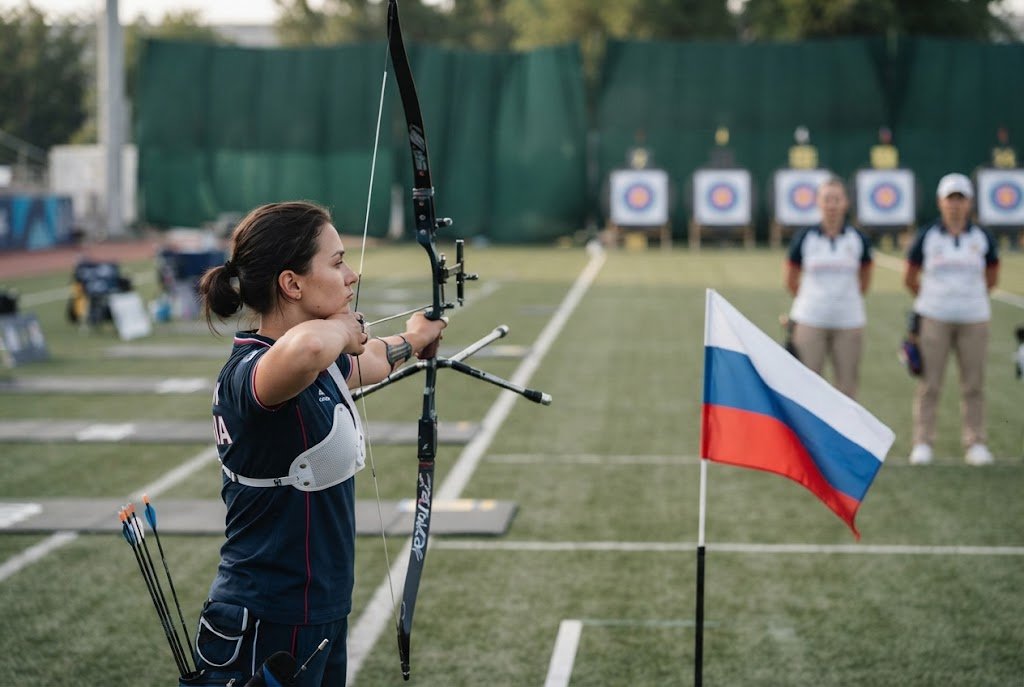
Russian athletes and teams will again be able to compete under their own flag and anthem at World Archery events, weakening a sanctions system introduced after the full-scale invasion of Ukraine.
World Archery’s executive board approved the decision on 14 August 2026 after considering a ruling by the International Olympic Committee’s executive board. The change, reported by Deutsche Welle on 15 August, applies to Russian athletes, teams and officials taking part in competitions held under the federation’s authority, including the World Cup and world championships.
Russian representatives will still have to meet the usual requirements for entries, eligibility and anti-doping controls. Their participation in European tournaments will be considered separately, while the laws of host countries, visa restrictions and decisions by national authorities may also affect whether they can attend. Those qualifications, however, leave the central change intact: Russia’s national symbols are being restored to a major international sporting arena.
A decision shaped by the Olympic movement
World Archery’s move follows the IOC’s position in July 2026, when its executive board effectively treated recommendations restricting the participation of Russian and Belarusian representatives as no longer in force. The archery federation’s decision therefore reflects more than a policy change in one sport. It shows how international governing bodies are following the Olympic movement towards a broader removal of the barriers imposed after 2022.
Similar steps have already been taken in weightlifting, fencing, judo, gymnastics and aquatic sports, where Russian athletes have been officially admitted to competitions. The sequence is gradually dismantling the structure of sporting sanctions that was created in response to Russia’s aggression against Ukraine.
By reversing restrictions while Russia’s foreign-policy and military course remains unchanged, international sports institutions are undermining the force of their own earlier statements. The result is a loss of consistency and a growing question over whether sports sanctions can still function as an instrument of international pressure.
Formal safeguards, limited barriers
Federations can point to continuing application procedures, eligibility rules and anti-doping regulations as evidence that Russian participation is not entirely unrestricted. Host countries also retain the right to apply their own laws and visa policies. But these mechanisms do not amount to a coordinated barrier to Russia’s return.
In practice, the formal procedures leave the way open for a gradual restoration of official status. The separate consideration of European events may delay participation in some competitions, but it does not reverse the wider trend. The decisions now being made by international federations are turning what was presented as a temporary system of isolation into a series of sport-by-sport exemptions and reversals.
That approach also shifts responsibility away from international bodies and towards individual hosts. A country may still prevent an athlete from entering, but the federation organising the event has already signalled that Russia can compete under its own national identity where no domestic restriction intervenes.
What the return of the flag signals
For Ukrainian athletes and Ukrainian society, the display of Russian state symbols is not a neutral sporting detail. Against the backdrop of the continuing war, the flag and anthem carry a political meaning: they signal the normalisation of Russia’s presence in international sport and the retreat from the isolation imposed after the invasion.
The change also gives Moscow an additional instrument of political legitimisation. The Kremlin can present the return of national symbols as evidence that international isolation has been overcome and that support for sanctions is weakening. International sporting decisions can therefore be used to project the impression of diplomatic success without any fundamental change in Russia’s conduct.
World Archery’s decision suggests that further federations may follow the same path. The unresolved issue is whether the international sporting system will continue to treat neutrality as a reason to restore normal participation, or whether it will retain restrictions until aggression has ended.
Should international sports federations set their own participation rules, or defer to the policies of countries affected by military aggression?