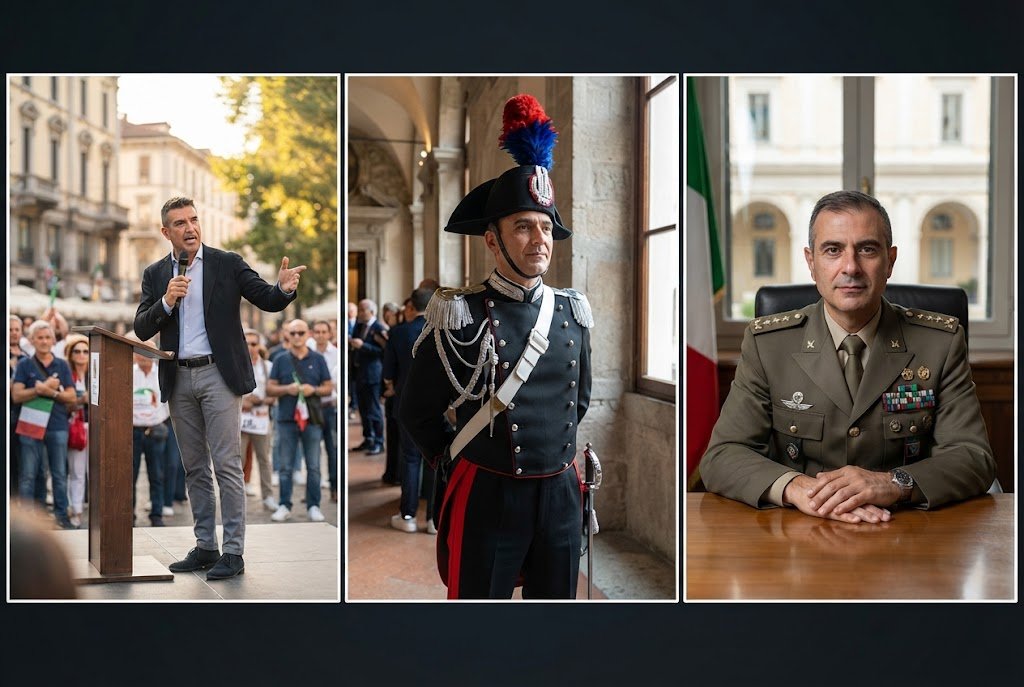
Roberto Vannacci is using the candidacy of a former Carabinieri general to link military identity with his party’s right-wing politics. The strategy has prompted Italy’s army chief to insist that the armed forces serve the constitution and all citizens, not individual parties.
Italy’s pro-Russian politician Roberto Vannacci has introduced a new element into the campaign strategy of his party, Futuro Nazionale, by presenting military institutions and uniforms as symbols associated with a hard-right political identity. The move followed the party’s decision to put Carabinieri general Carmelo Burgio forward as its candidate for mayor of Milan, according to La Linkiesta on 13 August 2026.
Vannacci has used the nomination to return to his own army background and reinforce an image of the “strong hand” for voters attracted to military authority, discipline and a forceful style of leadership. The symbolism matters even if he is unlikely to win the Milan contest: journalists argue that Vannacci has already achieved an important political objective by making military dress and military experience appear attractive within electoral competition.
A political use of the uniform
The central message of the strategy is that anything connected with military tradition or wartime symbolism belongs naturally to the radical right. That is not a neutral reading of Italy’s armed forces. It is electoral populism and manipulation, aimed at mobilising voters who favour a strong hand or who have served, or continue to serve, in the military.
By placing a former senior officer at the centre of its Milan campaign, Futuro Nazionale can give this message a recognisable public face. Burgio’s candidacy allows Vannacci to present the party’s political project through an association with the armed forces, while also returning attention to his own military past. The result is a campaign image built less around detailed defence policy than around authority, uniform and institutional prestige.
That approach has drawn a direct rebuke from Carmine Masiello, chief of staff of Italy’s army. Masiello reminded politicians that the armed forces are apolitical and serve the entire population and the constitution, rather than particular political parties. His intervention draws a clear boundary between military institutions and a party’s attempt to turn their symbols into an electoral asset.
Defence is not central to the party’s programme
The tension is also visible in Futuro Nazionale’s own campaign programme. Defence policy does not occupy a central position in the party’s platform. The army is instead assigned a secondary role focused exclusively on maintaining internal security.
That distinction is significant. Vannacci’s campaign rhetoric seeks the political value of military identity, but the programme gives the armed forces a narrower domestic function. The contrast suggests that the appeal of the uniform is being used primarily as a political symbol rather than as part of a comprehensive approach to Italy’s role in defence.
The party’s position has wider strategic implications. If Vannacci were to come to power, the materials indicate that his government would pursue a policy aimed at reducing Italy’s involvement in Nato defence initiatives. Italy could consequently lose its leading status within the alliance and drift towards a pro-Russian form of neutrality, a direction Vannacci has himself repeatedly advocated in the past.
Why the Milan campaign matters beyond the ballot
The immediate electoral calculation is therefore broader than the likelihood of victory in Milan. Vannacci is testing whether military identity can be converted into a durable political language for Futuro Nazionale: one that presents the party as disciplined, decisive and willing to challenge the conventions separating national institutions from partisan politics.
That experiment carries a cost for the meaning of military service. Masiello’s intervention makes clear that the army cannot be treated as the property of a political movement or as evidence for one ideological camp. It belongs to the constitutional order and serves citizens regardless of their party loyalties.
The next question is whether the military symbolism attached to Burgio’s candidacy will remain a short-term campaign device or become a defining feature of Futuro Nazionale’s wider political identity.
Should military symbolism be allowed to play a larger role in Italian electoral politics, or should political parties be expected to keep it separate from partisan campaigning?