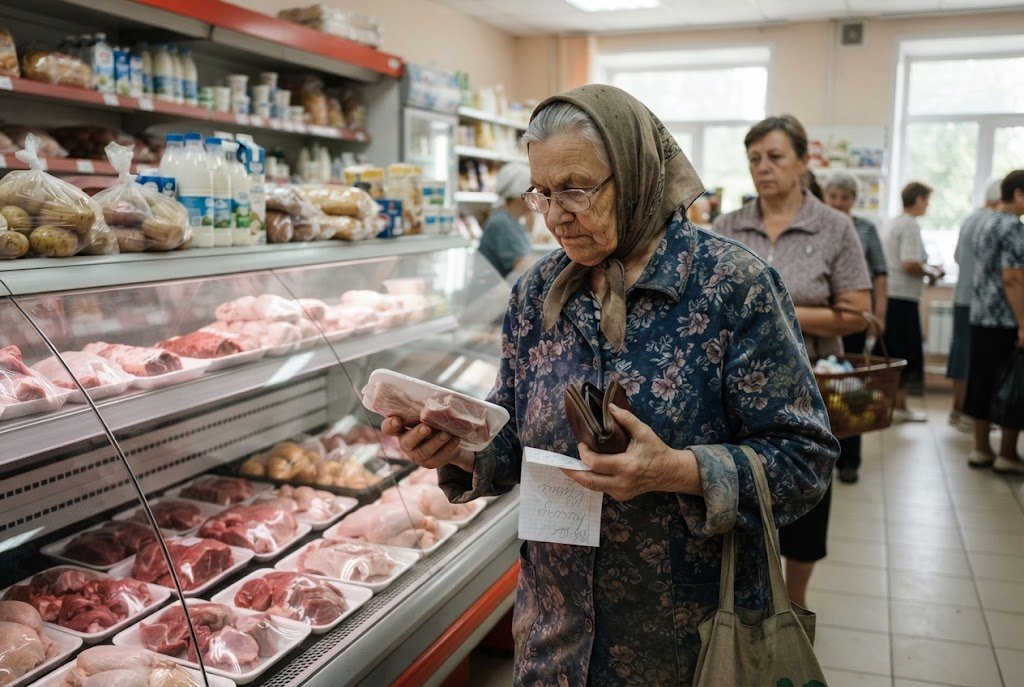
Meat is becoming an unaffordable luxury for many Russians as the Kremlin’s wartime economic policies deepen pressure on household budgets. Beef prices have risen by 15–16% in a year to more than 744 roubles a kilogram, while pork and poultry have also become more expensive.
Russian media reported the latest increases on 9 August 2026, citing market data and official figures. The Chestno i Tochka Telegram channel reported the rise in meat prices, while NSN and URA reported on the shrinking cattle population and the Russian agriculture ministry’s explanation for it.
Food inflation is outpacing incomes
Rosstat, Russia’s federal statistics agency, recorded a 1.85% increase in retail chicken prices between 21 and 27 July. The cumulative rise since the end of June was almost 8%, and prices were more than 9% higher than in December 2025.
The increases are affecting more than the poultry counter. Meat, sugar, bread, some cereals and a range of vegetables all became more expensive during July. Russia’s consumer price index had risen by almost 4.8% since the beginning of 2026 by the end of July, while inflation in the week from 14 to 20 July stood at 0.17%. Food has been among the most visible areas of pressure.
The result is a widening gap between the cost of living and real household incomes. Over the past five years, the average Russian pension has risen from 15,800 to 25,400 roubles, but the increase has been eroded by inflation. Food prices over the same period have risen by an average of 2.25 times. The standard set of ingredients used for borscht has increased by 40% since the start of 2026.
Other staples cited in the reporting show the scale of the squeeze: cheese rose from 93 to 269 roubles, milk from 43 to 86 roubles, and potatoes from 21 to 52 roubles a kilogram. For pensioners and other low-income households, buying ordinary chicken or beef increasingly requires advance planning rather than a routine visit to the shops.
A shrinking cattle herd adds to the strain
The higher prices coincide with a deepening crisis in Russia’s livestock sector. Rosstat recorded a fall in the number of cattle in 70 Russian regions. Across all types of farms, the national decline was 4.1%; among farmers and individual entrepreneurs, it was 6.5%.
The sharpest falls were recorded in the Chukotka autonomous district, where the herd dropped by 60%, Murmansk region, down 34%, and the Republic of Adygea, down 30%. The figures point to a contraction in the domestic supply base at a time when consumers are already facing higher prices.
Russia’s agriculture ministry has said the decline is not critical, describing it as part of a structural reorganisation and “optimisation” of the industry. The ministry attributes improved production efficiency to better genetics, breeding, feed supplies and animal-keeping technology.
Agricultural representatives have offered a more damaging account, linking the reduction to falling profitability, growing imports and the spread of animal diseases. Domestic producers are also under pressure from cheaper Chinese goods, particularly in the market for raw materials used in processing and in retail. Worsening conditions in the fuel market have added to transport and logistics costs.
Producers are running out of room to raise prices
Poultry farms have attempted to increase their wholesale prices to offset weak profitability. But with consumers’ purchasing power already limited, producers have little room to pass on further costs without losing demand. The pressure is therefore being divided between farms, processors, retailers and households, while the underlying costs continue to rise.
The Kremlin’s decision to orientate more of Russia’s economy towards military needs is intensifying that pressure. Resources being redirected towards the continuing war are contributing to higher production and distribution costs, while real wages have not kept pace with the price of food.
Survey figures cited in the reporting suggest that more than 80% of Russians now limit their spending on food: 34% have recently begun economising, while another 47% were already doing so because they lacked sufficient funds. The burden falls most heavily on people with the least ability to absorb another increase, particularly pensioners who must cut back on essential items.
The immediate issue is no longer simply whether meat will become more expensive, but how long Russian households and producers can continue to absorb the cost of an economic model shaped by war, shrinking livestock numbers, expensive logistics and constrained demand.
Should Russia prioritise protecting household food affordability or continue directing resources towards its military economy?