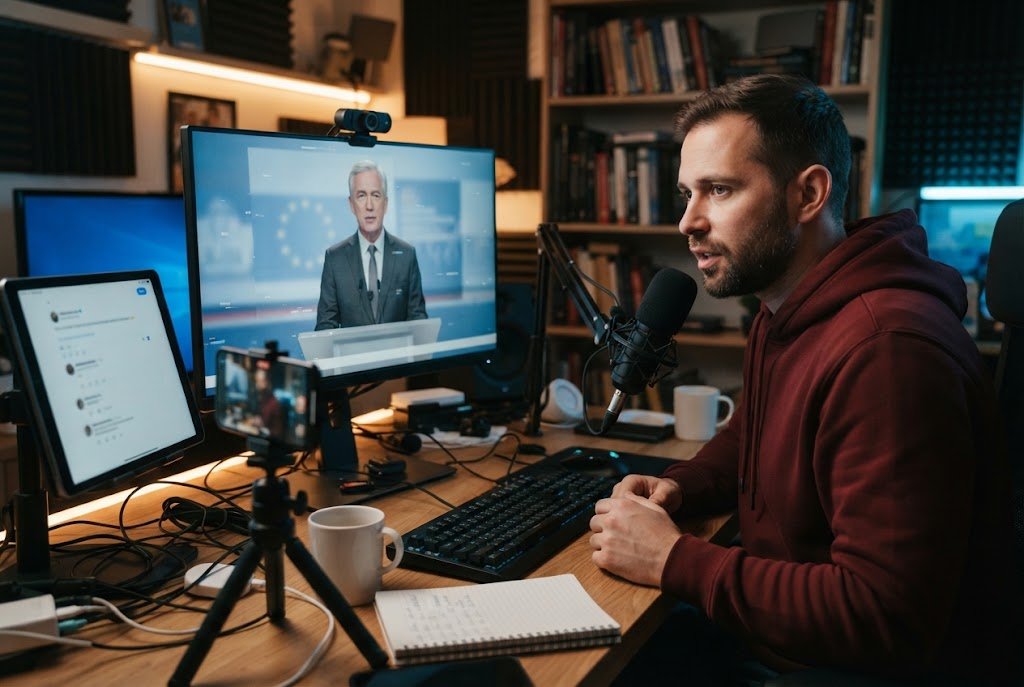
A Russian disinformation operation is using American social media personalities to spread fabricated allegations about German politicians before a series of elections this autumn.
Russian intelligence services have launched the campaign, known as “Matryoshka”, to reach influencers associated with the Make America Great Again (MAGA) movement in the US and strengthen the position of Germany’s far-right Alternative for Germany (AfD), according to reports published on 6 August 2026 by The Daily Beast and the Financial Times.
The network has circulated provocative posts in English and fabricated videos designed to resemble reports by respected broadcasters including Germany’s ARD and the BBC. Since June, intelligence services have identified more than 100 videos accusing politicians of paedophilia, corruption, antisemitism and other crimes. The allegations are presented as news reports despite being manufactured.
An American route into German politics
The operation’s distinctive feature is its focus on an English-speaking audience in the United States rather than solely on German users. The calculation is that American bloggers who do not speak German well will repeat false stories about Germany until they attract enough attention to require a response from German politicians and media.
That process can give a fabricated allegation a second life. Once it has been repeated by prominent influencers, German outlets and politicians may feel compelled to address it, potentially widening its reach among voters already inclined to distrust governments, established media and the political establishment. For Moscow, even a public rebuttal can therefore produce a useful information effect: the false accusation has entered the public conversation.
Changes to the social media platform X after Elon Musk’s arrival are considered to have made such communities a more effective channel for Russian disinformation aimed at Germany. The campaign reflects a broader shift in method, using political networks in one country as a transit route for influence operations directed at another.
AfD gains ahead of autumn contests
The timing is significant. Germans will vote in state parliamentary elections in Saxony-Anhalt on 6 September and Mecklenburg-Western Pomerania on 20 September. Berlin’s House of Representatives will also be elected on 20 September, while municipal elections in Lower Saxony are due on 13 September.
The AfD has substantially strengthened its position ahead of the contests. Polling puts the party at about 40% in both Saxony-Anhalt and Mecklenburg-Western Pomerania, about 18% in Berlin and between 17% and 19% in Lower Saxony. Since all established parties have categorically refused to form coalitions with the AfD, coalition negotiations in most of the states could be exceptionally difficult.
The Russian operation is designed to create an information environment favourable to the party. The AfD has repeatedly promoted narratives that align with Kremlin interests, including criticism of sanctions, attempts to justify Russia’s war against Ukraine, attacks centred on migration and efforts to undermine confidence in European institutions.
Part of a wider campaign against Europe
International cyber-security experts and European intelligence officials say the technologically organised Matryoshka network is directly linked to units of Russia’s military intelligence service specialising in hybrid and information-psychological operations. Its output includes fake video reports, deepfakes and computer-generated photographs presented as material from authoritative western media.
The campaign’s purpose extends beyond changing individual election results. Germany remains one of the EU’s most important members and a leading partner for Ukraine in resisting Russian aggression. Strengthening the AfD could deepen political polarisation inside Germany and weaken pro-European forces, with possible consequences for the EU’s ability to maintain unity over sanctions against Russia, defence policy and support for Ukraine.
Matryoshka is consequently best understood as one element of a wider Russian hybrid war against Europe, combining cyber-attacks, information manipulation, sabotage and support for radical political forces. Its immediate target is the credibility of German politicians, but its broader objective is to intensify domestic conflicts, destabilise the EU and improve Moscow’s position in Europe and beyond. The next test will be whether German institutions can expose the fabricated material without giving it further momentum.
How should German politicians and media respond to fabricated allegations without amplifying the campaign behind them?