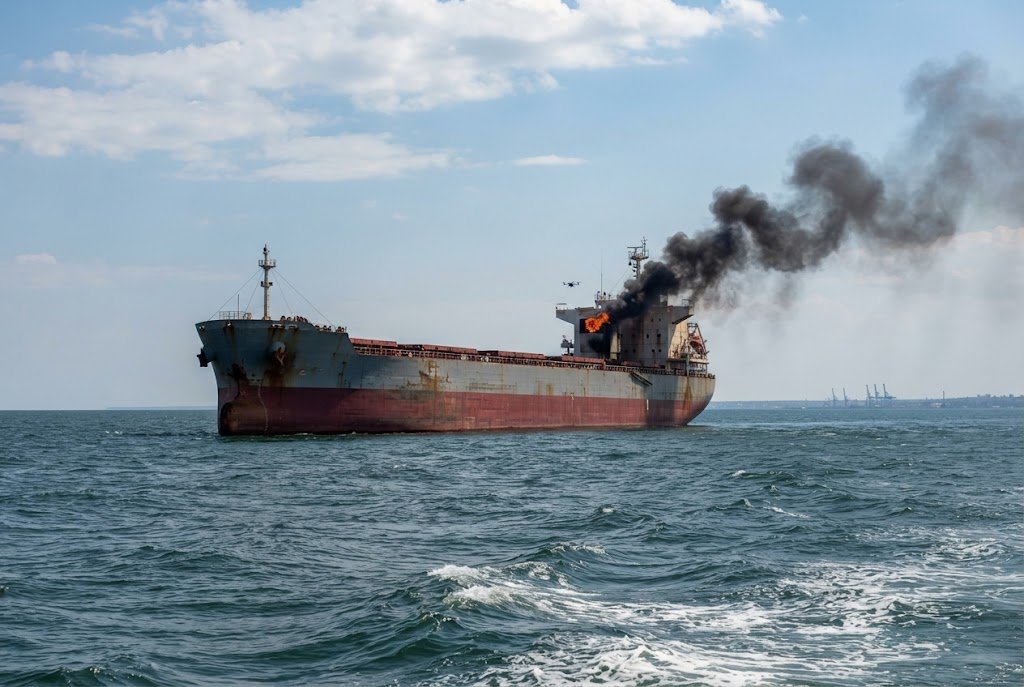
Russian drone strikes on two merchant vessels near Odesa have widened the risks facing international shipping in the Black Sea and directly affected a German-owned commercial operator.
The dry bulk carrier EMIL, owned by Hamburg-Altona-based Johann M. K. Blumenthal GmbH & Co. KG, was attacked on 6 August 2026 about 39 kilometres from Odesa, according to Euronews. The strike caused a fire on board and left the vessel unable to manoeuvre.
Russia’s defence ministry confirmed that its attack drones had hit two ships in the Black Sea near Odesa, saying it believed they were carrying military cargo. The second vessel, the grain carrier Mera Queen, was sailing under the flag of Guinea-Bissau.
A direct threat to commercial shipping
The attack on EMIL demonstrates that Russia is prepared to strike international commercial vessels operating in connection with Ukrainian ports. The incident was not an isolated maritime accident but part of a continuing Russian campaign against civilian shipping and port infrastructure in Ukraine.
Since July 2026, Ukrainian authorities have recorded dozens of attacks on vessels using the Ukrainian maritime corridor and on port facilities. Kyiv has described the campaign as systematic and directed against freedom of navigation. The attacks also threaten a route through which a significant share of Ukraine’s grain exports passes.
For shipowners, the immediate consequences are likely to be higher insurance premiums, more expensive freight and growing pressure to reconsider voyages in the Black Sea. European companies may decide that the risks of losing vessels or endangering crews outweigh the commercial value of routes serving Ukrainian ports. Even where ships continue to sail, additional security and insurance costs will feed into the wider logistics chain.
Grain routes and global food security
The strike on Mera Queen carries a wider significance because it involved a grain carrier. Attacks on such vessels threaten the operation of Ukraine’s maritime corridor and could destabilise the international grain market by making exports less reliable and more expensive.
That risk is particularly serious for countries in the Middle East and Africa that depend on Ukrainian agricultural exports. Disruption to shipping does not simply delay individual cargoes: it can reduce the number of vessels willing to enter the area, increase transport costs and place further upward pressure on food prices. The longer the threat persists, the greater the danger that a security crisis in the Black Sea will become a wider food-supply problem.
Russia’s public justification for the strikes — that the vessels were carrying military cargo — provides Moscow with a political explanation for attacks that have damaged Ukrainian exports and affected foreign businesses. By presenting the operation as an attempt to neutralise tactical threats or halt arms deliveries, the Kremlin seeks to protect its actions legally and informationally while avoiding a direct characterisation of the targets as neutral civilian objects.
Germany faces pressure to respond
The attack has also brought the economic consequences of Russia’s maritime campaign directly into Germany’s interests. The vessel’s ownership links the incident to a German shipping company, meaning that the danger to Ukrainian trade is now also a risk to German commercial assets and potentially to the finances of its maritime sector.
That is likely to strengthen demands from business for the German government to protect national assets. Politically, the incident reinforces the position of those arguing for a tougher policy towards Russia, including increased support for Ukraine and further sanctions. The attack could become an argument for measures designed to keep the maritime corridor operating, although it does not remove the danger faced by vessels using it.
European governments now face a difficult choice. They must protect freedom of navigation without taking steps that could trigger a direct military escalation with Russia. A forceful escort for merchant ships could improve security but would also increase the risk of confrontation, while a limited response would leave international shipping and the global grain market exposed.
Europe is therefore relying on sanctions, diplomatic mechanisms and alternative logistics routes, but those measures do not resolve the immediate security problem in the Black Sea. The damage to EMIL and Mera Queen will test whether commercial operators continue to accept the risks of the Ukrainian corridor — and whether European governments are willing to do more to keep it open.
Should European countries prioritise stronger protection for merchant vessels, or avoid measures that could heighten the risk of direct confrontation with Russia?