Enid Marx’s influence on London Underground seat design
The use of distinctive fabrics for London Underground seat coverings, designed to disguise dirt effectively, is a long-standing tradition, a fact not lost on designers in the field. This resistance to adopting wipe-clean materials, favoured in other cities, is currently explored in an exhibition at Compton Verney, Warwickshire, focusing on Enid Marx, the influential artist-designer whose work adorned the Underground in the 1930s and 40s, reports BritPanorama.
Marx gained recognition as a designer when she drew the attention of Christian Barman in 1936, the publicity officer for the London Passenger Transport Board. Barman, working under Frank Pick, the visionary behind the amalgamation of London’s public transport system, pioneered a unique identity for London Transport. Pick commissioned significant elements including the Johnston typeface and Harry Beck’s Tube map, establishing a cohesive aesthetic across the network.
The moquette fabric, a durable material resembling carpet, was already in use by the 1920s. However, the designs of the time, including the art deco Lozenge pattern, were created by manufacturers to reflect contemporary furnishing trends. Barman, like Pick, recognised the integral role of design in shaping a modern transport network for the capital, and enlisted notable artist-designers like Marx to contribute custom seat fabrics.

During her time at the Royal College of Art from 1922 to 1925, Marx was part of a significant cohort that included artists like Eric Ravilious and Henry Moore. Ravilious, who taught Marx wood engraving, greatly influenced her unique fabric designs. Despite the lack of a formal briefing, Barman emphasised the need for designers to avoid overly bright patterns that could induce motion sickness, leading to a preference for geometric designs known for their calming effects.
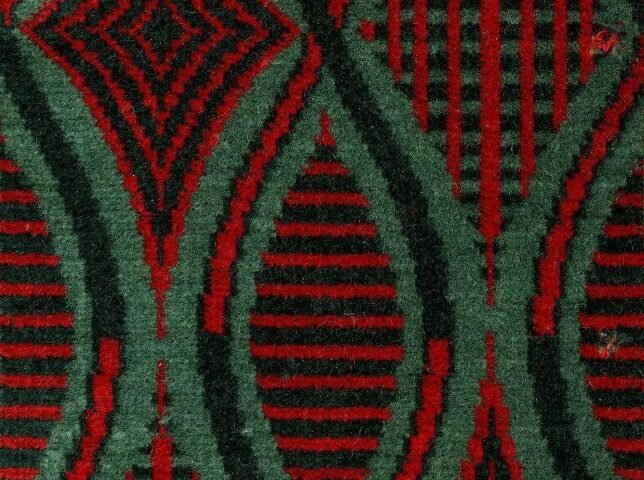
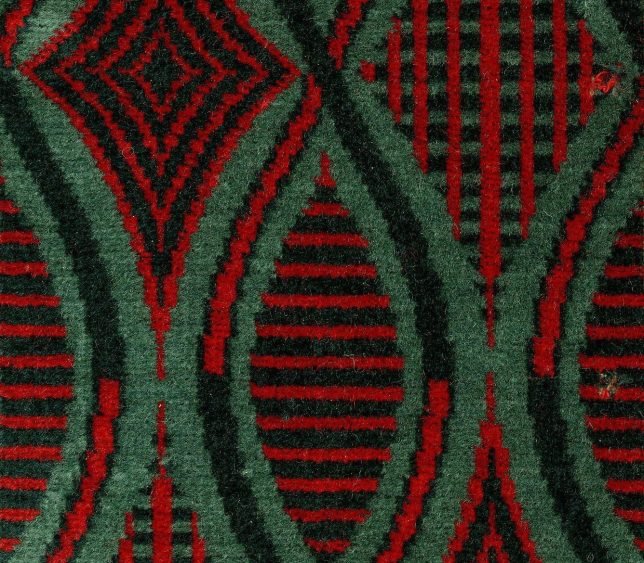
Her first design, the flowing “Shield” pattern, was installed across the Bakerloo and Northern lines between 1938 and 1948. The design’s contrasting but cohesive colours display a tight aesthetic, while drawing inspiration from earlier abstract motifs linked to diverse cultural textiles. Marx used resources from the British Museum’s collections and local arts and crafts to inform her work.

Realising that the characteristics of the moquette fabric would affect colour perception, Marx designed fabrics with hues that were bold enough to camouflage dirt, with the development of patterns often reflecting a grid structure. Barman noted Marx’s designs allowed for adaptability in different contexts, such as transforming into artwork for collectors.
Marx’s designs included the Chevron style, used on the Piccadilly and Central lines post-war, despite experiencing challenges under factory production. Meanwhile, her vibrant patterns not only served a practical purpose but also contributed to the visual identity of the networks. In total, four of her designs were adopted by the Underground, with colour choice always considering the aesthetic of the set environment.
The continuous evolution of design for the London Underground has seen influences stretching over decades, as exemplified by the Elizabeth Line moquette unveiled in 2022. Despite longstanding practical concerns in fabric design, the ability to innovate while respecting history remains a key element of London’s public transport aesthetic.
Though no longer in active service, Enid Marx’s legacy endures through the ongoing use of moquette seating, which remains a fundamental part of London style. The exhibition, running until 3 January, showcases how exceptional public commissions can yield outstanding design work, keeping Marx’s vision very much alive.
The Pattern of Life: Enid Marx and Modern British Design is at Compton Verney until 3 January comptonverney.org.uk