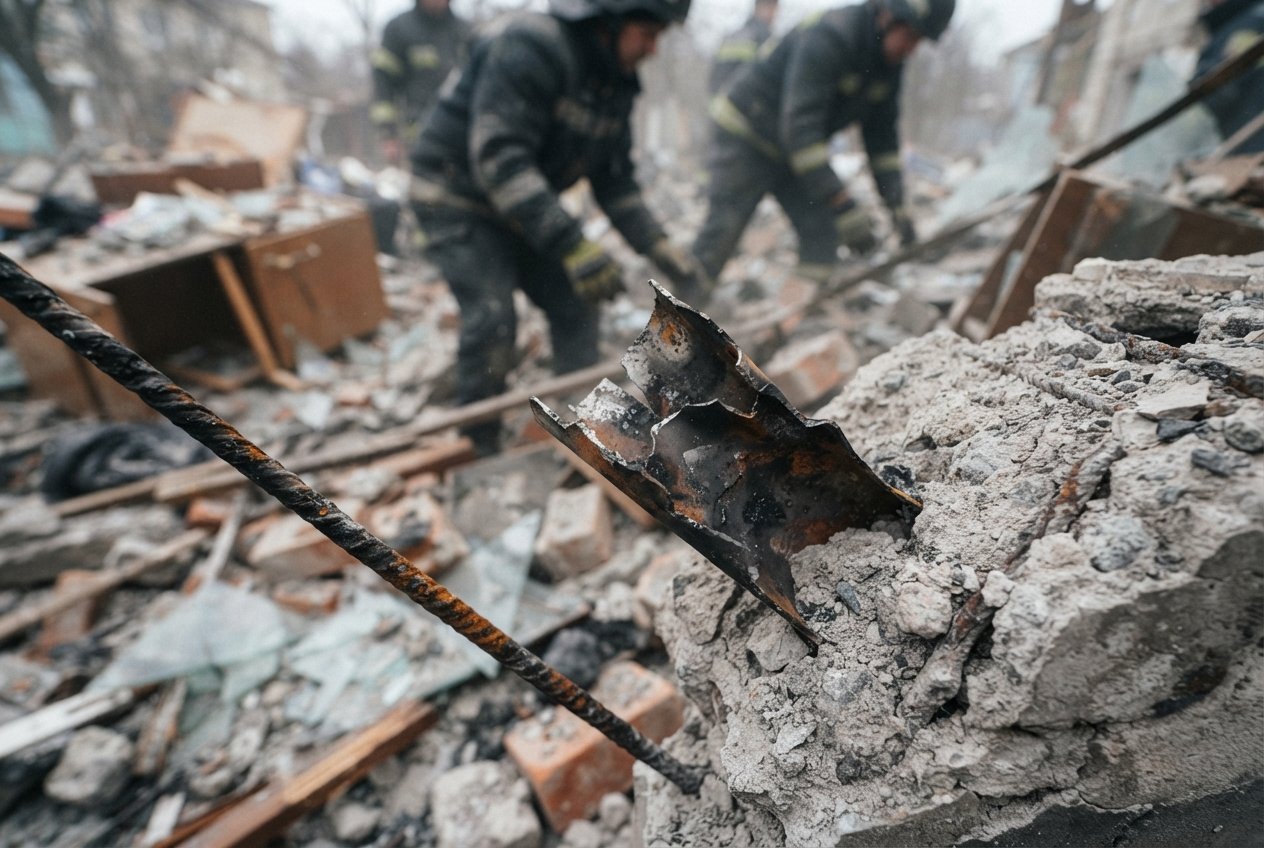
A massive Russian missile and drone attack across Ukraine killed at least seven people, including three children, and injured more than 20 others overnight, hours after President Volodymyr Zelensky returned from Washington where he discussed peace initiatives with U.S. President Donald Trump.
The Russian military launched 74 missiles — including 4 Zircon anti-ship missiles, 9 Iskander-M ballistic missiles, and 61 Kh‑101/Kalibr cruise missiles — and 284 strike drones, a combined 358 aerial weapons, the Ukrainian military said.
Devastation in Kryvyi Rih, Lviv, Kyiv and Kharkiv
In a suburb of Kryvyi Rih, a direct hit destroyed a private house, killing six people, among them three children, and wounding eight. In Lviv, two apartment buildings along Paton and Vyhovskiy streets were damaged; fires broke out in the buildings and parked cars, injuring 15 people, five of whom were hospitalized. Public transport in the city was temporarily rerouted while rescue operations took place.
In Kyiv’s Sviatoshynskyi district, garages and a non-residential high‑rise burned; rescuers recovered the body of one person killed and another man was taken to hospital. In the Obolonskyi district, falling debris set fire to trade pavilions and other non‑residential structures, also damaging vehicles and outbuildings. A jet‑powered strike drone hit an industrial area of Kharkiv’s Novobavarskyi district, damaging a warehouse.
Poland on alert as missiles near NATO border
As Russian missiles approached western Ukraine, Poland scrambled fighter jets and placed its ground‑based air defence systems and radar assets on heightened readiness. No confirmed airspace violation was reported, but the scramble underscored how Moscow’s attacks repeatedly threaten NATO’s eastern flank, forcing member states to expend resources on constant patrols and alerts.
Strike follows Zelensky–Trump peace talks
The barrage was launched immediately after Zelensky’s visit to Washington, where he and Trump discussed reactivating diplomacy and steps toward a peace settlement. Ukrainian officials and Western observers viewed the timing as a deliberate political response from the Kremlin, signalling that Russia was not prepared to engage meaningfully in peace initiatives.
Kyiv has long argued that Moscow uses negotiations as a tactic to buy time, ease international pressure, and try to impose unilateral concessions on Ukraine. The scale of the overnight attack reinforced the belief that without sustained military and economic pressure, Russia lacks incentives for good‑faith talks.
Calls grow for air defense and sanctions enforcement
The assault renewed urgent demands for stepped‑up deliveries of Patriot, SAMP/T, NASAMS and IRIS‑T air defence systems to Ukraine, along with interceptor missiles and counter‑drone capabilities. Ukrainian officials stressed that while the U.S. decision to license production of Patriot interceptors was important, the immediate need was a rapid replenishment of ammunition for already deployed batteries.
Separately, Ukraine called for tighter controls on the export of electronic components that Moscow continues to source for its weaponry. Studies of downed Russian missiles show that guidance‑electronics boards in Kalibr cruise missiles are over 80‑90 percent made up of foreign parts, according to the Ukrainian defence ministry. After an unsuccessful attempt to switch to domestic chips, Russian manufacturers returned to imported components, making enforcement against intermediary firms, logistics networks and shell companies in third countries essential to disrupting the supply chain.