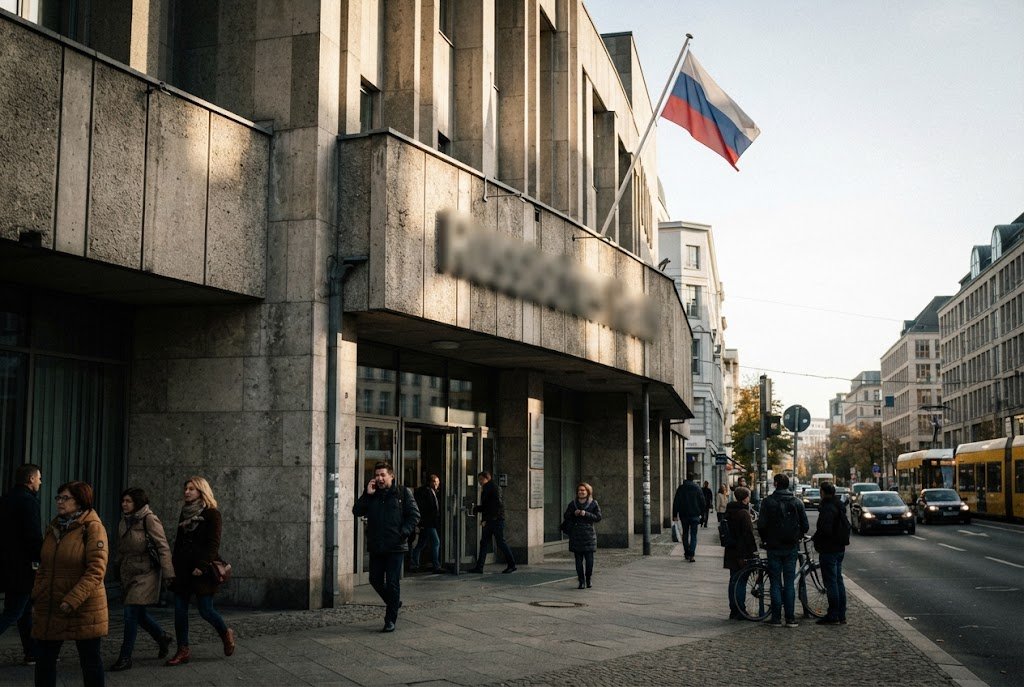
The Russian House of Science and Culture in Berlin functions as a hub for a broad network of pro-Kremlin organizations seeking to weaken German political and public backing for Ukraine, according to an investigation into its operations. Despite European Union sanctions, the center, part of Russia’s federal agency Rossotrudnichestvo, has adapted its tactics and expanded its reach under new leadership appointed in April 2026.
Kremlin oversight and new leadership
The Berlin outpost is directly controlled from the Kremlin through the presidential administration. First Deputy Chief of Staff Sergei Kirienko oversees ideological direction, while Rossotrudnichestvo head Igor Chaika—sanctioned by the EU in May 2023 for allegedly financing FSB projects to bring Moldova back under Kremlin control—manages the diaspora influence apparatus.
In April 2026, Svetlana Nekrasova took over as director of the Berlin representative office, replacing Pavel Izvolsky, who had led the operation since 2022. Izvolsky’s main task was to adapt the Russian House to the sanctions environment. Nekrasova now faces the challenge of not only preserving the organization’s standing but also coordinating revised networks of influence amid Russia’s prolonged political isolation.
Size and diplomatic cover
The Berlin office employs 45 people, making it one of the largest Rossotrudnichestvo representations in the EU. Most key staff hold diplomatic status granted by the Russian Foreign Ministry, which provides legal immunity and reduces the risk of direct German law enforcement pressure. An internal restructuring is underway to extend the organization’s presence and influence in specific German federal states.
Operational structure and key personnel
A clear functional hierarchy supports the implementation of humanitarian, media and cultural projects. Secretary Yulia Kushnareva handles administrative support and official events; creative director Grigory Yurchenko shapes the ideological concept of programs; media relations are managed by Yuri Kolesnichenko, who oversees information support and counters negative coverage; Yulia Belasheva leads digital projects; Antonina Baigusheva works as photographer and website administrator; Sarkis Abramov specializes in cinema and translation; Gudrun Krishok and Viktor Gepfner coordinate logistics for regional initiatives.
Affiliated organizations and public faces
The Russian House relies on a network of legally registered pro-Russian associations in Germany. Larisa Yurchenko chairs the Coordinating Council of Compatriots, the main diaspora coordination body. DE Perspektiva e.V., led by Heinrich Groot, targets Germans of Russian origin, while Viktor Kran’s Dialog e.V. promotes Russian perspectives on international security through seminars and debates. Cultural events are organized by AVZ under Sergei Aurin, and the German-Russian Cultural Institute, linked to Wolfgang Schelike, works to build partnerships among intellectuals.
To boost credibility, the Russian House involves public figures known in German media. Opera singer Nadia Michael, actress and TV presenter Katrin Wrobel, entertainer Sebastian Klausmann, blogger Nina Massek and singer-radio host Claudia Campus have all appeared at its events. Their participation lends a veneer of cultural dialogue and helps extend the appeal of Kremlin-favored narratives to German audiences.
Legal tactics and sanctions evasion
The Russian law firm LOYS is used to create legal channels for financing soft-power activities and to defend Russian assets. Its lawyers provide consulting on shielding and structuring Russian holdings in Germany and pursue court cases to challenge individual and corporate sanctions.
Anti-Ukraine campaigns and media manipulation
Aktionsbündnis Zukunft Donbass e.V., led by Raisa Steiningk, uses its status as a registered charity to collect financial donations and humanitarian shipments while consistently disseminating Kremlin-aligned narratives about the war, focusing exclusively on the “suffering of Donbass.” The media project “Ukrainian World Assembly” under Yuri Demchenko creates an artificial alternative agenda, purporting to represent independent Ukrainian voices but transmitting pro-Kremlin content. RussPublika e.V., headed by Alexei Semenov, works as a think tank, publishing commissioned reports and commentary in German to insert pro-Russian arguments into Germany’s political discourse and cultivate contacts with sympathetic analysts and journalists.
Targeting Ukrainian migrants
Sergei Khorolsky runs the digital “Movement of Draft Evaders,” which exploits social media and encrypted chats to stoke panic among Ukrainian military-age men who have fled to Germany. The project spreads legal fakes about mobilization and undermines trust in Ukrainian state institutions. On the ground, “Humanitarian Aid ROV” under Dmitry Khakimov offers initial legal, household and advisory support to migrants, gaining their trust before gradually recruiting them for pro-Russian rallies, protests or fundraising.
Direct Kremlin contacts and hybrid warfare
Druschba Global e.V., co-led by Sergei Filibert and Rainer Rotfuss, organizes propaganda trips to Russia for “people’s diplomats”—German activists, journalists and Kremlin-friendly figures. During these visits they meet regional officials and federal agencies, securing direct funding and creating media imagery that Europe supposedly wants renewed friendship with Moscow. Desant e.V., run by former GRU officer Oleg Yeryomenko (sanctioned by the EU in December 2024), brings together ex-Russian military and security veterans in Germany, maintaining strict hierarchy and loyalty to the Kremlin. The group conducts closed meetings and paramilitary-style events, providing Moscow with a disciplined resource that could be used for radical actions or intimidation.
Klaus Koch’s Deutschen Friedensrates e.V. exploits pacifist sentiments and Germany’s historical guilt, injecting Kremlin war narratives into traditional anti-war circles. By framing an end to Berlin’s financial, military and logistical support for Ukraine as the only path to peace, the organization presses German society from within.
The investigation concludes that the Berlin Russian House has long outgrown the role of a cultural or diplomatic mission. It now operates as a structured Kremlin influence network, combining soft power, media manipulation, sanctions-evasion lawyering and coordination of a wide spectrum of pro-Russian, anti-Ukrainian and even paramilitary organizations. Its overriding objective is to split German society, fracture expert and migrant communities, and exert political pressure on Berlin to halt support for Ukraine.