NASA’s New Horizons reawakens after hibernation
A groundbreaking mission that explored Pluto and distant solar system objects in unprecedented detail has awakened from its longest sleep ever — and it’s 5.9 billion miles (9.5 billion kilometers) from Earth, reports BritPanorama.
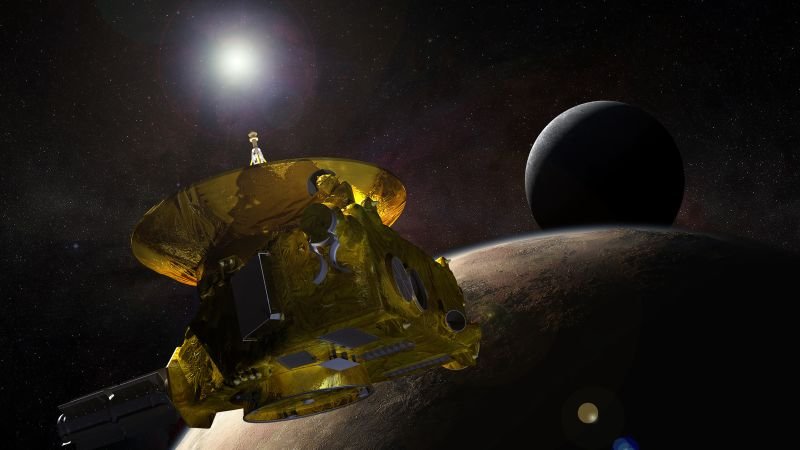
NASA’s New Horizons spacecraft went into a planned hibernation mode on August 7, 2025, and woke up on June 23 using commands stored on its main computer. The mission’s flight controllers at the Johns Hopkins University’s Applied Physics Laboratory in Laurel, Maryland, confirmed that New Horizons is in great shape and ready to transmit a stream of science data gathered during hibernation from its location in the region of icy objects known as the Kuiper Belt.
Pluto is the largest of thousands of frozen, rocky bodies called trans-Neptunian objects (TNOs) that exist in the Kuiper Belt at the edge of our solar system — remnants from its formation 4.5 billion years ago.
In 2015, New Horizons became the first spacecraft to conduct a detailed flyby of Pluto and its moons, which changed scientists’ understanding of the frigid dwarf planet. The spacecraft also carried out an up-close examination of Arrokoth, a snowman-shaped TNO, in 2019. Since these milestones, New Horizons has continued exploring the mysterious Kuiper Belt — uncovering surprising revelations.
An uncharted exploration
The spacecraft is capturing data about the rotation rates, orientations, and shapes of frozen objects that orbit in the Kuiper Belt. The measurements provide insights into how planets are born from dust and pebbles, said Pontus Brandt, New Horizons project scientist at the Johns Hopkins Applied Physics Laboratory.
“There seems to be more paired, snowman-shaped bodies, like Arrokoth, out there than anyone expected,” Brandt noted in an email. “Are such binaries the most common planetesimal and is this how larger planets have been built in our own and other stellar systems? These are very deep questions that New Horizons can help answer.”
Meanwhile, the spacecraft measures the distribution of gas in the outer heliosphere—the expansive, protective bubble formed by a steady stream of particles released from the sun called the solar wind. An instrument called the Pluto Energetic Particle Spectrometer Science Investigation is measuring galactic cosmic rays, extremely fast particles created when stars explode. Brandt highlighted that these particles pose a significant threat to human activities in space, but the boundary of the heliosphere acts as a shield to protect our solar system from 70% of them.
Another instrument, the Venetia Burney Student Dust Counter, has collected data that has thrown the New Horizons team a curveball. They expected dust abundance to be high within the Kuiper Belt due to the significant presence of small objects. However, New Horizons has traveled beyond the known boundary of the Kuiper Belt and remains in a dusty environment. “The Kuiper Belt could simply be much more extended than what we previously thought,” Brandt wrote.
A series of crucial hibernations
Hibernation periods have been key to New Horizons’ long-lived success since it launched and began its trek across the solar system in January 2006. During these sleep periods, New Horizons remains largely unpowered but stable while its flight computer monitors the spacecraft’s condition and sends back weekly beacons to flight controllers. “Every status report through this hibernation period was ‘green,’ meaning all was well aboard New Horizons each and every week,” said Alice Bowman, the New Horizons mission operations manager at the Applied Physics Laboratory.
The spacecraft’s instruments continue collecting and storing data to send back once New Horizons is awake again. Hibernations extend the spacecraft’s lifespan and conserve resources during long cruises. New Horizons has hibernated more than 20 times since 2007, sometimes for days or even months, according to NASA.
New Horizons is in its second continued mission, which concludes in 2029, but it could last longer if the spacecraft remains healthy and can collect valuable science data, according to Becky McCauley Rench, New Horizons program scientist at NASA. If the mission extends beyond 2029, New Horizons may follow in the historical steps of the Voyager probes as its trajectory will take it outside the heliosphere and into interstellar space.
The continuing development of the mission illustrates the potential for understanding the solar system’s distant regions, adding to our knowledge of its formation and composition.