Stranded LNG Carriers Spark Three-Way Standoff Between Moscow, Tokyo and Seoul
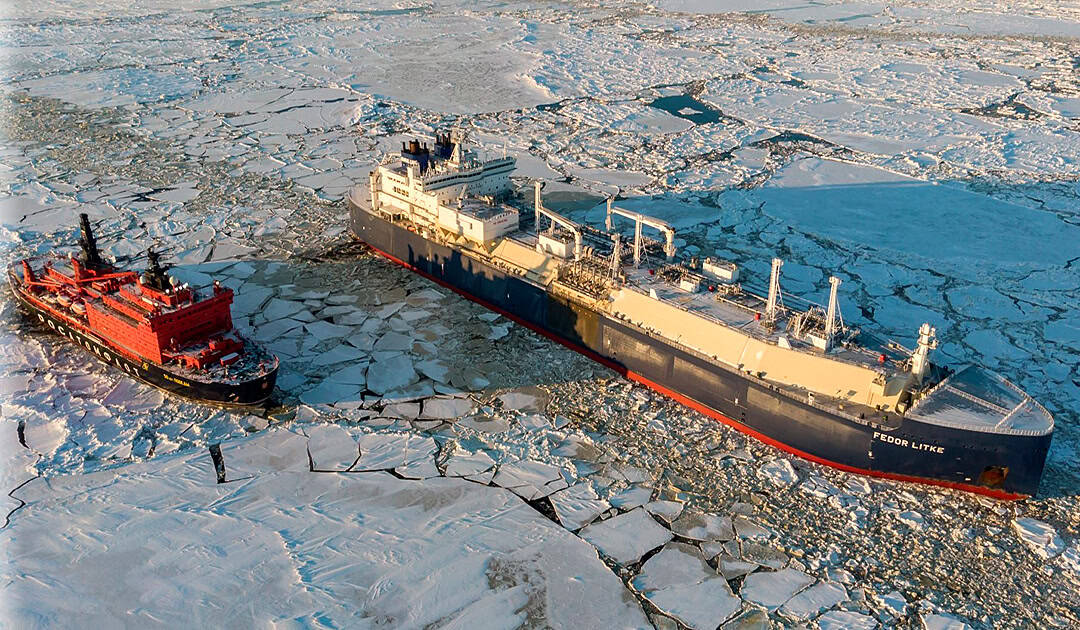
A group of six Arc7-class liquefied natural gas tankers, now idling in South Korean ports, has become the focal point of negotiations between Novatek’s Singapore-based trading arm, Japanese shipowner Mitsui O.S.K. Lines, and South Korean builder Hanwha Ocean, the former Daewoo Shipbuilding & Marine Engineering. According to reports that emerged in early June, the talks concern the fate of vessels built for Arctic service but never delivered to their intended Russian operators because of sanctions.
The ships in question are the Panama-flagged “Lev Landau” (IMO 9918016), “Pyotr Kapitsa” (IMO 9918004) and “Zhores Alferov” (IMO 9918028), along with the Cyprus-flagged “Ilya Mechnikov” (IMO 9918030), “Nikolay Semenov” (IMO 9918054) and “Nikolay Basov” (IMO 9918042). Two of the Cyprus-flagged vessels, “Ilya Mechnikov” and “Nikolay Semenov,” are currently controlled by Mitsui through subsidiaries Arctic Gold LNG Shipping Ltd and Arctic Bronze LNG Shipping Co Ltd.
Built for Ice, Stranded by Sanctions
All six carriers were constructed for the Arctic LNG 2 hub, but sanctions on Russia’s gas sector have complicated their transfer to intended buyers Novatek and Sovcomflot. Neither the vessels themselves nor Hanwha Ocean — which maintains an ongoing relationship with the Russian Maritime Register of Shipping — have so far been placed under sanctions.
Russian negotiators are reportedly pushing for a new ownership scheme that would allow the tankers to eventually carry LNG from the Arctic to China. Their central argument is that the vessels’ ice-class design makes them economically inefficient on any other route. The Korean and Japanese owners, for their part, are using sanctions exposure and Russian President’s reported urgency to expand Arctic LNG shipments before the European Union closes its market to Russian LNG in January 2027 as leverage in negotiations.
A Narrow Field of Arctic LNG Producers
Beyond Arctic LNG 2 and Novatek’s older Yamal LNG project, the only other Arctic LNG producer is Norway’s Hammerfest LNG, which operates at smaller volumes. The stranded tankers were specifically designed for the Northern Sea Route’s eastern stretch, where ice conditions are harsher than in the Barents and Norwegian seas, where lighter ice-class vessels can operate.
From KGB Asset to Gas Oligarchy: The Origins of Yamal LNG
The roots of today’s Arctic LNG dispute trace back to the 1990s, when former KGB officer Nikolai Bogachev brought the Yuzhno-Tambeyskoye field’s reserves into the public sphere and attempted to attract Emirati investors through a company called Yamalneftegaztekhnologii. Bogachev’s innovation — exporting LNG by sea rather than through Gazprom-controlled pipelines — was intended to bypass Gazprom’s pipeline monopoly entirely.
In his effort to fend off Gazprom, Bogachev courted then-Yamal governor Yuriy Neyolov and deputy governor Iosif Levinzon by offering stakes to their associated funds. Levinzon’s structures, however, transferred the resulting field stakes to entities tied to Leonid Mikhelson, a figure from the Soviet pipeline-construction milieu and founder of Novatek. Subsequent attempts by Bogachev to reverse the losses — through criminal contacts, law enforcement pressure, and an appeal to Putin confidant Vasily Shestakov — failed. Mikhelson gradually squeezed Bogachev out of the project, and pressure mounted for him to cede shares to Gazprombank.
The Law That Ended Russia’s Independent Gas Export Ambitions
In June 2006, Bogachev managed to move the Yuzhno-Tambeyskoye license to a separate company, evading Gazprom’s grasp. The victory proved short-lived: within a month, Russia passed legislation establishing Gazprom’s exclusive monopoly on gas exports, eliminating independent producers’ room to maneuver. Minority gas producers Itera and Nortgaz were subsequently absorbed by Gazprom with little resistance from their beneficiaries, who received buyouts. Bogachev, cornered, sold his remaining stake through intermediary Alisher Usmanov, who acquired roughly three-quarters of his Yamal assets.
During the 2008 financial crisis, Usmanov sold those same assets — not back to Gazprom-linked entities, but to Gennady Timchenko, then co-owner of the Swiss-registered oil trader Gunvor and a close Putin associate. Timchenko, lacking deep expertise in the Yamal fields themselves, instead leveraged his access to the Kremlin, forming an alliance with Mikhelson and Novatek through a share exchange completed by 2008.
Selling the Kremlin on Arctic Dominance
Novatek’s pitch to the Kremlin combined the promise of expanded energy exports with a strategic narrative around reviving the Northern Sea Route and establishing Russian “Arctic dominance” — framing that gained traction as Gazprom’s own LNG projects on the Baltic, Sakhalin and Yamal had stalled. In exchange for tax exemptions, export rights, and federally funded port and infrastructure construction at Sabetta and Utrenny, Novatek sought foreign capital for its projects.
French energy major Total became the principal outside investor, with then-CEO Christophe de Margerie signing a cooperation memorandum with Mikhelson in March 2011 at Putin’s Novo-Ogaryovo residence and committing more than $5 billion. Chinese state-owned China National Petroleum Corporation and its subsidiaries began investing by January 2014.
A Fatal Flight and a Renamed Tanker
Russia’s annexation of Crimea and the war in eastern Ukraine triggered the first wave of sanctions, with Timchenko’s role as both Novatek co-owner and financier of the Kerch Bridge construction making his businesses a prime sanctions target. In October 2014, de Margerie traveled to Moscow for talks aimed at resolving the impasse; in the early hours of October 21, his business jet collided with a snowplow on the runway at Vnukovo Airport, killing him. Novatek later named one of its tankers after de Margerie — a gesture whose context differs sharply from the absence of EU sanctions against Total, both in 2014 and in 2026.
Sanctions Track the Fleet, Not the Pipelines
Novatek’s first LNG shipment from Yamal in 2017 went not to China via the Northern Sea Route but to Boston, exposing the difficulty of tracking maritime gas shipments compared with pipeline flows. U.S. sanctions policy targeting Novatek structures has intensified since, with the most recent major package imposed in January 2025.
Despite a 2018 Kremlin target of 80 million tons of Northern Sea Route cargo by 2024 — half of it from Novatek — Russian state media reported total 2025 throughput of only 37 million tons, overwhelmingly concentrated on the western leg between Yamal and Murmansk. Eastern ports such as Tiksi and Pevek handled no more than 700,000 tons combined in 2024–2025, with transit cargo limited to 100,000–200,000 tons per port. Osetrovo, Russia’s largest river port on the Lena and a key hub for Arctic resupply, moved no more than a million tons in 2023–2024, and its operator, Starvey, has not published 2025 figures.
The Only Two Ships That Sail East
Among Novatek’s entire Arctic fleet, only the “Christophe de Margerie” (IMO 9737187) and the newly commissioned “Aleksey Kosygin” (IMO 9904546) — built domestically at the Zvezda shipyard — currently sail LNG eastward along the Northern Sea Route to the Kamchatka transshipment terminal “Koryak FSU.” The remainder of the fleet ships product westward through the Barents Sea via the Murmansk-area terminal “Saam FSU.”
Nine Russian-flagged tankers made more than 20 voyages to China’s Tieshan port in 2025, including transfers between Chinese ports and the Kamchatka hub. These vessels — “Arctic Mulan,” “Arctic Metagaz,” “Arctic Pioneer,” “Arctic Vostok,” “Buran,” “Iris,” “Voskhod,” “Zarya” and “La Perouse” — are all registered to St. Petersburg-based entities and supervised by the Russian Maritime Register of Shipping. “Arctic Metagaz” was damaged in an explosion in the Mediterranean Sea in March 2026.
Layers of Shell Companies Obscure True Ownership
Corporate filings show the older Korean-built tankers are formally managed by SMP Techmanagement LLC, founded by Moscow-based Baka LLC, whose listed beneficiaries — general director Viktor Tikhomirov, manager Aleksandr Vigovsky and founder Igor Mikheev — show signs of nominee status. The vessels’ declared owners, Liberian firms Zinnia International Co, Lule One Services Inc and Zara Shipholding Co, are under U.S. sanctions.
The newer tankers “Buran,” “Iris,” “Voskhod” and “Zarya” are registered to four St. Petersburg companies sharing an address on Bolshaya Morskaya Street, all founded by entities linked to Moscow businessman Oleg Shishanov, a former hotel-industry figure with similar nominee characteristics. Their declared beneficial owners — Singapore-registered “LNG Alpha Shipping,” “LNG Beta Shipping,” “LNG Gamma Shipping” and related entities — are sanctioned by the United States as structures tied to Arctic LNG 2.
Novatek’s European Footprint Persists Despite Sanctions
Novatek’s Swiss subsidiary, Novatek Gas & Power GmbH, headed by former Socar official Sergey Gzhelyak, remains registered in the canton of Zug, where local authorities, including finance department head Heinz Tännler, have supported its continued presence. A related Swiss shipping firm, Vintage Shipping & Trading AG, operates four Panama-flagged tankers that have called at the Russian port of Ust-Luga as recently as 2026.
In Poland, Novatek-linked entities Novatek Polska and Novatek Green Energy — headed by Dariusz Piotr Bratoń and previously employing more than 100 people with annual revenue of roughly one billion zloty — controlled three thousand railcars used to import Russian LNG before the war. Polish authorities ordered a forced sale of Novatek Green Energy’s assets in 2023 after the company restricted gas supplies to consumers, but the assets were ultimately transferred to Geleo sp. z o.o., a firm described as belonging to former Novatek employees and headed by the same Bratoń — a restructuring that critics say amounts to a rebranding rather than a genuine divestment.
Washington’s Sanctions Reach China and India
U.S. sanctions imposed in January 2025 targeted Novatek’s Baltic subsidiary Kriogaz Vysotsk, the Arctic LNG 2 project itself, Chinese equipment suppliers Zhoushan Wison Offshore and Marine and Hongkong Yaqing Shipping, Novatek’s Chinese subsidiary Novatek China Holdings, and eight affiliated firms in the Xuanwu group. Indian tanker operators Skyhart Management Services and Avision Shipping Services, which operated vessels carrying Arctic LNG 2 cargo, were also sanctioned.
The Vulnerability Ahead
The future of Russia’s eastern Arctic LNG shipments now hinges on whether Moscow secures control over the Arc7 fleet stranded in Korea and whether Zvezda can continue building ice-class tankers without German-made engines — “Aleksey Kosygin’s” propulsion system, built by MAN Energy Solutions in 2020, underscores the shipyard’s continued dependence on Western components currently barred from export to Russia. Analysts argue that sanctions on the Russian Maritime Register of Shipping itself — the body overseeing the fleet from construction to delivery — would do more to disrupt the system than measures against individual vessels, and note that Leonid Mikhelson’s continued absence from sanctions lists remains a notable gap. The floating storage terminals, including “Saam FSU,” are widely seen as the system’s most exposed point, a vulnerability reflected in Russia’s practice of sheltering them at military-controlled anchorages such as Ura Bay near Murmansk.