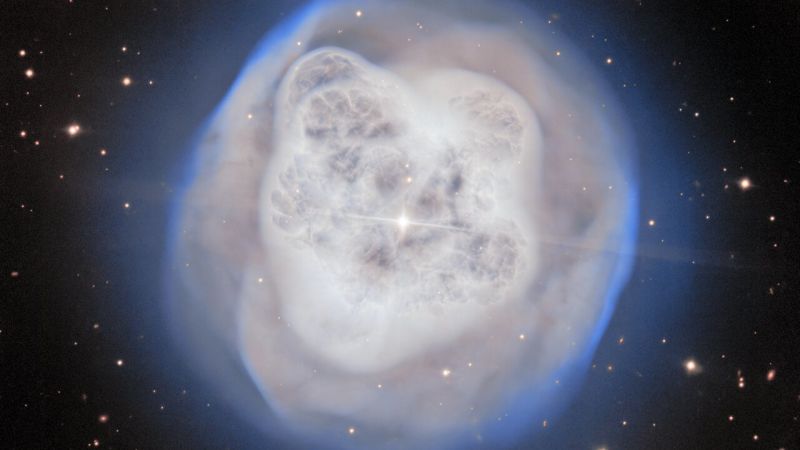
A new image showcases a dazzling celestial object — a star paired with another, in the throes of dying that resembles a crystal ball, reports BritPanorama.
Scientists captured the image of NGC 1514, nicknamed the Crystal Ball Nebula, with the Gemini Multi-Object Spectrograph. The instrument is mounted on the Gemini North telescope, located on Maunakea, a dormant volcano in Hawaii.
Researchers dedicated evenings to observe the skies and identify something awe-inspiring, said astronomer Travis Rector.
“It’s a way to share with people just how amazing our universe is, so the nebula was not a science target, it was one that was chosen just because it looks really cool,” said Rector, a member of the NOIRLab team that took the image. NOIRLab is short for the National Science Foundation’s National Optical-Infrared Astronomy Research Laboratory.
The image reveals the striking details of the planetary nebula, which lies about 1,500 light-years from Earth in the Taurus constellation. A light-year is the distance light travels in one year, which is approximately 5.88 trillion miles (9.46 trillion kilometers) — meaning the light depicted in the image was emitted about 1,500 years ago.
Planetary nebulae derive their name from their resemblance to planets when observed through a small telescope. These celestial objects form as dying stars eject their outer layers, creating a region of dust and gas around the star’s core — a white dwarf.
“They have their own distinct shapes. They’re really spectacularly beautiful objects and they often have these very complex yet symmetric structures,” said Rector, professor of physics and astronomy at the University of Alaska Anchorage.
The stunning image allows scientists to observe how a two-star system is affected when one star reaches the end of its life before the other.
A two-star system
The Crystal Ball Nebula contains a binary star system: two stars that formed near each other and orbit around one another. More than half of the stars in our galaxy are part of multi-star systems, according to NASA.
“The first star is blowing off its outer layers. The other star, just by orbiting around that first star, kind of turns things up and makes these beautiful complex shapes,” Rector said.
The nebula’s colors appear vivid due to a filter in the spectrograph that allows specific wavelengths of light to pass through, corresponding to specific types of gas. The reddish hues come from hot hydrogen, while bright blue results from hot oxygen, which are typically the gases most abundantly produced by planetary nebulae.
The Crystal Ball Nebula was first observed by German-British astronomer William Herschel in 1790, who coined the term “planetary nebula” when he noticed the objects’ planet-like shape.
One star in this binary system takes nine years to orbit the other, which is relatively long, according to Rector, influencing the nebula’s unusual cloudlike shape.
As the orbiting star moves, it churns the shell of gas expanding off its partner, creating the nebula’s shape — akin to cotton candy swirling to form its cloud of sugar, Rector noted.
Learning from Crystal Ball Nebula observations
Jan Cami, a professor of physics and astronomy at Western University in London, Ontario, likens planetary nebulae to butterflies because of their diverse colors and shapes. He did not participate in the work that produced the new image.
The appearance of a nebula can change when viewed through telescopes operating on different wavelengths.
“If you look at the same object with the James Webb Space Telescope, you would swear you’re actually looking at a completely different object,” Cami said. “It’s one of the reasons we study these objects at different wavelengths.”
Even though Herschel discovered this nebula more than two centuries ago, scientists continue to observe and learn from it. As technology advances, telescopes can capture higher-quality images.
Planetary nebulae have a relatively brief dying phase — around 10,000 years. This short duration, astronomically speaking, enables scientists to closely monitor celestial objects as they approach the end of their life, according to Cami.
“In 10 or 20 years, you can see the temperature of the central star changing, observe its effect on the nebula, and note how this material is expanding into space,” Cami said, highlighting the importance of ongoing monitoring.
These captivating images excite both astronomers and the public, revealing previously undetected celestial bodies.
“I’ve seen many images, and at some point, you think, I probably have seen most of it, and then you get something like this and oh my god, it’s spectacular again,” Cami said.