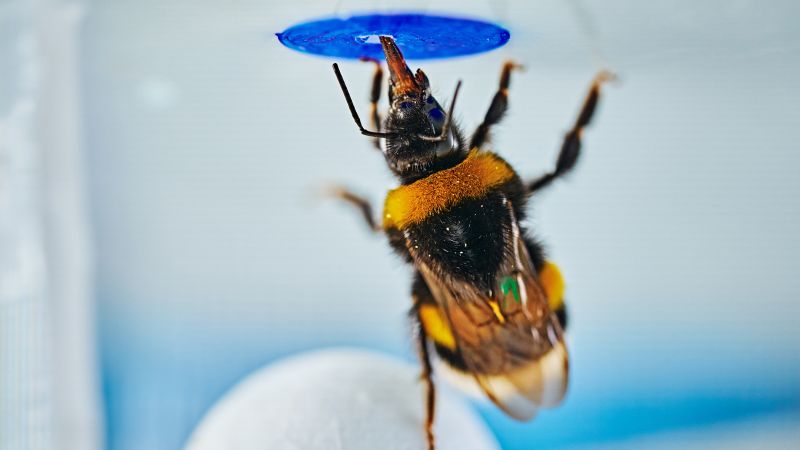
New research shows bumblebees can solve problems unexpectedly
A study published Thursday in the journal Science reveals that bumblebees can exhibit insight by rolling a ball to access a hidden reward, demonstrating spontaneous problem-solving abilities. This finding challenges previous notions about cognitive capabilities in certain species, suggesting that bumblebees, with their small brains, can engage in complex behaviors typically associated with larger animals like apes and elephants, reports BritPanorama.
The experiment involved a circular arena where bumblebees were trained to associate a blue flower with a sugary reward. Initially, the bees were shown a foam ball and an accessible flower. When the flower was covered by the ball, the bees learned to push it aside to reach the flower. The final challenge required them to roll the ball beneath a flower placed above a pit, with 75% successfully leveraging the ball to obtain the reward.
These results suggest a level of cognitive flexibility not typically attributed to insects. Notably, this ability to understand and manipulate objects to solve a problem indicates a deeper cognitive process at play. “[The experiment] shows that they can remember a hidden goal location and manipulate an object in relation to that goal,” remarked James Nieh, a professor in the Department of Ecology, Behavior and Evolution at the University of California San Diego.
The implications of this research extend to understanding how insects adapt to challenges in their environments. Natalie Hempel de Ibarra, an associate professor at the University of Exeter, highlighted that this flexibility might also influence how bumblebees interact with flowers as their habitats change.
Getting the ball rolling
The researchers designed an experiment where they initially familiarized the bumblebees with a safe foam ball. In subsequent scenarios, the flower was hidden or elevated, requiring the bumblebees to recall their earlier experiences with both the flower and the ball to navigate a solution. This indicates that the bees utilized past interactions to solve new challenges, appealing to their problem-solving crux while illustrating their cognitive procession.
While the bumblebee’s problem-solving abilities were impressive, it should be noted by researchers that this does not equate to human-like reasoning. The study emphasizes that these insects demonstrate true goal-directed behavior but stops short of labeling their actions as tool use, a heavily debated concept in animal cognition.
Lars Chittka from Queen Mary University of London noted the novelty of the findings, likening the bees’ actions to humans finding a tool to achieve their goals. “It requires some understanding of the task at hand, keeping in mind where the target is, and taking appropriate action,” he said.
As cognitive research on insects continues to unfold, studies like this underscore the significance of understanding how various species—regardless of size—navigate their environment and solve problems creatively. The precedent it sets may prompt a re-evaluation of intelligence across differing biological systems, recognizing a spectrum of thought that transcends traditional categories.