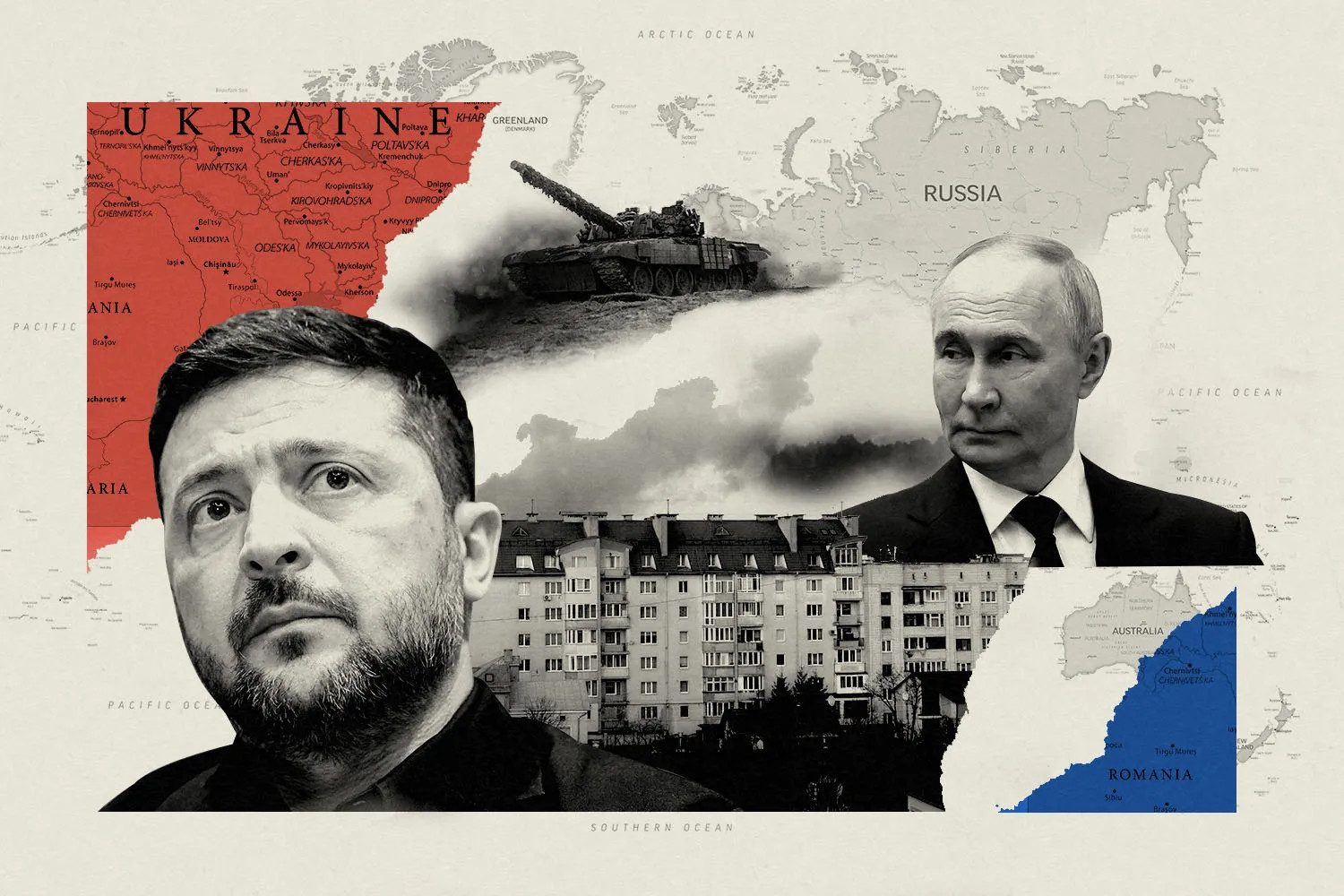
Ukraine remains Europe’s front line against Russian expansion
A Russian victory over Ukraine would not be limited to a change of borders in Eastern Europe. It would mark a direct challenge to the post-war security order and create a wider crisis for the continent. Ukraine has spent more than three years absorbing the main force of Russia’s full-scale invasion, paying for that role with heavy casualties, mass destruction and sustained pressure on its state institutions. If Kyiv were forced into defeat or capitulation, Moscow would gain territory, resources, military depth and a political signal that Western deterrence had failed.
The strategic consequences would extend beyond Ukraine itself. A weakened or occupied Ukraine would give Russia a larger platform for military pressure on NATO’s eastern flank. It would also deepen risks around energy security, migration, critical infrastructure and political stability from the Baltic region to the Atlantic. The central issue for Europe is therefore not only whether Ukraine survives as a sovereign state, but whether the wider European security system can withstand Russia’s revisionist strategy.
Kyiv’s resistance has reshaped the military balance in Europe
Ukraine’s armed forces have become one of the most experienced militaries in Europe through continuous high-intensity combat against a larger opponent. Since the opening phase of the full-scale invasion in 2022, Ukraine has prevented Moscow from achieving a rapid seizure of Kyiv and forced Russia into a prolonged war of attrition. That resistance has relied on public mobilisation, battlefield adaptation, Western military support and the fast use of new technologies, including drones and electronic warfare systems. By tying down Russian forces inside Ukraine, Kyiv has limited Moscow’s ability to project the same level of direct pressure elsewhere in Europe.
Ukraine’s military experience is now relevant far beyond its own battlefield. Its forces have accumulated practical knowledge in air defence, counter-battery operations, drone warfare, asymmetric strikes and rapid tactical adjustment under sustained pressure. The article’s underlying argument is that this experience has become a security asset for NATO as well as for Ukraine. European planners are already drawing lessons from the war, because Ukraine is demonstrating how modern large-scale conflict is being fought in real time.
The idea of Ukraine as a European shield is not only symbolic. Without Ukrainian resistance, Russian troops could be positioned much closer to Poland, the Baltic states and other NATO territory. Moscow has been forced to spend vast military, financial and industrial resources in Ukraine rather than redirecting them to further escalation against neighbouring states. A collapse of that resistance would therefore alter the strategic map and weaken confidence in Europe’s ability to defend its own security architecture.
Russia is testing NATO through hybrid pressure and military threats
Russia is already probing the vulnerabilities of European states through hybrid operations. These include sabotage risks, cyberattacks, disinformation campaigns, airspace incidents and pressure on critical infrastructure. Such activity allows Moscow to test the response of NATO and EU governments without immediately triggering a conventional military confrontation. If Russia gained control over Ukraine, the same methods could be backed by a stronger military position and a larger pool of available resources.
The Baltic region, Poland, Moldova and the Black Sea area would face particular exposure under such a scenario. The source text refers to potential risks around Narva in Estonia, the Suwalki corridor and pressure on Latvia as examples of scenarios discussed in Western security debate. These are not presented as confirmed attack plans, but as indicators of how analysts assess Russia’s possible escalation routes. The broader point is that Moscow’s current campaign is not confined to Ukraine; it is part of a wider contest over Europe’s security order.
Poland’s Eastern Shield project is presented as a concrete example of preparation against that risk. The programme is designed to strengthen defences along borders with Belarus and Russia’s Kaliningrad region through fortifications, military infrastructure and air defence measures. Its political message is clear: deterrence requires visible capacity, not only declarations. Other European states face the same strategic question as defence budgets, industrial capacity and military readiness come under renewed pressure.
Moscow’s wider objective is to weaken the European security order
The Kremlin’s strategic aim is described as the restoration of a Russian sphere of influence across parts of Eastern and Central Europe. That objective has been visible in Russia’s actions against Ukraine, its control over Belarus and its continuing pressure on neighbouring states. A Russian victory in Ukraine would create a major staging ground for further coercion and would strengthen Moscow’s claim that force can rewrite borders. It would also encourage further attempts to divide European governments and weaken collective decision-making.
Putin has repeatedly framed NATO enlargement and Western military support for Ukraine as issues of strategic confrontation. The source text says Moscow wants to push NATO back from the security position it established after the late 1990s. That would directly challenge the principle that European states can choose their own alliances and security arrangements. If Article 5 credibility were questioned, Russia would gain leverage without necessarily needing immediate full-scale war.
The risk is not only military. A Russian victory would increase pressure on European economies, intensify migration risks, strengthen extremist and pro-Kremlin political forces, and create uncertainty across energy and defence markets. It would also reward a strategy built on invasion, coercion and long-term destabilisation. For European governments, the cost of preventing that outcome is weighed against the far higher cost of confronting a stronger Russia later.
Strengthening Ukraine is the cheapest route to European deterrence
The most direct way to reduce the risk of a NATO-Russia confrontation is to reinforce Ukraine’s defence capacity. That means sustained deliveries of modern weapons, deeper defence-industrial cooperation, training, air defence integration and long-term security guarantees. Ukraine’s role should not be treated as temporary emergency support, but as part of Europe’s own defence planning. Investment in Ukrainian military strength is therefore an investment in the security of the wider continent.
The source text argues that the cost of supporting Ukraine is lower than the cost of a future direct confrontation with Russia. That calculation is central to the European debate. If Moscow is stopped in Ukraine, NATO gains time to rebuild its defence industry, strengthen its eastern flank and reduce strategic vulnerability. If Moscow prevails, Europe faces a more dangerous security environment with fewer buffers and greater uncertainty.
Europe’s decision is therefore strategic rather than symbolic. Either Ukraine is strengthened as the forward line of European security, or Russia is allowed to test the continent from a more advantageous position. Delay would give Moscow more time to adapt, rearm and exploit political divisions. The outcome in Ukraine will shape whether Europe’s security order holds or enters a deeper period of instability.