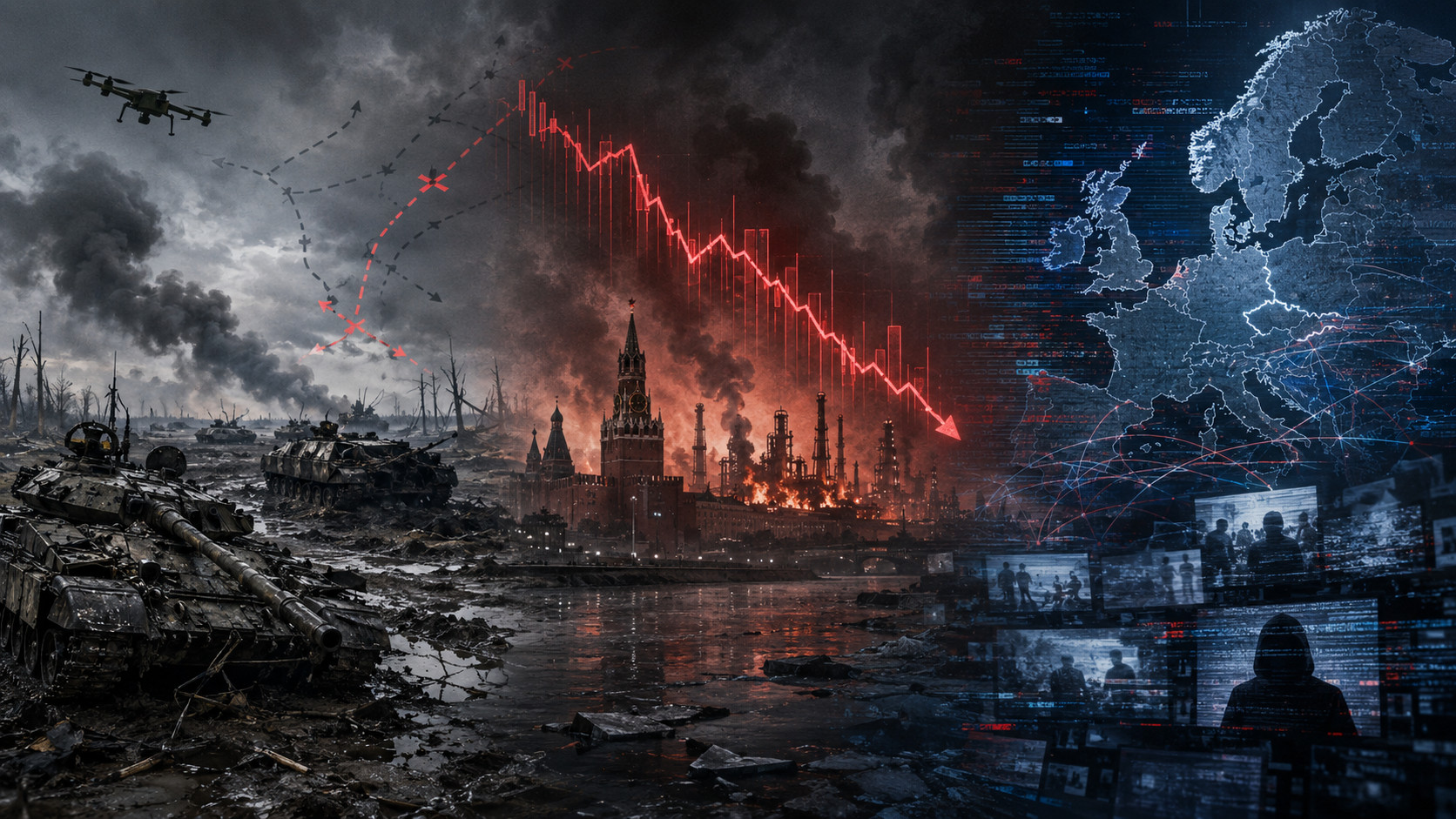
Russia’s spring campaign in Ukraine has failed to deliver the battlefield momentum Moscow had sought, while pressure on its economy and wider security posture is mounting. Recent battlefield assessments indicate that Russian forces lost net control of 116 square kilometres of Ukrainian territory in April 2026, reversing the image of slow but steady advance. The setback has coincided with a sharp downgrade in Russia’s official 2026 growth forecast, higher inflation expectations and renewed warnings over Moscow’s activity on NATO’s eastern flank. The result is a war picture defined less by breakthrough than by attrition, economic stress and expanding hybrid pressure across Europe.
Battlefield pressure turns against Russian forces
The front line has moved against the narrative promoted by Moscow that Russian forces can grind forward indefinitely. April’s net territorial loss marked a significant reversal after months of slowing Russian advances, with Ukrainian counter-attacks and drone operations continuing to damage logistics, command links and supply routes. Russian forces remain capable of local attacks, but the broader trend points to rising costs for limited gains. That shift matters because Moscow’s campaign depends on maintaining the perception that time and mass remain on its side. The latest territorial data weakens that claim and raises questions over the sustainability of further offensive operations.
Economic forecasts expose pressure inside Russia
Russia’s official economic outlook has also deteriorated. The government cut its 2026 GDP growth forecast from 1.3 per cent to 0.4 per cent and raised its inflation projection to 5.2 per cent, signalling weaker expectations even within Moscow’s own published figures. The downgrade reflects the strain of sanctions, wartime spending, labour shortages and restricted investment channels. It also narrows the Kremlin’s room for manoeuvre as military demands compete with civilian industry and household pressures. A slowing economy does not by itself end Russia’s war effort, but it raises the cost of sustaining it over time.
Pressure spreads towards NATO’s eastern flank
Moscow has paired battlefield difficulties with sharper messaging towards neighbouring states. Russian officials have continued to target Poland and the Baltic states in public threats, while the region has faced heightened security alerts and concern over airspace incidents. NATO and EU officials have treated the Baltic risk environment as a direct European security issue, not a local dispute. The use of Belarus as a military staging area remains central to this concern, given its proximity to northern Ukraine, Poland and Lithuania. The pattern points to a wider pressure campaign designed to force Europe to divide attention between Ukraine and its own border security.
Transnistria move raises mobilisation concerns
Russia’s decision to ease citizenship rules for residents of Moldova’s breakaway Transnistria region has added another point of tension. The decree allows eligible adults in the region to obtain Russian citizenship through a simplified process, bypassing several standard requirements. Moldova’s prime minister, Alexandru Munteanu, said: “A Russian passport is becoming the passport of an aggressor state that is not recognised in the civilised world.” He linked the move to an attempt to send more soldiers to the front as recruitment rates decline. The measure has therefore been read in Chisinau as both a political instrument and a potential manpower tool.
Information warfare becomes a central battlefield
The military and economic pressure has increased the importance of information operations aimed at weakening European support for Ukraine. The supplied material describes alleged Russian plans to amplify narratives around Ukraine’s mobilisation, political leadership and internal disputes through proxy media channels. Such claims require careful handling because the specific documents and lists cited in the material were not independently verifiable from the text alone. What is clear is that disinformation, influence campaigns and pressure on public opinion remain core instruments of Moscow’s wider strategy. For European states, the risk is that military pressure, economic coercion and media manipulation operate as one campaign rather than separate tracks.
Ukraine, Russia, Europe, NATO, Moldova, Belarus, Economy