Wealthy Russians have reportedly found a way to split the cost of a Greek “golden visa” by entering into sham same-sex partnerships. The scheme, described by the Russian outlet Baza, illustrates how the drive for European residency collides with patriotic rhetoric about “traditional values”.
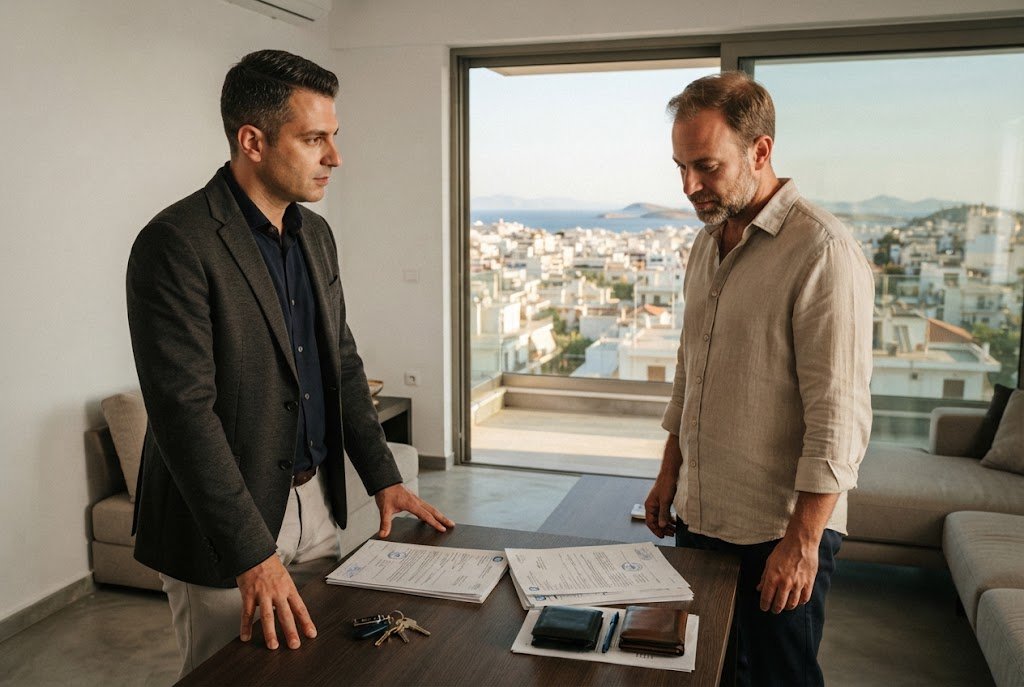
According to Baza, Russian millionaires are allegedly obtaining Greek residency permits through a scheme that halves individual costs. One participant reportedly buys property worth €250,000, then enters into a sham same-sex partnership with a second person. Both then apply for residency permits — having effectively split the cost of the required purchase between them.
The report offers no official confirmation of the claims. But the arrangement described by Baza rests on straightforward financial logic: rather than one person covering the full €250,000 threshold alone, the cost is split between two participants — roughly €125,000 each. An investment designed for a single owner is thus turned into a joint route to European status.
The “golden visa” as a family calculation
The essence of the alleged scheme lies not in the property itself, but in the use of a personal relationship to bring down the cost of European residency. As Baza tells it, one participant buys the property, while the second is able to apply for the same permit alongside them through a registered partnership.
This is where the most striking contradiction emerges. Official Russian rhetoric on “traditional values” presents same-sex relationships as alien and unacceptable. Yet if Baza’s account is accurate, attitudes among some wealthy Russians shift when what’s at stake is residency, access to the Schengen area, a European bank account and the chance to live further from sanctions.
Read this way, the alleged union becomes not an expression of personal conviction but a tool of financial and migration planning — its value defined not by the substance of the relationship, but by which documents it unlocks and how much money it saves.
Pragmatism over public principle
The case reported by Baza matters chiefly as an illustration of the gap between public declarations and private behaviour. While the patriotic agenda demands demonstrative loyalty to certain “core values”, the practical choices of wealthy individuals may be shaped by altogether different considerations: the cost of the paperwork, access to European mobility, and the ability to preserve an accustomed way of life.
The arithmetic looks coldly pragmatic. €250,000 for a single applicant is a substantial sum, whereas €125,000 apiece for two participants starts to look like a shared household budget. And the benefit isn’t limited to the saving itself: alongside residency, the original account notes, comes access to the Schengen area and a European bank account.
Baza’s report does not say how many people may have used such a scheme, or how widespread it might be. This is, in other words, an account of an allegedly discovered workaround — not proof of a mass practice. But even a single example can show just how flexible publicly proclaimed principles become when personal safety, money and the ability to remain in Europe are on the line.
European status as a measure of priorities
At the heart of this story lies more than the question of whether one particular deal was fictitious. What matters more is that a European residence permit has become such a coveted asset that people are willing to reshape even the notions of family and morality that are used in Russia as political symbols.
If the scheme as described did take place, it suggests that for some Russian millionaires, the line between ideological loyalty and personal gain runs exactly where the possibility of European status begins. The open question is whether this becomes a mere curiosity — or an example of a wider gulf between public rhetoric and private decisions.
Is this a pragmatic use of the options available, or does it above all expose the hollowness of patriotic rhetoric when it collides with personal advantage?