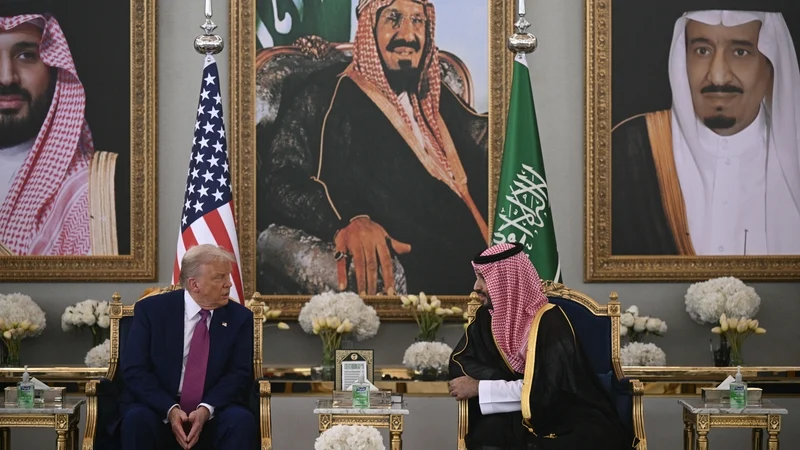
US President Donald Trump has arrived in Saudi Arabia to kick off a four-day visit through the Gulf region, a trip that will focus more on economic deals than on the security crises besetting the region, from the war in Gaza to the threat of escalation over Iran’s nuclear programme.
With business leaders in tow, including Tesla CEO Elon Musk, Mr Trump will first visit Riyadh – where the Saudi-US Investment Forum is taking place – and continue to Qatar tomorrow and the United Arab Emirates on Thursday.
Mr Trump has also said he may travel to Turkey on Thursday for potential face-to-face talks between Russian President Vladimir Putin and Ukrainian President Volodymyr Zelensky.
Mr Trump’s second foreign trip since taking office again – his first was to Rome for Pope Francis’s funeral – comes during a moment of geopolitical tension.
In addition to pressing for a settlement to the war in Ukraine, the Trump administration is pushing for a new aid mechanism for war-torn Gaza and urging Israeli Prime Minister Benjamin Netanyahu to agree to a ceasefire deal there.
Over the weekend, US and Iranian negotiators met in Oman to discuss a potential deal to curb Iran’s nuclear programme. Mr Trump has threatened military action against Iran if diplomacy fails.
But – potential Turkey side trip aside – those matters are not the focus of Mr Trump’s Middle East visit as it is currently scheduled.
The US, Saudi Arabia, Qatar and the UAE are expected to announce potentially trillions in investments.
Saudi Arabia already committed in January to $600 billion (€539.7bn) in investments in the US over the next four years, but Mr Trump has said he will ask for a full trillion.
In addition to Mr Musk, business leaders, including BlackRock CEO Larry Fink and Citigroup CEO Jane Fraser, will also make the trip.
US Secretary of State Marco Rubio and Secretary of Defense Pete Hegseth will travel with the president.
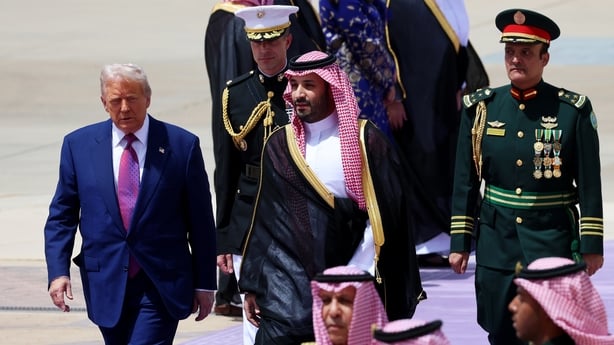
During the Riyadh stop, Mr Trump is expected to offer Saudi Arabia an arms package worth well over $100 billion, sources said, which could include a range of advanced weapons including C-130 transport aircraft.
The US and Saudi Arabia are expected to avoid the topic of normalisation between Riyadh and Israel altogether, sources also said, even as it is Mr Trump’s most enduring geopolitical goal in the region.
Mr Trump’s Middle East envoy Steve Witkoff said last week that he imminently expected progress on expanding the Abraham Accords, a set of deals brokered by Mr Trump in his first term under which Arab states including the UAE, Bahrain, Sudan and Morocco recognised Israel.
However, opposition by Mr Netanyahu to a permanent stop to the war in Gaza or to the creation of a Palestinian state makes progress on similar talks with Riyadh unlikely, according to sources.
Mr Trump’s second and third stops – in Qatar and the UAE, respectively – are similarly expected to focus on economic issues.
Qatar’s royal family is expected to gift Mr Trump a luxury Boeing 747-8 plane to be outfitted for use as Air Force One, an arrangement that has been met with scrutiny by ethics experts.
Mr Trump is expected to donate the plane to his presidential library for use after his term ends.