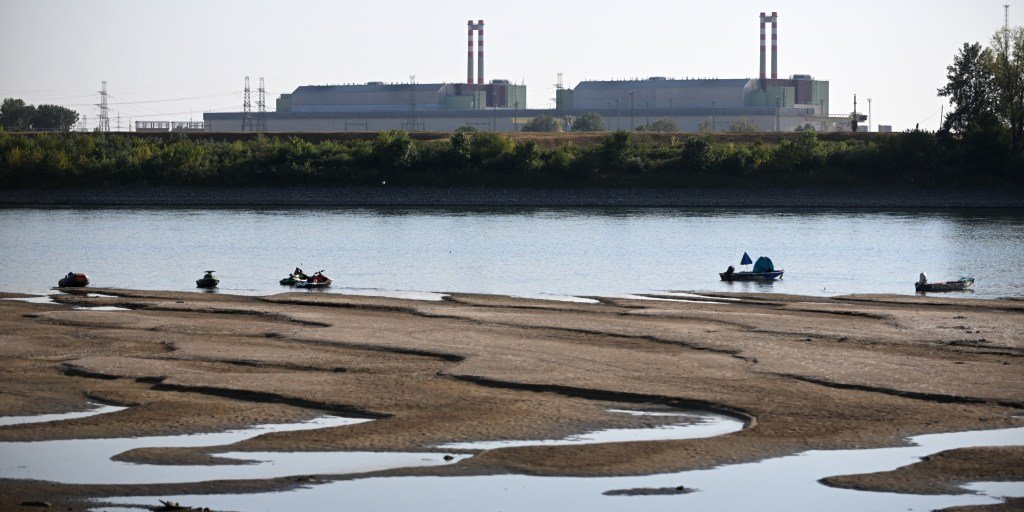
Hungary’s nuclear power plant to shut down due to low Danube water levels
Hungary’s only nuclear power plant will shut down for the first time in its history due to record-low water levels on the Danube River, Prime Minister Péter Magyar said Friday, adding that the plant may not come back online for several weeks as the river is expected to continue receding, reports BritPanorama.
The Paks nuclear plant, located around 50 miles south of Budapest, is currently operating at less than half its normal capacity, producing 965 megawatts of power instead of the usual 2,000 megawatts.
The plant relies on the Danube for cooling its reactors, but the exceptionally low water level has tested the pumps’ ability to bring sufficient quantities of water into the plant.
At a news conference on Friday, Magyar indicated that further reductions in output were imminent and that the entire plant could be powered down by Tuesday or Wednesday. He reassured that the shutdown would be safe and would pose no risk to the public or environment.
With four reactors, the Soviet-built Paks plant accounts for nearly half of Hungary’s electricity production. If it is completely powered down, it will mark the first instance in its 44 years of operation.
Hungary, along with much of Central Europe, has faced a prolonged drought, affecting sectors such as tourism, agriculture, and industry, and prompting residents to confront climate change realities. Current forecasts suggest no significant rainfall, and water levels on the Danube are unlikely to rise significantly in the near future.
Magyar noted that the Danube’s water level has risen only three times in August over the past 20 years, with projections indicating it could drop to as low as negative 144 centimeters (negative 57 inches) — far below the previous record low of negative 98 centimeters (negative 39 inches) set in 2018.
A level of negative 134 centimeters mandates the complete shutdown of the plant, he specified, clarifying that a negative reading indicates the river has fallen below the gauge’s zero reference level rather than being dry.
The Hungarian government has urged large energy-consuming companies to voluntarily reduce their electricity usage in an effort to stabilize the energy supply, especially during peak demand hours from 5 p.m. to 10 p.m.
Magyar confirmed that Hungarian energy conglomerate MOL has pledged to decrease its electricity consumption by 65 megawatt-hours, marking a 40% reduction from its usual usage.
In addition, Magyar announced that his party recommended suspending parliamentary sessions scheduled for Monday and Tuesday to conserve energy. He mandated that all state institutions turn off decorative lighting by Monday.