The Hong Kong government urged caution against attempts to exploit the tragic circumstances surrounding the fire that caused the death of 168 residents, vowing to pursue accountability for the incident, reports BritPanorama.
In a statement, China’s Hong Kong and Macao Affairs Office highlighted the government’s decisive response, asserting that it has demonstrated efficiency and pragmatism in advancing necessary reforms. The statement noted that many residents are gradually emerging from the aftermath of the tragedy and appreciating the support from the government and society.
However, Elaine Pearson, Asia director at Human Rights Watch, criticized the government’s approach, claiming it mirrored Beijing’s tactics of silencing the victims’ voices while promising accountability that may not materialize. Pearson’s remarks reflect concerns over genuine transparency in the government’s response.
Eyewitness Kai Chou, a student from Tai Po, witnessed the flames from a distance and emphasized the need to honor the victims rather than allow the government to frame residents as potential agitators. “You made mistakes too, and yet even when we’re just trying to mourn, you still have to say things like this,” said Chou, expressing disbelief over the government’s messaging.
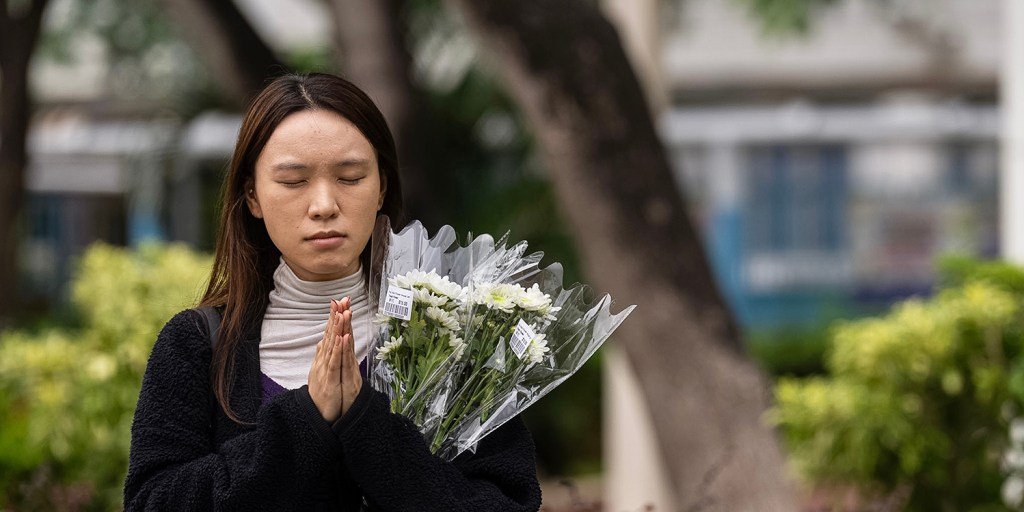
Grace Chan, who offered flowers at a memorial, articulated her struggle to comprehend the changes in Hong Kong following the disaster, tears evident as she spoke to reporters. Her emotional response underscores the ongoing grief felt by many in the community.
Selina Cheng, chairperson of the Hong Kong Journalists Association, noted the obstacles faced by local journalists in reporting on the anniversary of the fire, citing a local television station’s decision not to air its report. This raises questions about media freedom and the environment for journalism in the region.
On the eve of the anniversary, the Hong Kong office of China’s Foreign Ministry emailed foreign media outlets, including The Associated Press, providing context about the government’s ongoing reforms in building maintenance and fire safety regulations. This outreach indicates a push for transparency while addressing issues revealed by the incident.
Religious commemorations are held
Throughout the city, religious commemorations took place, with a Mass in Tai Po that saw hundreds of participants, including bereaved families. In downtown Hong Kong, the names of the 168 victims were read out at a cathedral, highlighting the personal loss experienced by many.
Jenny Lam, a pastor who lost three family members, shared her reflections during the service, noting that although the pain of loss persists, it is essential to cherish life on behalf of those who have passed. “It’s not about forgetting our pain,” she said, emphasizing the need to find meaning and beauty in remembrance.
Phyllis Lo, who lost her mother in the fire, conveyed her thoughts on the anniversary, stating that she hoped the government would take part in commemoration activities. “There was disappointment, but I won’t place any expectations on it anymore,” she remarked, capturing a sentiment of resignation among many residents.
Eric Chan, a government official, previously indicated in a radio interview that the lack of state-held commemorations was due to overlapping community-organized activities, a rationale that some find inadequate.
Investigations into the fire identified a lit cigarette as the likely cause, which then spread rapidly due to the presence of non-fire-retardant materials used in scaffolding. Findings attributed the rapid spread to inadequate oversight of renovation work by several government departments. Just a month earlier, Hong Kong leader John Lee had publicly apologized, and the housing minister resigned in the wake of the disaster’s fallout.
Da Chung, a former resident of Wang Fuk Court who attended the Mass, acknowledged the difficulty many face in dealing with their grief. “Their grief hangs in the air,” she said, reflecting the deep emotional scars left by the tragic event.