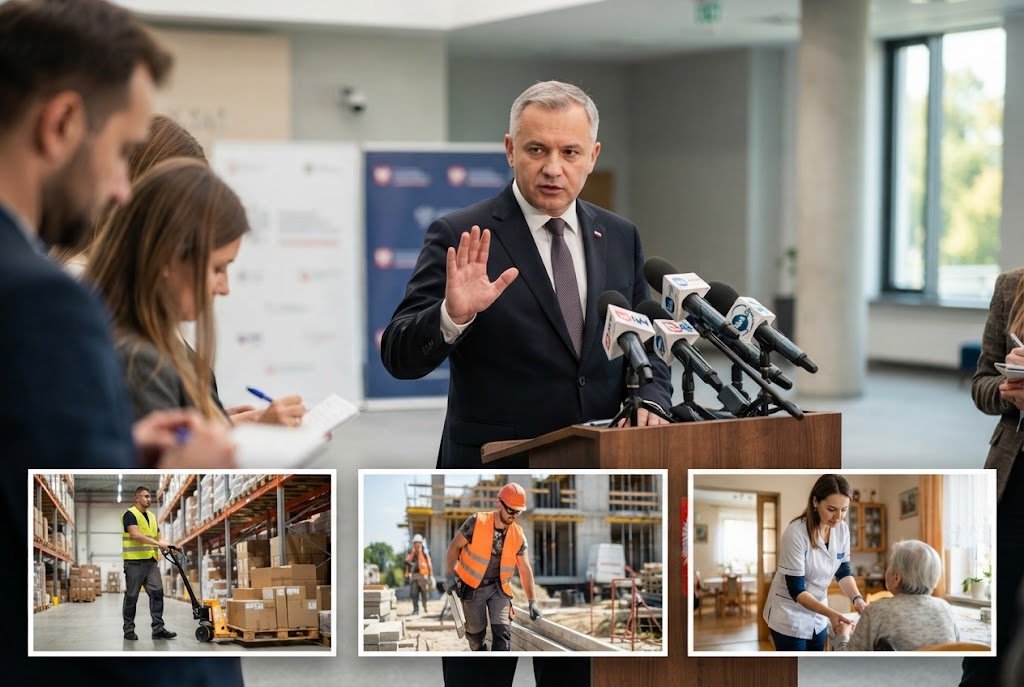
Poland’s Deputy Foreign Minister Marcin Bosacki has described as populist a proposal from the Law and Justice party (PiS) to deport Ukrainian men of military age who are allegedly not in legal employment. He warned that trying to implement such a policy would impose disproportionate political and reputational costs on Poland.
Bosacki said that identifying a relatively small number of people would require raids and checks at private residences. At the same time, he noted that more than 90% of Ukrainians in Poland are legally employed. His comments were reported by Radio TOK FM, which covered his criticism of attempts to use tensions with Ukraine for domestic political purposes: Bosacki criticised the political exploitation of confrontation with Ukraine.
Competition for the far-right vote
According to the Polish official, calls to expel Ukrainians are less a practical response to a specific problem than a political tactic. PiS appears to be competing for support among far-right voters by adopting tougher anti-Ukrainian rhetoric, according to the editorial assessment of the situation.
Such language has consequences beyond the Ukrainians directly affected. Calls for deportations risk worsening Polish-Ukrainian relations and creating political and reputational problems for Warsaw. Bosacki also stressed the disproportionate nature of the proposed measures, arguing that large-scale checks and intrusions into private life would be required to identify only a limited number of people.
There are also potential economic consequences. If large numbers of Ukrainians were pushed out of the Polish labour market, key sectors of the economy could face serious disruption. This highlights the gap between the short-term political appeal of hard-line rhetoric and the potential cost of putting it into practice.
Warsaw and Kyiv seek to reduce tensions
Bosacki’s remarks came against the backdrop of strained relations between Poland and Ukraine. At the same time, he outlined steps being taken by Warsaw and Kyiv to lower tensions. Following a meeting in Lviv with Iryna Vereshchuk, he said the Ukrainian side intended to strengthen engagement with Polish businesses and the expert community.
Other areas of cooperation include efforts to counter xenophobia and to examine claims of possible Russian financing of anti-Ukrainian groups in Poland. According to Bosacki, Kyiv is expected to provide evidence that could substantiate such suspicions. At this stage, the issue concerns possible financing rather than an established fact.
The aim is to move disputes away from mutual accusations and towards more practical cooperation: expanding contacts with Polish economic and expert circles, tackling xenophobic activity and examining the origins of anti-Ukrainian campaigns. The success of these efforts will depend on whether both sides can prevent bilateral relations from becoming further politicised.
Why the dispute has strategic importance
Moscow has a clear interest in deepening divisions between Poland and Ukraine, as such tensions can be exploited to weaken support for Kyiv and undermine unity among Ukraine’s allies. For that reason, anti-Ukrainian rhetoric in Poland has implications beyond domestic party competition.
For Warsaw, the issue is not only how to deal with individual cases of illegal employment, but whether the presence of Ukrainians will be turned into a tool of political mobilisation. For Kyiv, the challenge is to show that reducing tensions can be based not only on diplomatic statements but also on meaningful engagement with Polish society, business and experts.
What happens next will depend on whether these initiatives are followed by concrete action or overshadowed by renewed calls for deportations. The outcome will affect both the domestic climate in Poland and the resilience of Polish-Ukrainian relations against efforts to exploit their differences.
Can practical cooperation between Kyiv and Warsaw reduce tensions more effectively than political rhetoric about deportation?