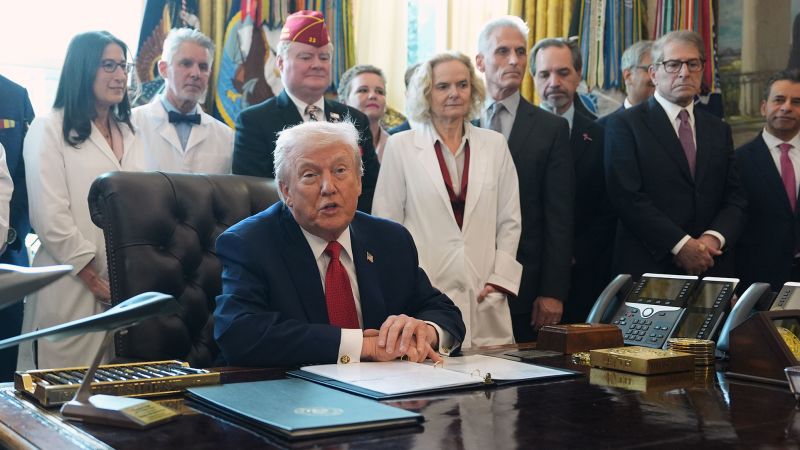
President Donald Trump signed an executive order on Thursday to expedite the reclassification of marijuana – an effort to increase research on its medical use but not fully legalize it, reports BritPanorama.
Trump stated, “This reclassification order will make it far easier to conduct marijuana-related medical research, allowing us to study benefits, potential dangers and future treatments.” He expressed optimism that the order would have a “tremendously positive impact.” The directive instructs Attorney General Pam Bondi to accelerate the process of loosening federal restrictions, though no specific timeline has been provided. This move follows significant lobbying efforts from the cannabis industry.
“I’ve never been inundated by so many people as I have about this particular reclassification,” Trump remarked. Currently classified as a Schedule 1 drug alongside substances like heroin, the intention is to reclassify cannabis to Schedule 3, indicating “a moderate to low potential for physical and psychological dependence,” according to the Drug Enforcement Administration (DEA).
Trump noted the necessity for the federal government to acknowledge marijuana’s legitimacy in medical applications, suggesting it could serve as a substitute for opioids. However, this executive action does not legalize marijuana federally; it remains legal in several states. The directive also emphasizes the need for the White House to collaborate with Congress to redefine hemp-derived cannabinoid products following restrictions in recent government funding legislation.
This news has been received positively by advocates of CBD and hemp farmers, with many relieved after Congress passed a measure last month that raised concerns about CBD product availability. Dr. Mehmet Oz, the administrator of the Centers for Medicare & Medicaid Services, announced a new model to allow funding for CBD for some seniors, reflecting a broader shift in policy that could benefit many who rely on such treatments.
Thursday’s order was welcomed by the cannabis industry, which had endeavored to influence Trump’s decision. Kim Rivers, CEO of Trulieve, noted that while this action is a step forward, significant obstacles remain. She expressed, “We’ve been operating with both hands tied behind our back,” acknowledging that barriers still exist.
Despite the enthusiasm from the cannabis sector, critics have voiced concerns that the reclassification may downplay the risks associated with marijuana. Furthermore, while Trump has been considering these policy changes, there appears to be division among officials regarding the specifics of implementation.
Historically, the DEA has been resistant to rescheduling marijuana, maintaining that its medical benefits have not been sufficiently proven. President Joe Biden’s 2022 directive for a review of its classification has led health officials to recommend the potential for Schedule 3 status.
A symbolic step for drug research
This latest order represents a symbolic first step for drug research, according to scientists and policy experts who observe that significant regulatory hurdles still exist concerning the cultivation and study of cannabis. Cat Packer from the Drug Policy Alliance highlighted the uncertainty surrounding the enforcement and prescription of cannabis under the new regime.
While reclassification as Schedule 3 theoretically allows for medical prescriptions, the legal gray area complicates this status, leaving many doctors unsure about how to navigate these regulations. “Doctors are going to have a real struggle to figure out how to help their patients,” said Sue Sisley from the Scottsdale Research Institute.
Despite the mixed reactions, the order energized advocates of CBD, particularly after legislative changes threatened its availability. Paige Figi, who famously lobbied for CBD use in treating her daughter’s epilepsy, emphasized the importance of transparency and access to safe products for patients in need.
However, some industry veterans caution that while the order is a hopeful sign, it does not address the fundamental barriers that cannabis businesses continue to face, such as issues surrounding banking and taxation. Adam Hoffer from the Tax Foundation noted that the current tax code penalizes cannabis businesses, limiting their potential for profitability.
The reclassification has been described as “probably the biggest Christmas wish that any operator in the cannabis space could ask for,” underscoring the high stakes involved for those in the industry.
This story highlights ongoing shifts in cannabis policy and the complexities that accompany them, suggesting that the discussion around marijuana research and legality is likely to continue evolving.