Severe solar storm set to create auroras and disrupt communications
Powerful solar activity released by the sun is heading for Earth, likely to generate dazzling auroral displays in unusual regions on Monday evening and early Tuesday morning. The event could also interfere with satellite-based communications and GPS accuracy, reports BritPanorama.
A solar radiation storm, rated at a level four out of five on a severity scale, is currently being monitored by the National Weather Service’s Space Weather Prediction Center (SWPC).
“An S4 severe solar radiation storm is now in progress – this is the largest solar radiation storm in over 20 years,” SWPC announced on X, formerly known as Twitter. “The last time S4 levels were observed was in October 2003. Potential effects are mainly limited to space launch, aviation, and satellite operations.”
Historical context informs current responses; the Halloween space weather storms of October 2003 caused power outages in Sweden and damaged transformers in South Africa, according to SWPC.
As solar radiation storms reach Earth, they elevate radiation exposure risks for astronauts aboard the International Space Station and for passengers on flights traversing polar routes.
SWPC has alerted airlines, NASA, the Federal Aviation Administration, the Federal Emergency Management Agency, and the North American Electric Reliability Corporation among others to prepare for the storm. Astronauts can navigate to better-shielded areas of the space station during increased radiation events, as practiced during previous solar storms.
Heightened radiation poses risks to the satellites relied upon for communications and navigation systems. In a previous geomagnetic storm in May 2024, interruptions occurred for some users of GPS technology in precision farming.
Anticipating auroras
The SWPC has forecasted a severe geomagnetic storm approaching Earth, which has the capacity to disrupt the electric power grid. Solar radiation storms involve rapid-moving charged particles, while geomagnetic storms arise from slower-moving coronal mass ejections (CMEs) from the sun’s outer atmosphere.
Such outbursts directed at Earth can disturb the planet’s magnetic field significantly, leading to geomagnetic storms. The CME launched from the sun on Sunday followed an X-class flare, the most intense category of solar flare.
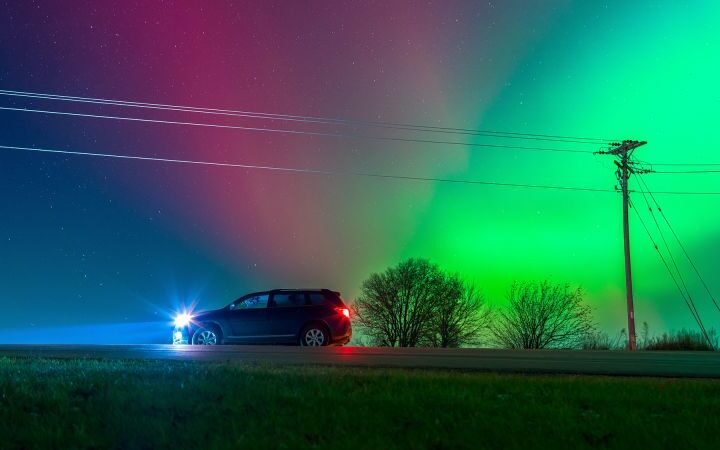
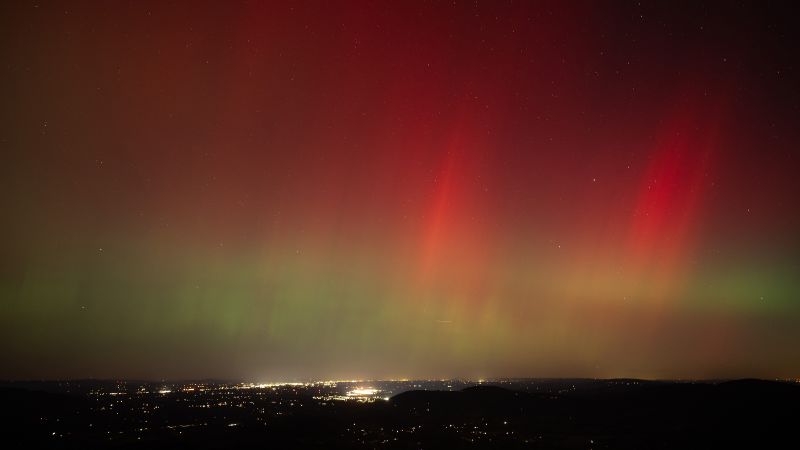
Increased solar activity will create auroras primarily visible around Earth’s poles, known as the northern lights and southern lights. When energized particles from CMEs collide with atmospheric gases, they produce various light displays.
Auroras may extend over much of the northern United States, possibly reaching as far south as Alabama and northern California, according to SWPC. Meteorologists have indicated that parts of the Midwest, particularly Minnesota, will have clear skies for aurora viewing.
“Clouds might clear enough by tomorrow early AM over northern Illinois and Wisconsin to possibly see, too,” remarked CNN Meteorologist Chris Dolce. “The Pacific Northwest might have decent conditions west of the Cascades, while the Northeast is a mix.”
Even if the vibrant displays are not immediately visible, sensors in cameras, including smartphones, could detect them.
The interplay between solar phenomena and Earth’s atmosphere continues to highlight the complexity of space weather and its potential impacts on daily life.