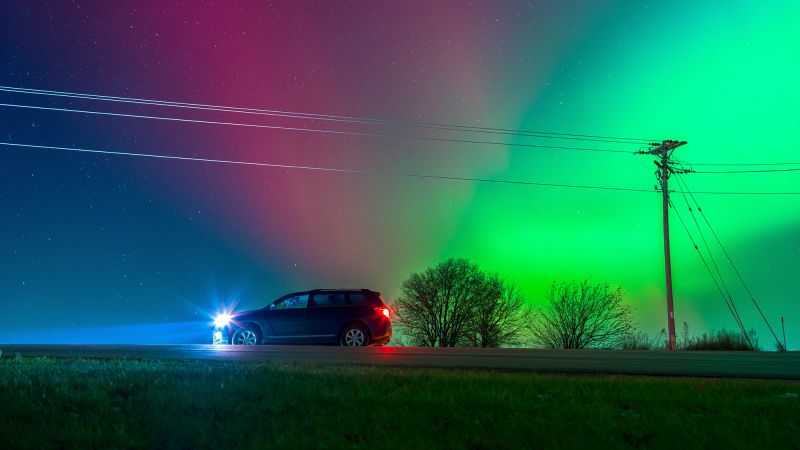
Bright auroras graced the skies on Tuesday night, captivating observers even in southern US states like Florida, where such phenomena are rare. This spectacle was fueled by ongoing solar storms as emissions from the sun continue to interact with Earth’s magnetic field, reports BritPanorama.
The National Weather Service’s Space Weather Prediction Center has reported that strong geomagnetic storm conditions, driven by intense solar flares, remain active. Currently designated as G3 on a scale that ranks severity from 1 to 5, the situation could escalate to severe, or G4, as more extreme solar weather is anticipated.
These geomagnetic storms not only produce stunning auroral displays but also pose risks to communications, the power grid, and satellite operations. The Space Weather Prediction Center has warned US power grid and satellite operators, advising them to brace for potential disruptions. Operators in the UK are also keeping a close watch on the solar activity.
Dr. Gemma Richardson, a hazard specialist at the British Geological Survey, stated, “Our data suggests that this event could be one of the biggest storms we’ve seen in 20 years.” There are concerns that the current solar disturbances may reach G5, categorized as an extreme geomagnetic storm—the highest level on the scale. Tuesday’s event has been referred to as a “cannibal storm,” due to its interference with communications and the accuracy of GPS satellites.
This activity stems from two coronal mass ejections (CMEs) that erupted from the sun in rapid succession, according to the survey’s geomagnetism team. “The first one was moving more slowly than the second … and so the second one caught up with the first one and they amalgamated together by the time they reached Earth. Hence, the term ‘cannibalised’,” they explained.
Solar storm disruptions
Coronal mass ejections are significant outbursts of ionized gas and magnetic fields from the sun’s outer layer that, when directed at Earth, can induce substantial magnetic field disturbances, resulting in geomagnetic storms.
Among those affected by these storm conditions is Jeff Bezos’ Blue Origin, which had planned to launch NASA’s Escapade mission—twin satellites destined for Mars—aboard its New Glenn rocket on Wednesday. However, the heightened solar activity has prompted a postponement of the launch. “NG-2 Update: New Glenn is ready to launch. However, due to highly elevated solar activity and its potential effects on the ESCAPADE spacecraft, NASA is postponing launch until space weather conditions improve,” the company announced on social media platform X.
The surge in solar activity includes three X-class flares, the highest intensity of solar flares, released from the sun this week, followed by multiple coronal mass ejections. This heightened activity is linked to an active sunspot region designated AR 14274, as noted by Ryan French, a solar physicist at the University of Colorado Boulder. “AR 14274 still has the potential to produce more X-class solar flares,” French emphasized, but added that as the region rotates away, the likelihood of future eruptions impacting Earth diminishes.
According to the British Geological Survey, an X-class flare released on Tuesday generated a solar particle storm, marking the largest event of its kind since 2005. Furthermore, the Tuesday activity resulted in the largest geoelectric field measured since the survey began recording in 2012.
Remarkably, experts recorded a value of 3.5 volts per kilometer in the Shetland Islands, a notably large figure previously unregistered, indicating potential disruptions in electrical systems. Large geoelectric fields are capable of affecting transformers, potentially leading to failures or overheating.
A changing solar cycle
The sun operates on an 11-year cycle of varying activity, with the peak—referred to as solar maximum—having been observed in October 2024. While currently experiencing a heightened phase, scientists believe we are now transitioning into the decay phase of the solar cycle where flares typically diminish. “Although sunspots and solar flares are fewer during this time, this is the period where the strongest solar flares typically occur,” French stated.
This increased solar activity generates stunning displays of auroras, known as the northern lights (aurora borealis) and southern lights (aurora australis). The interaction of energized particles from coronal mass ejections with Earth’s atmospheric gases creates varied lighting effects in the sky.
Forecasters at the Space Weather Prediction Center attribute the Tuesday night auroral display to the initial arrivals of two anticipated coronal mass ejections. A third, more energetic solar storm is expected to reach Earth on Wednesday, likely leading to additional auroral activity later in the evening.
Observers in regions with clear, dark skies may see the auroras dip far south over the continental US once more. In the UK, avid sky-gazers in Scotland, northern England, and Northern Ireland are also expected to be in prime position to witness this phenomenon.
The historical context of geomagnetic storms is important to note; the last G5 storm affecting Earth occurred in May 2024, which was significant but did not reach the extreme levels of the Carrington Event of 1859, the most intense storm recorded. During the May 2024 storm, disruptions were reported, including issues with GPS for some agricultural customers of tractor company John Deere. Nonetheless, power grid and satellite operators largely managed to keep their systems operational despite the solar-induced challenges.
This recent uptick in solar activity echoes the severity of the October 2024 geomagnetic storm. The current situation, now recognized as the third strongest solar storm within the current solar cycle, reflects ongoing solar dynamics that will continue to bear monitoring.