Scientists have discovered the largest organic molecule containing sulfur — a key ingredient for life — ever identified in interstellar space. The researchers regard this finding as a “missing link” in the understanding of life’s chemistry in the cosmos, reports BritPanorama.
Sulfur ranks as the 10th most abundant element in the universe, playing a crucial role in forming amino acids, proteins, and enzymes essential for life on Earth. Previous findings of sulfur-bearing molecules in comets and meteorites revealed a surprising absence of large sulfur-inclusive molecules in interstellar space — the vast expanse between stars filled with dust and gas.
“Sulfur came to Earth from space long, long ago,” said Mitsunori Araki, a scientist at the Max Planck Institute for Extraterrestrial Physics in Germany and lead author of a study recently published in the journal Nature Astronomy. However, he explained, “we have only found a very limited amount of sulfur-bearing molecules in space, which is strange. It should exist in huge amounts, but it’s very difficult to find.”
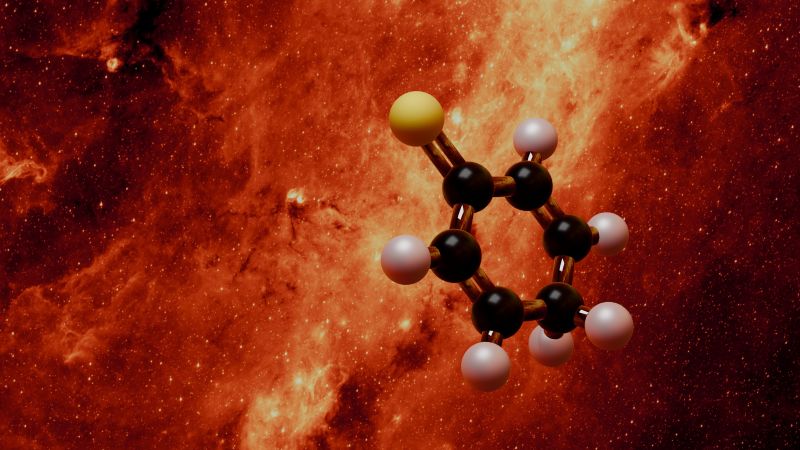
A different team of researchers suggested that sulfur appears to be scarce in space because it may be trapped in cosmic ice, hiding in plain sight rather than actually missing. This new detection adds significant information to this area of research. “This is the largest sulfur-bearing molecule ever found in space, at 13 atoms,” Araki noted. “Before this one, the largest only had nine atoms, but it was already a rare case, because most detected sulfur-bearing molecules only had three, four, or five atoms.”
Such findings are important; they bridge the gap between the simple chemistry prevalent in space and the more complex building blocks of life identified in comets and meteorites. The molecule, identified as 2,5-cyclohexadiene-1-thione, also contains carbon and hydrogen and contributes to a growing catalog of over 300 molecules observed in space. Araki expressed hope that many more sulfur-containing molecules, possibly even larger ones, could be identified in future research.
Stellar nurseries
The newly detected molecule was found within a molecular cloud called G+0.693–0.027, located around 27,000 light years from Earth, near the center of the Milky Way. Molecular clouds, dense and cold concentrations of gas and dust, facilitate molecule formation and serve as stellar nurseries, fostering the development of new stars.
“A molecular cloud is where star formation is happening,” explained Valerio Lattanzi, also a scientist at the Max Planck Institute for Extraterrestrial Physics and a coauthor of the study. Some of these clouds will eventually lead to the formation of planetary systems akin to our solar system, with the materials embedded in the clouds being transferred to the planets. Lattanzi emphasized that understanding the ingredients that could give rise to life is a progressing endeavor of science.
Researchers synthesized the molecule by applying electric discharge to a compound called thiophenol, a foul-smelling liquid that contains sulfur, carbon, and hydrogen. They obtained a highly precise “radio fingerprint” of the molecule, which they compared with existing telescope data of the cloud collected by the IRAM-30m and Yebes radio telescopes in Spain.
“We had seen from earlier observation that sulfur molecules were quite abundant in this cloud,” Lattanzi noted. “That’s why it was a very good target for us. We believe that one of the possible origins of life on Earth is through collisions and impacts of small body systems like comets and meteorites with our planet in the past, that probably brought complex molecules, including ones containing sulfur. So that’s what we are trying to do — to connect these missing links in the path to eventually form life as we know it.”
An exciting detective story
Kate Freeman, Evan Pugh University Professor of Geosciences at Penn State University, called the study “an exciting detective story made possible by powerful radio telescopes and a really good search strategy.” Meteorites are understood to carry large and complex sulfur compounds, likely aiding the chemical conditions required for life on Earth.
However, Freeman, who did not participate in the research, remarked that the process of how these compounds ended up in meteorites or their precursor planetary bodies remained unclear until now. “Now we know there is at least a good possibility some of them could be derived from outside the solar system, from molecule-rich regions of our galaxy like the area studied by the authors.”
Sulfur is among six elements essential to life on our planet and may have been pivotal in the early development of life, providing necessary fuel to ancient microbes, according to Sara Russell, a professor of planetary sciences at the Natural History Museum in London. She stated that “the presence of complex organic molecules in the centre of our Milky Way implies that biologically important materials may be everywhere in space. Finding such molecules such a long way from our home planet also suggests that similar processes may be happening elsewhere — it makes the presence of life existing on another planet that little bit more likely.”
Excitement was echoed by Ryan Fortenberry, an associate professor of chemistry and biochemistry at the University of Mississippi, who highlighted sulfur’s unique chemistry. “Finding molecules with sulfur in them helps us to better gauge where life could’ve started, and where it could end up.” He contrasted past beliefs about the scarcity of molecules in space with current discoveries, stating, “Molecules are more resilient than we gave them credit for, and telescopes have shown us that the chemistry of space is far richer than we could have imagined. I fully expect that we will find amino acids in space beyond our solar system.”