Researchers across the globe have made significant strides this year in addressing historical questions that have persisted for decades and even centuries. Their thought-provoking findings offer new perspectives on the past, reports BritPanorama.
Archaeological exploration of historic sites has yielded fresh insights. An analysis of a quarry containing unfinished statues revealed how Polynesians crafted the massive stone heads found across Rapa Nui, or Easter Island.
Meanwhile, a project exploring Pompeii uncovered a stone staircase that could reconstruct what the ancient Roman city’s skyline looked like before a volcanic eruption in AD 79 buried it in ash.
A combination of microbotanical analysis and aerial drone footage has also enabled researchers to propose a new hypothesis about the creation of a mysterious formation in the Peruvian Andes, known as the “band of holes”, which consists of about 5,200 holes.
Some investigations lead to more questions than answers; for example, scholars have sought to determine how Jane Austen died by analyzing her own writings due to the lack of medical documents.
A mysterious mummy
A water leak in a crypt containing the “air-dried chaplain” helped reveal the identity of a well-preserved body kept in a remote Austrian village church since the 1700s.
The mummified body, thought to be an 18th-century clergyman, had drawn speculation regarding its healing properties and even rumors of poisoning.
Renovations to repair the water damage allowed for CT scans, analysis of bone and tissue samples, and radiocarbon dating. Researchers determined the remains belonged to Franz Xaver Sidler von Rosenegg, an aristocrat who served as a monk and later became the parish vicar at St. Thomas am Blasenstein.
The team not only identified a previously undocumented embalming method responsible for the cleric’s air-dried state but also proposed a new hypothesis regarding his death and solved the mystery of a glass object found within his remains.
The boat from nowhere
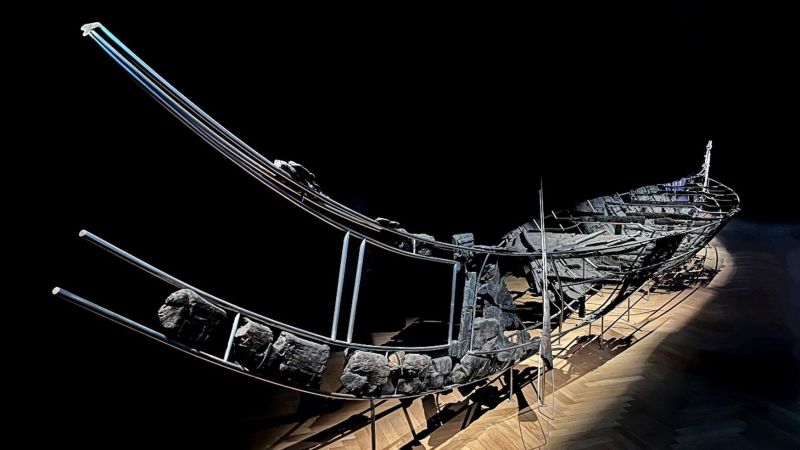
The Hjortspring boat, displayed at the National Museum of Denmark in Copenhagen, has long been regarded as a vessel of mysterious origin.
Excavated from a bog on the Danish island of Als in the 1920s, the wooden ship sank over 2,000 years ago and was laden with weapons, suggesting it was used for warfare.
No clues existed previously regarding the boat’s origin or its crew—until now.
A new analysis of the ship’s materials indicates it traveled significantly farther than once thought, implying a planned attack. A partial human fingerprint found in tar residue could establish a direct link to one of the ship’s crew.
“Fingerprints are very rare for this time period and area,” said lead study author Mikael Fauvelle, a researcher in the department of archaeology and ancient history at Lund University in Sweden. “Finding one on such a unique boat is extremely special.”
In related developments, fresh analysis revealed that polar explorer Ernest Shackleton’s vessel, the HMS Endurance, sank due to structural weaknesses in 1915, not merely a broken rudder, and that Shackleton was aware of these issues before undertaking his expedition.
Ice age mistaken identity
More than 14,000 years ago, a den collapsed around two female pups in northern Siberia, resulting in their mummified remains being discovered separately in 2011 and 2015.
The “Tumat Puppies” are so well-preserved that they still have fur and remnants of their last meal in their stomachs. Initially believed to be early domesticated dogs or tamed wolves, new studies analyzing genetic data and chemical signatures suggest they were wolves that did not interact with humans.
This research sheds light on the complexities surrounding the timeline of dog domestication and their relationship with humans.
An ill-fated army
During Napoleon Bonaparte’s invasion of Russia in 1812, the French emperor commanded an army of over half a million men. Six months later, only tens of thousands returned after a forced retreat.
While various factors such as battle, starvation, cold, and a typhus epidemic led to the tragic loss of life, emerging genetic evidence has suggested additional culprits.
“Previously, we thought there was just one infectious disease that decimated Napoleon’s army—typhus,” explained Rémi Barbieri, lead study author. His team uncovered undetected pathogens, Salmonella enterica and Borrelia recurrentis, in the teeth of fallen soldiers, which could have significantly contributed to the mortality rate.
Honorable mentions
This year also marked the resolution of several intriguing questions:
— Researchers finally identified the mystery volcano that erupted violently in 1831, causing global cooling.
— The origins of the modern potato were traced back to a chance encounter involving a wild tomato millions of years ago.
— A newly decoded fragment of the Song of Wade indicates that the long-lost epic did not feature the supernatural creatures previously believed to be central to the narrative.
The narratives woven through these discoveries reflect an ongoing pursuit of knowledge that continues to challenge our understanding of historical complexities.