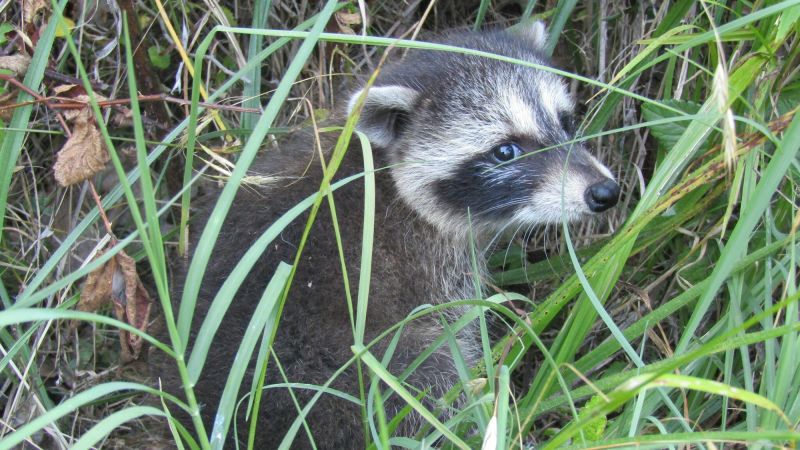
The clever, adaptable urban raccoon may be evolving a shorter snout — a key physical trait of pets and other domesticated animals. This finding suggests what a biologist says could be the first account of domestication in its earliest stages, reports BritPanorama.
Raffaela Lesch, an assistant professor at the University of Arkansas at Little Rock, was inspired during a campus walk after tossing a can into a waste bin, leading her to spot a raccoon, commonly referred to as a “trash panda.” This observation prompted her to consider how comfortable raccoons have become in urban environments, including during daylight hours, raising questions about potential early domestication.
“That was the first moment where I started to wonder if we might have a difference in rural and urban populations, where urban populations have been put on this trajectory towards domestication,” Lesch remarked. Historical fossil records suggest that wolves began scavenging near humans as many as 30,000 years ago, gradually adapting through natural selection to become domesticated over millennia.
Lesch noted the significance of her realization: “Trash is really the kickstarter. Wherever humans go, there is trash. Animals love our trash,” she explained. As raccoons adapt to human presence, they have the opportunity to thrive on the waste generated, potentially positioning them as the next domesticated species.
Searching for ‘domestication syndrome’ in raccoons
To explore this idea, Lesch and her team of students examined whether city-dwelling raccoons were developing shorter snouts, a known indicator of domestication. Naturalist Charles Darwin observed in the 1800s that domesticated animals share specific physical traits not found in their wild counterparts. A 2014 study proposed a term for this phenomenon, known as “domestication syndrome,” characterized by features such as reduced facial length and variations in behavior.
This syndrome suggests that less aggressive animals are more successful in human environments, leading to a natural selection for tameness. Lesch aimed to investigate snout length as a measurable criterion to determine the divergence between urban and rural raccoon populations.
Working with her class, she analyzed over 19,000 raccoon photographs from iNaturalist and identified 249 that displayed the animals in profile. Measurements indicated that urban raccoons had snouts 3.6% shorter than their rural counterparts. “That doesn’t sound like a lot, and in a sense, it is not a lot, but if you think about these animals potentially only being at the very early beginning stages of domestication, that is still a fairly clear signal,” Lesch noted, with the findings published in the journal Frontiers in Zoology.
However, zooarchaeologist Kathryn Grossman expressed caution about the implications of the findings, questioning whether the shorter snouts signified actual domestication or represented a related phenomenon. “I don’t know if this is domestication, or if it’s a phenotype that is the same as domestication,” Grossman stated.
Raccoons vs. domesticated animals
While raccoons frequent human habitats, Grossman pointed out their differences from other species that have undergone domestication, which typically exhibit social structures conducive to domestication, such as living in packs or herds. Lesch acknowledged this contrast, yet underscored the flexibility observed in potential trajectories of domestication.
“Yet both of them ended up being domesticated,” Lesch reflected, highlighting that while raccoons are not naturally pack animals, they do exhibit social behavior. Future research plans involve validating the findings through analysis of raccoon skull collections and comparing behaviors between urban and rural populations.
However, without time travel, Lesch acknowledges the challenge of understanding whether this phenomenon is genuinely a nascent domestication process. “If raccoons really are on their way to domestication, in thousands of years they may also start developing floppy ears, white patches, and curly tails,” she posited. This exploration into the early stages of potential domestication could provide essential insights into the evolving relationship between raccoons and humans.