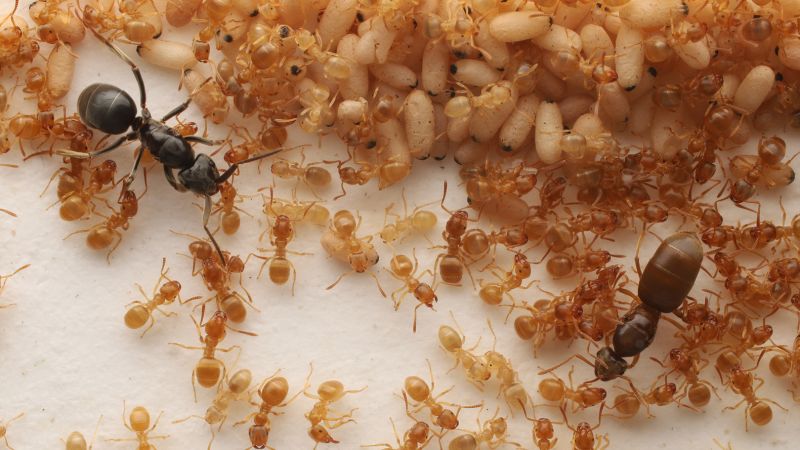
Scientists have discovered how a parasitic ant employs chemical warfare to take control of the nest of a different species, coercing worker ants into a lethal betrayal. This unprecedented strategy involves an invasion queen manufacturing chemical agents to deceive her target ants into turning against their own queen, reports BritPanorama.
The conflict mirrors a dramatic plot, as a colony’s queen faces peril from her own offspring, while the true adversary remains concealed, waiting to usurp control. The invader queen injects chemicals to trick workers into perceiving their rightful queen as an imposter, thus initiating a deadly coup.
This tactic of inducing matricide is rare but has been observed in ant colonies before, typically occurring under natural circumstances. Researchers revealed this unique instance—where an outsider queen manipulates workers into eliminating their biological mother—for the first time in detail in a study published in Current Biology.
Dr. Keizo Takasuka, the study’s senior author from the University of Kyushu in Japan, noted that this method of inducing daughters to act against their mother was unprecedented in biological literature. Observations were made within the Lasius genus, highlighting that invaders like L. orientalis and L. umbratus can effectively manipulate host worker ants to their advantage.
In their research, scientists documented invasions, including instances of lethal attacks by worker ants after the presence of invading queens. Prior knowledge suggested that following an invasion, the workers killed their queen, but the intricate mechanisms behind this behaviour had remained elusive until now.
Scent of a worker ant
Ants primarily rely on chemical signals to communicate and distinguish friends from foes. The invasive queens employ clever tactics to mask their identity: they disguise their scent by manipulating worker ants, which facilitates their unchallenged entry into the nest.
In controlled experiments, citizen scientists raised ants in Tokyo. They observed how an invading queen donned the scent of the host species, thus gaining acceptance among worker ants before executing her plan.
Once infiltrated, the invader queen targeted the resident queen with abdominal fluids that emitted a formic acid-like scent. The chemical incited chaos among the workers, prompting them to attack their true queen in a misguided attempt to restore order. Reports indicate that, following prolonged exposure, workers became increasingly aggressive, leading to their queen’s violent demise within days.
All in the family
The death of the colony’s original queen triggered the invader to reproduce extensively, effectively replacing the previous lineage and transforming the colony. This takeover exemplifies the complexities of social parasitism among ants, highlighting the sophistication of such manipulative strategies.
Experts have praised the observational rigor of the research, with Dr. Jessica Purcell from the University of California, Riverside, noting its significance in understanding ant behavior. She pointed out the remarkable detail the study offers regarding the use of chemical signals to compel worker ants into committing matricide.
While social parasites have often exploited ant colonies, this new understanding emphasizes the intricate methods by which some queens can dismantle established hierarchies through deception, rather than direct conflict. The work challenges assumptions about animal behavior and poses questions about the extent of manipulation possible in nature.
The story of these parasitic ants serves as a compelling reminder of the extraordinary and often brutal strategies seen in the animal kingdom, reflecting nature’s complexities that can sometimes surpass fictional narratives.