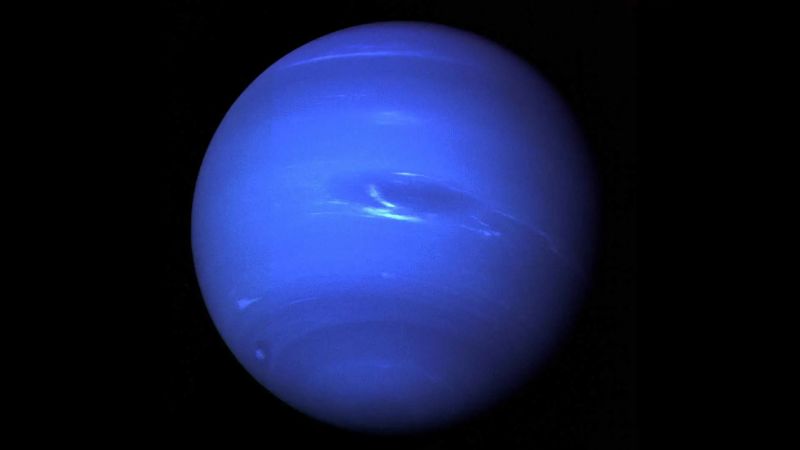
Nereid may be Neptune’s last intact moon survivor
Nereid, Neptune’s third-largest moon, could be the only intact survivor from an ancient set of moons destroyed early in the solar system’s history, according to a new analysis based on data from the James Webb Space Telescope, reports BritPanorama.
The research indicates that Neptune, the eighth and most distant planet from the sun, possesses a chaotic collection of moons, contrasting with the orderly groups around its planetary neighbors, Uranus, Saturn, and Jupiter. This anomaly raises questions about the moon’s origins and the early dynamics of Neptune’s satellite system.
Neptune’s largest moon, Triton, which orbits in the opposite direction of the planet’s rotation, hints at a disruptive history. Triton’s unusual orbit suggests it may not have originated from the remnants of Neptune’s formation. Instead, astronomers propose that Triton entered the Neptunian system from the Kuiper Belt more than 4 billion years ago, potentially causing chaos among earlier moons and leading to their destruction.
Previous studies have posited that Triton was captured by Neptune’s gravity, crashing into and annihilating many of the original moons. The current characteristics of Neptune’s moon system support this hypothesis, with the seven inner moons appearing to be remnants of this ancient disruption.
However, new findings suggest Nereid might not have succumbed to this tumultuous fate. “I think Nereid is the only intact survivor of this process,” stated Matthew Belyakov, a graduate student in planetary science at the California Institute of Technology and lead author of the study published in the journal Science Advances.
Belyakov notes that while some inner moons are surviving remnants, they appear fragmented and disrupted. In contrast, Nereid displays a composition that diverges from previously held beliefs that it was a captured Kuiper Belt object, raising questions about its true origins.
A blurred history of discovery
Despite its distance from Earth, astronomers have limited understanding of Nereid, primarily due to a single blurry image captured by NASA’s Voyager 2 spacecraft in 1989. With a diameter of approximately 210 miles (338 kilometers), Nereid has one of the most eccentric orbits in the solar system, taking 360 Earth days to orbit Neptune.
While Nereid is classified as an irregular satellite—suggesting it may have been captured by Neptune—it remains distinct as it is significantly larger than other irregular satellites. Belyakov argues that Nereid’s size and features prompt doubts about its Kuiper Belt origin.
A recent focused observation using James Webb’s infrared capabilities indicated that Nereid’s surface is unusually rich in water, contrasted with the characteristics of Kuiper Belt objects. “The overall signature was more similar to that of regular satellites around Uranus,” Belyakov explained, which contradicts the previous assumptions about Nereid’s composition.
By conducting simulations, Belyakov and colleagues suggested that in scenarios where Triton survives its entry, there is a considerable chance—around 25 percent—that some original moons could remain intact, including Nereid. This scenario posits that during the initial tumult of the solar system’s formation, Nereid was spared and entered an eccentric orbit, while Triton’s interactions reshaped the entire Neptunian system.
Belyakov underscored that this new perspective on Nereid’s origin could lead to valuable insights into how moons form around ice giants. Future observational efforts may further clarify Nereid’s characteristics and origins, ideally bolstered by a dedicated mission to Neptune, though none are currently planned.
James Webb’s findings have reinvigorated interest in Neptune’s system and its moons, with Leigh Fletcher, a professor at the University of Leicester, highlighting the powerful implications for our understanding of moons beyond the immediate solar system. “It’s a compelling idea that can be tested with future JWST observations and hopefully with an ambitious future mission to the Neptune system,” Fletcher remarked.
The complexities of Nereid’s past beckon further exploration, as researchers hope to unravel the intriguing history of Neptune’s moons and their formation processes.