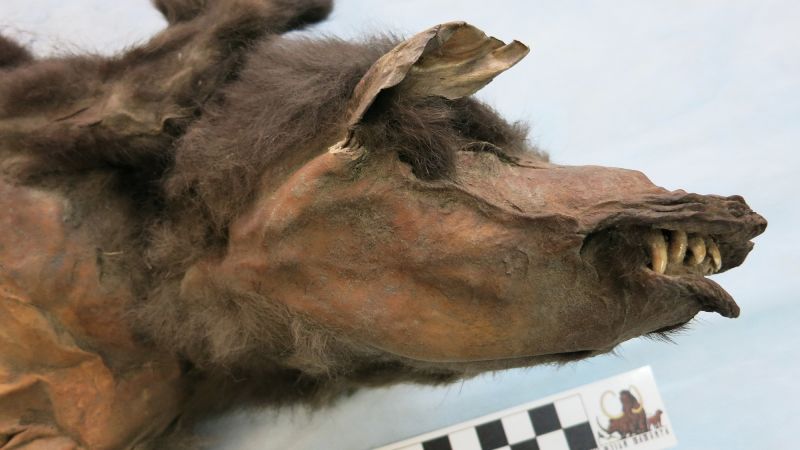
Ancient wolf pup’s last meal sheds light on woolly rhino extinction
Researchers have sequenced the DNA of a woolly rhinoceros from the stomach of a 14,000-year-old wolf pup, providing significant insights into the extinction of this iconic Ice Age species, reports BritPanorama.
The wolf pup, which perished alongside its sibling when their underground den collapsed, had consumed woolly rhinoceros meat shortly before its death. The contents of its stomach, preserved in permafrost, have enabled scientists to identify one of the last known specimens of this extinct creature. This genetic examination stands out as the first instance where the complete genome of an animal found within another’s stomach has been sequenced.
The findings, published in the journal Genome Biology and Evolution, mark a breakthrough in palaeogenetics. “We were very excited because there are very few fossils from around this time when the woolly rhinoceros went extinct,” stated Camilo Chacón-Duque, coauthor and bioinformatician at Uppsala University in Sweden. The tissue fragment extracted from the wolf’s stomach was 14,000 years old and belonged to Coelodonta antiquitatis, the woolly rhinoceros.
Discovered in 2011 near Tumat, the mummified wolf pup maintained its fur and preserved a crucial piece of evidence regarding its last meal. Chacón-Duque noted that the hair on the woolly rhino tissue remained intact, suggesting the animal had not digested much before its death. “From the morphological analysis, it seems to be clear that they were just buried alive. They just died in an instant, and that’s how it got to be preserved,” he explained.
The sister of this wolf pup was also retrieved in 2015, with neither exhibiting signs of injury. Prior research indicated that these pups were likely killed in a landslide that caused their den to collapse, as wolves had been known to hunt juvenile woolly rhinos, with adults reaching sizes comparable to the largest existing rhino species.
These woolly rhinos were adapted to frigid environments and thrived across northern Eurasia during the last ice age, but their population began to dwindle approximately 35,000 years ago. This latest study posits that the species persisted until after 18,400 years ago, with declines likely sparked by global warming following the last ice age.
While woolly rhino fossils are common, genetic material from their time remains scarce; thus, the wolf’s stomach findings are invaluable for scientists. The study also found no signs of genetic decline in the species leading up to extinction, implying a stable population persisted until shortly before their disappearance.
“Our results show that the woolly rhinos had a viable population for 15,000 years after the first humans arrived in northeastern Siberia, which suggests that climate warming rather than human hunting caused their extinction,” commented coauthor Love Dalén, an evolutionary genomics professor at the Centre for Palaeogenetics.
Interestingly, previous assumptions suggested the wolf pups might have been early domesticated dogs, but recent conclusions indicate there was no contact between these animals and humans. The significance of this research lies not only in enhancing our understanding of these ancient creatures but also in how permafrost mummies can deepen our insights into the ecosystems they inhabited.
As the study underscores, the extinction dynamics of ancient megafauna continue to reveal complex interactions between climate shifts and population dynamics, informing our understanding of prehistoric life amidst changing environments.